
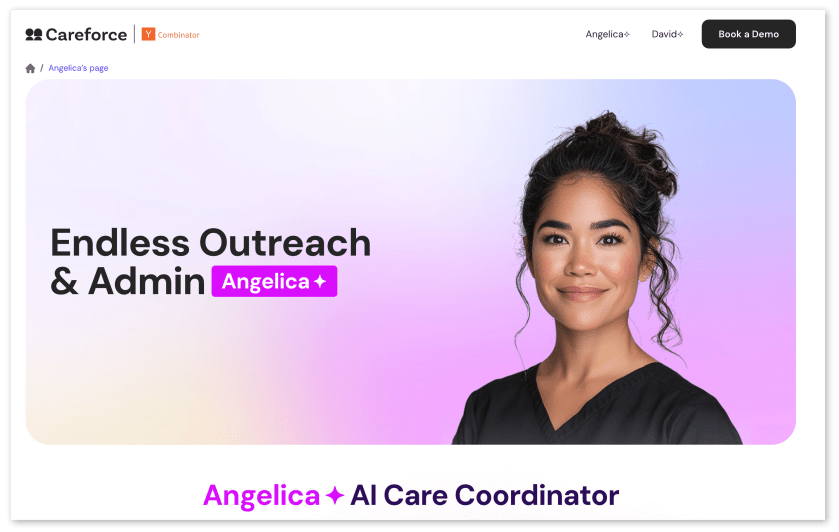
Vanessa Barahona received a call this past spring from Angelica at Kern Family Health Care in Bakersfield, California, telling her it was time to renew her coverage under Medi-Cal, the state’s version of Medicaid.
Angelica helped Barahona, 41, schedule an appointment to complete her paperwork in person at Kern Family’s offices before she submitted it to Kern County officials for approval. When Barahona had a conflict with her office-cleaning job, Angelica rescheduled the appointment. Barahona finished the process a little later than she’d planned but early enough to avoid an interruption in her coverage.
“It was easy. The fact that Angelica spoke Spanish when we were on the phone made it better,” Barahona, whom KFF Health News met through Kern Family Health Care, said via a translator. “It felt like I was talking to a real person.”
She definitely wasn’t.
“Angelica” is the name assigned to an AI program deployed last year by Kern Family Health Care, the largest provider of Medi-Cal services in Kern County. An estimated 52% of residents there rely on the safety net program for health coverage, among the highest enrollment rates in the state.
Kern Family has spent about $370,000 on the software from Careforce, a San Francisco startup, to facilitate rapid and repeated outreach to members when it’s time to renew their coverage — a process that is about to become more complex under new Medicaid eligibility rules established under Republicans’ One Big Beautiful Bill Act, signed into law last year by President Donald Trump. Mandatory work requirement documentation will take effect nationally beginning in 2027, and under the GOP’s new rules, most Medicaid patients will now have to renew their enrollment twice a year, rather than once a year.
Kern Family and other similar health plans have an interest in keeping people enrolled, since they’re paid through managed care contracts with Medi-Cal. They can also save money by using AI software to do what Kern says would otherwise require it to hire 40 full-time workers. Angelica does it at a fraction of the cost and without increasing payroll — or requiring Kern Family to navigate workers’ rights issues or government-mandated workplace protections.
Although Kern Family officials say no workers have lost jobs, the health plan, which is not unionized, estimated it would have had to spend $2.4 million in staffing costs to match the program’s more than 800,000 calls to its 387,000 members since Kern Family began using Angelica late last year.
As the federal government ended pandemic-era protections and states resumed screening people for Medicaid eligibility, health plans such as Kern Family began looking to technology to keep eligible people enrolled. Kern Family officials say that Angelica helps people, in their preferred language, set up appointments with the plan’s staffers, who make sure that applications are filled out correctly and delivered to county health officials for verification and processing.
Careforce CEO Huzaifa Sial said Kern Family is one of a few health insurers using his company’s software to help boost its Medi-Cal enrollment, and the company is also working with the Central California Alliance for Health in much the same way. “Most people don’t know what they need, and if they do, they have a hard time getting there,” Sial said. “That’s the hidden execution problem that nobody sees.”
“Angelica” is the name assigned to a conversational AI program deployed last year by California’s Kern Family Health Care, the largest provider of Medi-Cal services in Kern County. Kern Family has spent about $370,000 on the software by Careforce, a San Francisco startup, to facilitate rapid and repeated outreach to members when it’s time to renew their coverage. (Screengrab of Careforce.ai)The rise of AI in the healthcare industry has prompted worries about who’s overseeing these tools and whether people are being improperly denied treatments or cut off from care. Unions have raised concerns about workplace surveillance and the prioritizing of savings over safety. Polling shows widespread fear over AI-driven job losses and growing income inequality, while health policy researchers have also raised red flags about algorithmic biases, transparency, data privacy, and safety risks.
Mark Duggan, a Stanford University economics professor who has studied the Medicaid system for 30 years, said one long-standing fear is that insurers could use such software to cherry-pick patients for coverage.
“When you have a new technology like this, you need to police it,” Duggan said.
Complying With Regulations
California health plan regulators say they are tracking AI use closely, and the state attorney general’s office has sent reminders to healthcare entities about their obligation to follow consumer protection rules.
Anthony Cava, a spokesperson for the state’s Department of Managed Health Care, said Medi-Cal health plans have flexibility in how they handle member renewals, including with the use of AI tools. But plans are responsible for ensuring that technology complies with state and federal regulations, including patient privacy and data security, he said.
Last year, the agency, foreseeing the huge volume of reenrollments that were going to be required in the state, began allowing managed care plans to contact members about renewals. State rules still prohibit Medi-Cal health plans from soliciting new enrollees, and only county health officials determine eligibility.
Emily Duran, CEO of Kern Health Services (which administers Kern Family), said that the plan worked closely with the Kern County Department of Human Services to obtain some data, allowing Kern Family to know when a member’s Medi-Cal eligibility will expire.
The health plan, in turn, lets the county know anytime it receives updated demographic or contact information for its Medi-Cal members. And the county has stationed workers inside Kern Family Health Care’s main facility in Bakersfield to answer enrollment questions for people who walk in to finish their paperwork.
“They have a leadership group that is very innovative and forward-thinking,” Vanessa Frando, the chief deputy director of Kern County Human Services, said of Kern Family. The agency also works closely with other Medi-Cal providers in the county, Frando said.
Duran said the health plan was initially concerned about how Angelica would be received.
“We had to set the tone to really be open to the idea, because you hear ‘AI’ and you’re like, ‘Oh, yeah, Jeff Bezos laid off 100,000 people because of that,’” Duran said. “But we are already stretched thin. We need this functionality to be much more effective and augment our efforts.”
Duran said Kern Family’s leadership and staff bought in after seeing a demonstration.
Today, it would take 40 Kern Family employees, each working 40 hours a week, to match Angelica’s calls to remind people to reenroll and talk them through what is involved, according to Jackie Byrd, a spokesperson for the health plan. The AI program’s settings are constantly adjusted to match the capacity of Kern Family’s full-time staff.
Full Conversations With AI
Barahona said she received a Medi-Cal packet in the mail but didn’t think about it until Angelica called days later. That exchange highlights one of local and state health officials’ biggest concerns — that people who’ve grown accustomed to automatic renewals aren’t aware of the reenrollment requirements.
Angelica speaks more than 30 languages and can answer lengthy questions. In samples of actual conversations provided to a reporter, Angelica sounded lifelike at first, although more than once cross-talk with a patient caused the program to pause suddenly. Barahona said it took her a minute before she realized she wasn’t speaking with a human, but she ended up having a full conversation with Angelica.
Duran said Kern Family was able to redirect full-time staff to focus on the more complex parts of the Medi-Cal process, such as making sure the patients’ information is complete and up to date. The Angelica software also operates at all hours, making it easier for patients to call back at their convenience. Another version, David, is used internally to help staffers navigate the technology.
“This will always be, in my opinion, an AI-human combination,” said Careforce’s Sial. Working with AI solutions for more than a decade at UnitedHealthcare and Optum, Sial said, he saw an opportunity to improve the enrollment process by helping people organize their paperwork.
Kern Family’s Medi-Cal renewal rate in April was 94.9%, delighting the plan’s officials, who feared a significant drop-off from patients who’d gotten used to being automatically renewed over the past several years. By comparison, Duran said that about 80% of enrollments had automatically renewed under federal pandemic-era rules, but that figure was cut in half as those protections began to expire.
Kern Family officials say there could be other uses for Careforce’s software in the future; Angelica, like other generative-AI large language models, can learn and adapt to new situations and requests.
Cesar Delgado, Kern Family’s chief information officer, said Angelica is already being used to make general greeting calls to new members and can discuss plan benefits and answer basic questions. But Kern Family officials say the program’s primary purpose, for now, is limited to contacting patients whose Medi-Cal eligibility is coming up for review.
Duggan, the Stanford professor, said Angelica could help Kern Family minimize the number of Medi-Cal enrollees who lose coverage as federal requirements take effect.
“The best-case scenario is helping people to stay on when they don’t realize that things are changing,” Duggan said. “It’s not an easy program to navigate.”
This article was produced in collaboration with Capital & Main, an independent, California-based nonprofit investigative news publication that reports on inequality, climate change and other issues.
KFF Health News is a national newsroom that produces in-depth journalism about health issues and is one of the core operating programs at KFF—an independent source of health policy research, polling, and journalism. Learn more about KFF.This article first appeared on KFF Health News and is republished here under a Creative Commons Attribution-NonCommercial-NoDerivatives 4.0 International License.
Hence then, the article about ai is being used to boost medicaid enrollment but not without concerns was published today ( ) and is available on KHN ( Middle East ) The editorial team at PressBee has edited and verified it, and it may have been modified, fully republished, or quoted. You can read and follow the updates of this news or article from its original source.
Read More Details
Finally We wish PressBee provided you with enough information of ( AI Is Being Used to Boost Medicaid Enrollment, but Not Without Concerns )


Also on site :
- Stockton high school teacher arrested in child sexual abuse material case, CHP says
- Famous Beer Secures Top Ranking in YouGov’s 2026 Alcohol Survey; The 153-Year-Old Dutch Lager Edged Baileys to Lead America’s ‘Most Considered’ Brands
- The ‘Intermittent Kindness’ Pattern People Miss When Dealing With a Gaslighter, According to Psychologists