
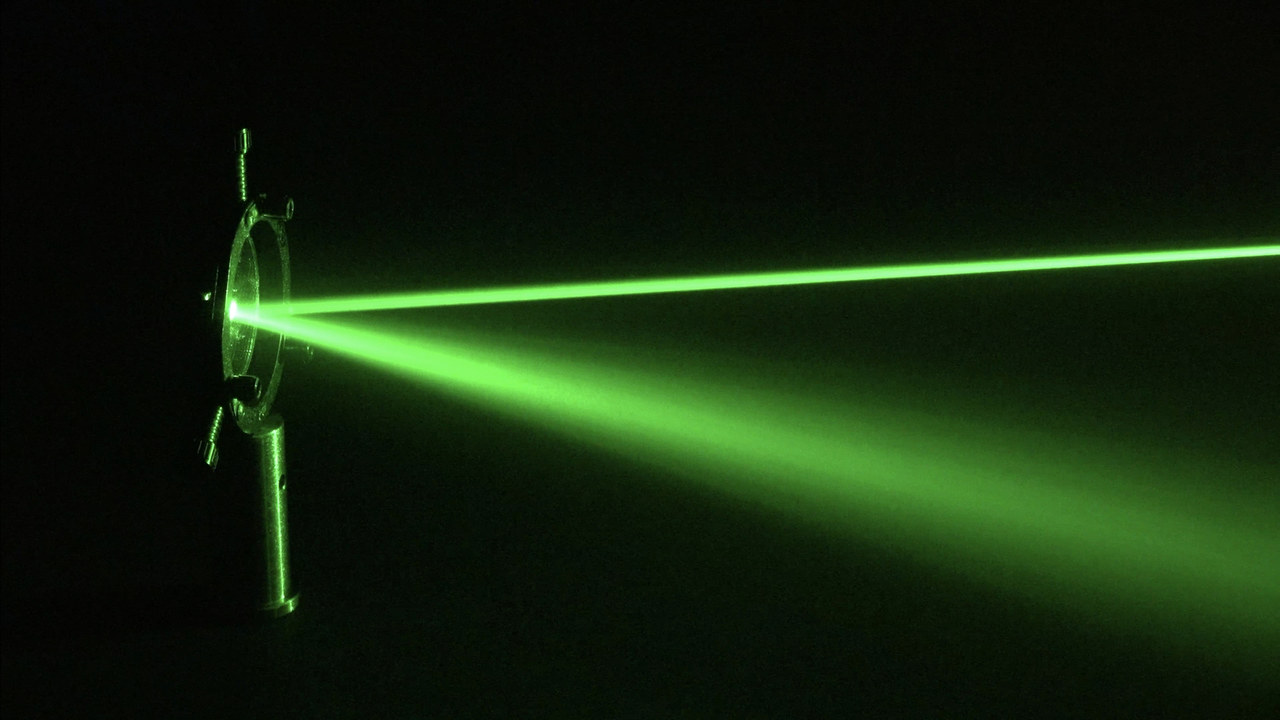
Chinese researchers have revealed a new technology that could soon enable drones to charge mid-flight using high-powered lasers.
The scientists built a prototype of the system using a model of a drone and attached a receiver that works similarly to a solar cell. Fixed to the underside of the wing, the receiver successfully converted the energy from the laser beam into electricity to power the aircraft’s propellers.
The breakthrough was made by researchers at the Civil Aviation University of China and Tsinghua University, with details outlined in a new study published on 29 July in the journal Matter & Light.
"Previous studies largely focused on the materials or the device itself," study senior author Jianhua Han, a researcher at the Civil Aviation University of China, said in a statement. "We wanted to think beyond the laboratory, to how the system could actually be integrated into an aircraft, cooled during operation, and made compatible with flight. It isn’t just a materials science problem; it’s an engineering one."
The receiver is what's known as a perovskite laser cell-thermoelectric (PLC-TE) tandem device optimized to turn laser light into electricity.
Perovskite is a highly efficient material used in cutting-edge solar cells, noteworthy for its crystal structure that allows it to capture more wavelengths of the light spectrum than silicon. For this reason, it’s prized as a future solar material, with some research indicating it could even be used to convert ambient indoor light into usable electricity.
When hit with a green laser, the receiver converted 38.49% of the light into electricity — well above the 34% peak results for perovskite-silicon tandem cells as recorded by the U.S. Department of Energy (DOE).
In initial testing, the researchers discovered an unwelcome side effect of using the laser: the drone was being heated to extreme temperatures, reducing its overall efficiency.
Following initial testing using a model, scientsts plan to wirelessly charge a real drone mid-flight. (Image credit: Y. Han and X. Han et al. (2026))"When we tested the device under a high-power laser, the thermal camera showed temperatures of 80 to 90 degrees Celsius [176 to 194 degrees Fahrenheit]," said Han. "That was much higher than we expected and made us realise that heat buildup was a far more serious problem than we had imagined."
To combat this, the researchers introduced nanocrystals made from antimony triselenide — an abundant semiconductor material — into the PLC-TE design. This plays the role of a thermal barrier, preventing the device from releasing too much heat.
In addition to their cooling innovation, the constant airflow generated by the drone’s propeller helped further regulate the temperature of the receiver’s cool side.
Overcoming battery life barriers
"Imagine a future where drones inspecting forests, monitoring disasters, or delivering packages no longer need to land frequently to replace batteries,” said Han. "As drones take on longer missions, battery life has become one of the biggest barriers."
The researchers specifically identified reconnaissance, logistics, and disaster relief as key areas where drones powered by lasers could one day be used. But they also said more needs to be done to develop real-time tracking systems that precisely target the PLC-TE on in-flight drones before the system could be used in the wild.
Going forward, the researchers will test how the device functions on a real lightweight drone in outdoor conditions.
The promise of indefinite flight has made wireless power tests a focus for militaries around the world. If achieved, reconnaissance and weapons-carrying unmanned aerial vehicles (UAVs) could operate in radically different environments than those they are currently restricted to, with regular refuelling requirements.
Related storiesDrones could achieve 'infinite flight' after engineers create laser-based wireless power system that charges them from the groundJapanese power breakthrough could be 'step toward a fully wireless society'Japan trials 100-kilowatt laser weapon — it can cut through metal and drones mid-flight
For example, the most commonly used hand-launched unmanned aerial vehicle (UAV), the AeroVironment RQ-11 Raven, can fly for a maximum flight time of 60 to 90 minutes before needing to charge.
In June 2025, the U.S. Defense Advanced Research Projects Agency (DARPA) successfully beamed 800 watts of power over a distance of 5.3 miles (8.6 kilometers), as part of its Persistent Optical Wireless Energy Relay (POWER) program.
Private companies such as PowerLight Technologies, in collaboration with the U.S. Department of Defense, have said they could deliver kilowatts of energy to in-flight drones operating at altitudes of up to 5,000 feet (1,500 meters).
Hence then, the article about high powered lasers can wirelessly charge drones mid flight was published today ( ) and is available on Live Science ( Middle East ) The editorial team at PressBee has edited and verified it, and it may have been modified, fully republished, or quoted. You can read and follow the updates of this news or article from its original source.
Read More Details
Finally We wish PressBee provided you with enough information of ( High-powered lasers can wirelessly charge drones mid-flight )


Also on site :
- The Zodiac Killer shot cab driver Paul Stine in 1969, the last of his five confirmed murders; San Francisco police marked the case inactive in 2004, then reopened it and still list it as open
- After Kelly Clarkson Slams Brooklyn Novelty Store, Shop Says the ‘One-of-a-Kind’ Singing Animatronic Bird She Wanted Wasn’t Actually For Sale
- Robert Pattinson Approached Chris Hansen Portrayal In ‘Primetime’ As “A Fan”: “I Was Trying To Make Him Cool”