
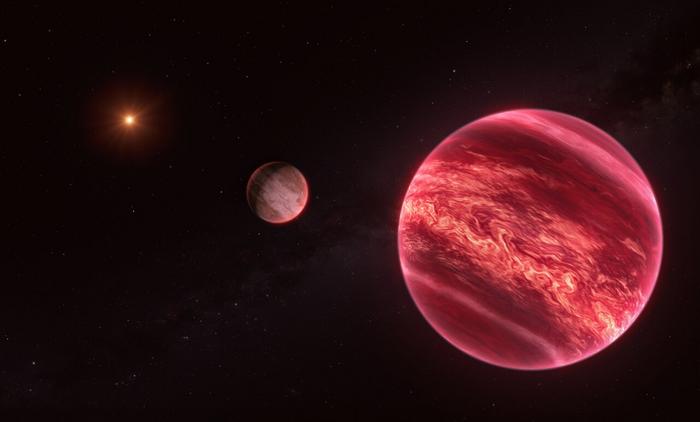
Humans have been observing distant stars since antiquity. Distant planets, however, have been a different matter. It was not until 1992 that the first exoplanet—or a planet orbiting a star other than our sun—was detected. Since then there has been a storm of such observations, with space-based and Earth-based telescopes spotting more than 6,000 exoplanets all over the skies. Astronomers now believe that there is at least one planet circling virtually every existing star.
What has eluded detection so far have been exosatellites: moons orbiting those remote planets. Our solar system is home to a whopping 891 moons, but the rest of the known cosmos? Nothing. Until now.
As a new paper in Nature reports, a team of scientists using the European Southern Observatory’s Very Large Telescope (ESO’s VLT) in Chile have discovered astronomy’s first known exosatellite, or exomoon, orbiting an unusual body in the solar system known as CD-35 2772, just 71 light years away—next door by astronomical standards. That, by itself, makes cosmic news, but the nature of that planet and that moon make the story even stranger.
The moon is huge—at least as massive as Jupiter, which is itself the largest planet in our solar system with a diameter 11 times that of Earth. And the planet that exosatellite orbits isn’t a planet at all. Rather it’s a brown dwarf, a gassy object far too big to be a conventional planet—in this case 33 times the mass of Jupiter—but too small to ignite its nuclear furnace and become a star.
“The host [brown dwarf], span[s] the mass regime between more normal planets and the smallest stars,” says Kevin Hoy, lead author of the study, who is an ESO student in Chile and an investigator at Chile’s Universidad Diego Portales, in an email to TIME. “You'll actually find some brown dwarfs in both stellar and exoplanetary catalogs.”
Exoplanets typically aren’t spotted visually, since the pinpoint light of the distant world is swamped by the glare of the nearby star—a little like a moth fluttering invisibly next to a street light. Rather they are discovered in one of two indirect ways. The first is known as the transit method. When an orbiting planet passes in front of its parent star, it blocks a bit of the star’s light. The dimming is exceedingly tiny—the equivalent of removing one light bulb from a board containing 10,000 of them—but it’s enough for a sensitive telescope to detect. The greater the dimming the greater the diameter of the planet. The second means of detecting an exoplanet is known as the radial velocity method: looking for the tiny wobble the moving planet’s gravity causes in the star. The greater the wobble, the greater the planet’s mass.
The brown dwarf “planet”—which orbits the star in the CD-35 2772 solar system—was discovered in 2011 using neither of these methods. Its huge, almost star-like bulk was great enough that astronomers could detect it with an ordinary optical telescope. The exosatellite, however, was a different matter. Even with its Jupiter-like mass it was too small to be seen from 71 light years away. Instead Hoy and his colleagues used the radial velocity method to look for wobbles in the brown dwarf. They spotted them and used the degree of the wobble to calculate the size of the world.
What does the discovery of an exomoon teach us about the universe?
“Being the third wheel in this system makes us want to call it a moon,” said Hoy in a statement that accompanied the release of the study, “even if it is nothing like the small, rocky moons we have in our system.”
That fact raises the larger question in this discovery, which is essentially one of nomenclature. When is an almost-star actually a planet, and when is a Jupiter-like planet actually a moon? Astronomy typically has neater labels than that, but the CD-35 2772 solar system defies such tidiness.
“It's hard to say what we will learn from this one particular system,” says Hoy, “because we don't know if it's common for high-mass systems to look like this, or if it's a weird case among more comparable systems.”
Whatever the answer is, Hoy plans to keep looking. He and his colleagues are already on the trail of another, as yet undisclosed, exosatellite candidate. Their work will be aided by the planned European Southern Observatory’s Extremely Large Telescope (ESO’s ELT) which is expected to go into service in early 2029, providing 20 times more light-collecting power than the existing ESO’s VLT.
“That will be an enormous boon to the search for exomoons,” says Hoy, “as we'll have much better access to known exoplanet systems and be able to discover new ones [by] applying the same method we used here.”
The deeper astronomers look into the universe the more curious it becomes. Solar system CD-35 2772, with its mammoth exosatellite is not the first example of that—and it surely won’t be the last.
Hence then, the article about astronomers discover the first known moon outside our solar system and what a moon it is was published today ( ) and is available on Time ( Middle East ) The editorial team at PressBee has edited and verified it, and it may have been modified, fully republished, or quoted. You can read and follow the updates of this news or article from its original source.
Read More Details
Finally We wish PressBee provided you with enough information of ( Astronomers Discover the First Known Moon Outside our Solar System—and What a Moon it Is )


Also on site :
- Steven R. McQueen Sends Direct Message in First Social Media Selfie in 5 Years After Rare Public Return Sparks Buzz Over His Changed Appearance
- Ice-T on ‘Law & Order: SVU’s’ Longevity and Cultural Impact: ‘I’m on a Good Treadmill, and I Want to Stay on It’
- What were Trump operatives doing for pro-Russian politician Dodik in Bosnia?