
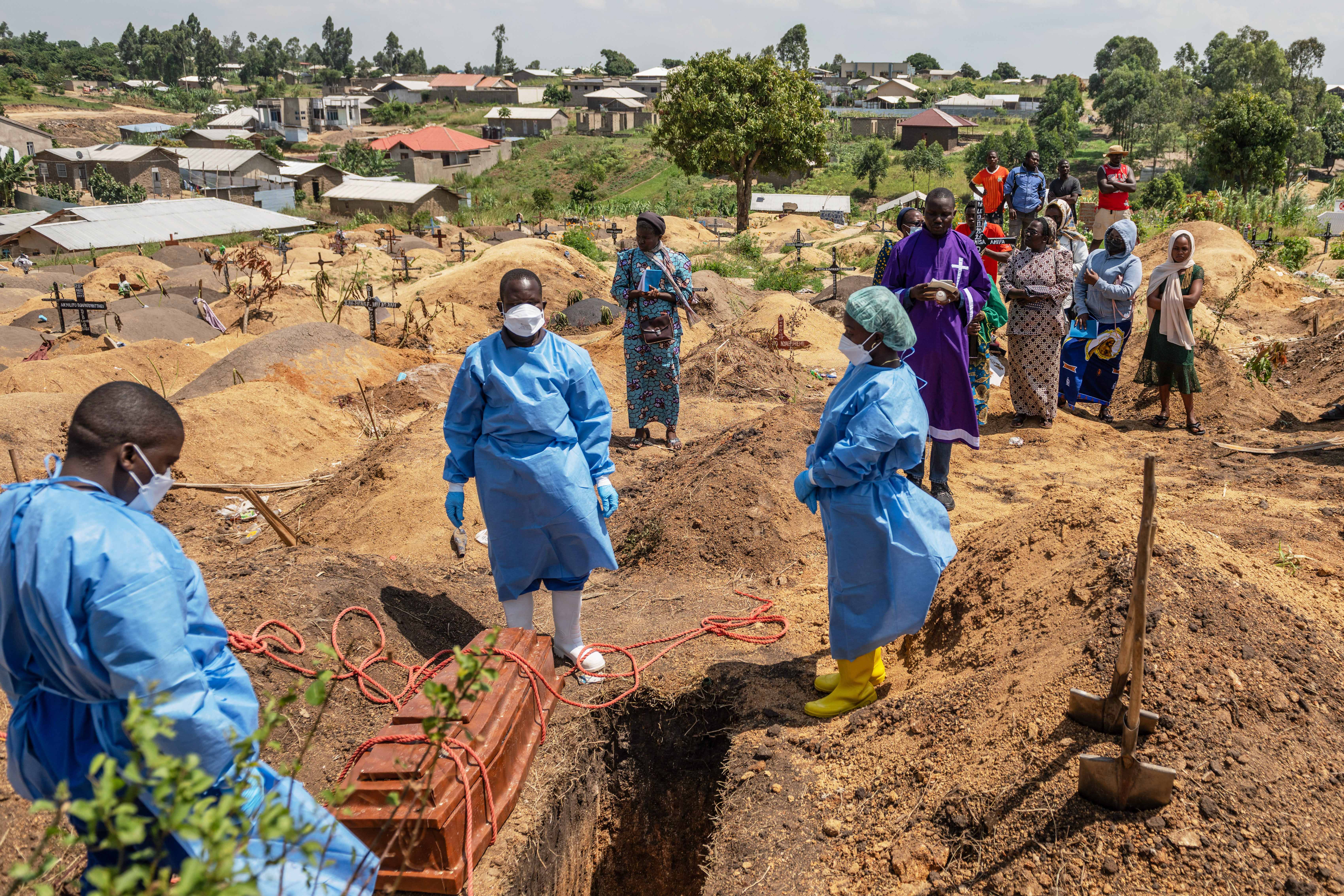
As the Democratic Republic of Congo’s latest Ebola outbreak rages on, health care workers are increasingly under attack.
Dozens of attacks against medical facilities and teams have taken place since the outbreak began, primarily due to fear and mistrust within local communities, health care workers tell TIME. They warn that this violence escalates risk for both the professionals and the infected people in their care—and it will undoubtedly raise the death rate.
Crowds of people—including the relatives of patients—stormed Ituri’s Nyakunde Hospital, throwing stones and damaging its perimeter fence on July 15, according to Reuters. Ituri is the province at the epicenter of the outbreak, where about 90% of cases are concentrated.
“Many of the attacks have been carried out by angry mobs who have stormed treatment centers or targeted response teams in the field,” Dr. Pierre Akilimali, incident manager for the Ebola response at the National Public Health Institute of the DRC, said at a press briefing in Bunia on July 18.
“It makes frontline personnel feel insecure and it puts them in an uncomfortable position to perform their duties,” he said, adding that they face both “infectious risks [and] security risks.”
Locals told the Associated Press (AP) that health care workers were seen last week fleeing more remote communities in Ituri and heading to its capital, Bunia.
“I've been in many, many emergencies—but this one takes a toll on you because it's exhausting, it’s all the time,” Alice Ribes, the Ebola response team lead for the International Rescue Committee, tells TIME. Though she says she never considered fleeing, “It's scary, I must say. For me, it was scary.”
Critical response specialists have also been “held captive” in certain health zones, said Dr. Adelard Lufongola, the operations manager for the DRC’s Ebola response, in a briefing over the weekend according to AP.
Read More: Ebola Returns: How We Can Fight Back
And it isn’t just medical staff. Frontline workers, such as those tasked with “safe and dignified burials,” are frequently targeted in local cemeteries, he said.
“The moment when somebody dies and they are buried is a very, very sensitive moment,” Ribes says. “In this part of the world—as in many parts of the world—there are rites around the body when somebody dies.”
However, bodies that have been affected by Ebola are “much more contagious” than when they were alive, so health care workers must dispose of bodies in specific ways, she explains. These safety protocols may not be compatible with the rites that family members want to carry out, such as washing and preparing the bodies of their loved ones.
Sensitivity around burial is compounded by general mistrust toward the region’s health care system.
“The health system is quite weak,” Abdou Sebushishe, senior health advisor with the nonprofit International Medical Corps, tells TIME. “Then when the outbreak starts, and [community members] see a lot of resources being deployed for the single disease that they just heard about, they feel like that discrepancy is suspicious.”
That erosion of trust can quickly become one of the biggest obstacles to containing an outbreak.
The recent attacks against health care workers are especially alarming because a successful Ebola response depends on people seeking care, reporting cases, and working with health officials.
The latest outbreak is caused by the Bundibugyo ebolavirus, which is not as common as some of the virus types associated with past outbreaks. There is no approved vaccine or treatment for Bundibugyo.
The only way to prevent its rapid spread is through containment—but containment efforts can also fuel mistrust, Sebushishe says, and that’s partly because outreach is often insufficient at the beginning of an outbreak.
Upon hearing that there was no approved vaccine, community members told Sebushishe’s team that it felt like the medical response unit was needlessly separating them from their loved ones.
“You say it everywhere, that this disease does not have specific treatment, so why are you isolating us—for what reason?” he recalls people asking.
“The supportive treatment that is being provided in isolation units was not emphasized enough at the beginning of the outbreak,” Sebushishe continues, explaining that the approach “created misunderstanding in the community.”
He says it took considerable effort for his team to convince locals that “when someone is treated early, they can have a chance to survive.”
Sebushishe was deployed to respond to the Ebola outbreak just three days after the emergency was declared. He is now in Bunia, the “hot spot” of the outbreak, and says that community-building work is critical.
The virus is already spreading “substantially faster” than it did in previous Ebola outbreaks, according to the United States Centers for Disease Control and Prevention (CDC). It’s the third-largest on record, with 2,473 confirmed cases since the crisis began in May, according to DRC government data from Wednesday. In the 2018-2020 outbreak, it took 10 months to reach 2,000 cases, the CDC reported.
There have been 999 deaths in just under 10 weeks, and the current outbreak spans five provinces in Congo: Ituri, North Kivu, South Kivu, Tshopo, and Haut Uele. The outbreak has also spread to Uganda, which reported 20 confirmed cases as of July 20, per CDC data, with one case found in France in June—a doctor who had just returned from the DRC.
Professionals who come in after an outbreak is detected, as part of “response teams,” can only do so much. Sebushishe advocates for a more proactive approach: educating communities and seeking their support. Without community cooperation, he says, the disease is likely to spread exponentially.
“It is really affecting the ability for this response to be contained,” Sebushishe says.
Ribes agrees that community cooperation is key. Since Ebola is only contagious once there are symptoms, she believes that community members must be able to identify a potential new case.
“They are the ones who are going to be able to act on it, isolate, call, and refer the case as needed,” she says, adding that they also need to be trained to use thermometers and have access to handwashing or sanitizing stations. “You want to provide healthcare facilities with enough protective equipment, infection prevention, and control equipment, and that is very costly."
Funding is critical for both shoring up resources and implementing the necessary training in the affected areas. However, the World Health Organization said last week that it has received about 40% of the $115 million that it has deemed necessary to fight the outbreak.
Diminishing foreign aid budgets in the United States, and throughout the West, have contributed to staff shortages and less comprehensive operations in the impacted areas, as well, according to Phuong Pham, associate professor in the Department of Global Health and Population at Harvard University. “We’ve lost so many professionals, in this region and around the world, who know local languages and customs and context, and who over time established trust with communities so that their work there is accepted and effective.”
The result is often greater resistance to—and even hostility toward—response teams.
Attacks compound the challenges that health care workers face
The atmosphere of violence is creating new obstacles for doctors, nurses, and support staff.
“When our team goes on the ground now, they have to go through security first,” Sebushishe says. “So it's delaying the deployment of staff.” In some instances, they drive with tinted windows to avoid being identified as health care workers, he says.
They also risk contracting the disease themselves. At least 36 health care workers in Congo have become infected with the virus and died since May.
Additionally, when people begin to think treatment centers are unsafe, “it will further reduce their care-seeking behavior,” Sebushishe says. Some symptomatic individuals might never come for help—and those who do might leave while they are still contagious.
Patients often get scared and flee after witnessing attacks, he explains, and they wind up returning to their communities, where they are likely to continue spreading the disease.
The response is also being challenged by administrative hurdles. Care providers in Ituri went on strike in July, blocking the entrance to Bunia General Hospital.
“They were protesting because, well, their work conditions are extremely hard,” Ribes says, explaining that there is limited access to protective equipment, and some workers had experienced a delayed stipend payment.
As a result, she adds, any delay in funding the response “is just leading to more death.”
“One day of interruption has a massive consequence on how the disease is spreading,” she says. “One day of interruption is not only an interruption in care, but also interruption in surveillance.”
Surveillance, she explains, allows health professionals to identify new cases, make sure those impacted are quickly isolated, and begin to trace contacts to try to prevent further spread.
The Congolese Health Ministry said on Monday that it is intensifying response efforts, though it did not explain what measures might be taken going forward that are not already in place.
TIME has reached out to the Congolese Health Ministry for comment.
‘We are all at risk if we don’t stop it’
Sebushishe, who is Congolese and grew up in Goma, says that the risks of infection and violence are not enough to keep him from continuing his work.
“I know that if we don't stop this outbreak from wherever it has reached, it will spread farther,” he tells TIME. “It will reach our own families and ourselves. So we are all at risk if we don't stop it.”
“Viruses don’t respect borders and can use weaknesses in our global health security systems to thrive and propagate. So it’s in the best interest of everyone—Americans included—to keep these systems strong,” Pham said.
Sebushishe says his team has made massive strides in increasing trust and cooperation from the community by including them in decision-making.
“We involve the community from the conception, from the planning of each of the projects,” he says. When they are building a treatment center, for instance, they bring in community leaders, show them the building site, ask for feedback, and ask them to help spread the message to others in the community.
He gives the example of Kigonze Camp, an internally displaced persons site on the outskirts of Bunia, where he says groups of people initially threw stones at the teams responsible for “safe and dignified” burials. Once Sebushishe’s team invited the community leaders to meet, explained their intentions, and gave them more control over how things would be done, the leaders agreed to allow the medical professionals to do their work without further interruption.
“The key for this outbreak to end—but also for all these new threats to the response to end—is the proper community engagement,” he says. “Reach every community by every means, so that everyone understands that this is not an issue that can be taken lightly.”
Hence then, the article about angry mobs are attacking health workers in congo it will only make the ebola outbreak worse was published today ( ) and is available on Time ( Middle East ) The editorial team at PressBee has edited and verified it, and it may have been modified, fully republished, or quoted. You can read and follow the updates of this news or article from its original source.
Read More Details
Finally We wish PressBee provided you with enough information of ( Angry Mobs Are Attacking Health Workers in Congo. It Will Only Make the Ebola Outbreak Worse )


Also on site :
- ‘Grey’s Anatomy’ Star Receives Outpouring of Support After Revealing Wife Died From Massive Hemorrhagic Stroke
- Macron laments the EU’s nosedive like he’s not one of the pilots
- Box Office: ‘Digger’ Majorly Bombs With $8 Million Opening Weekend, ‘Verity’ Scores $32 Million Debut