
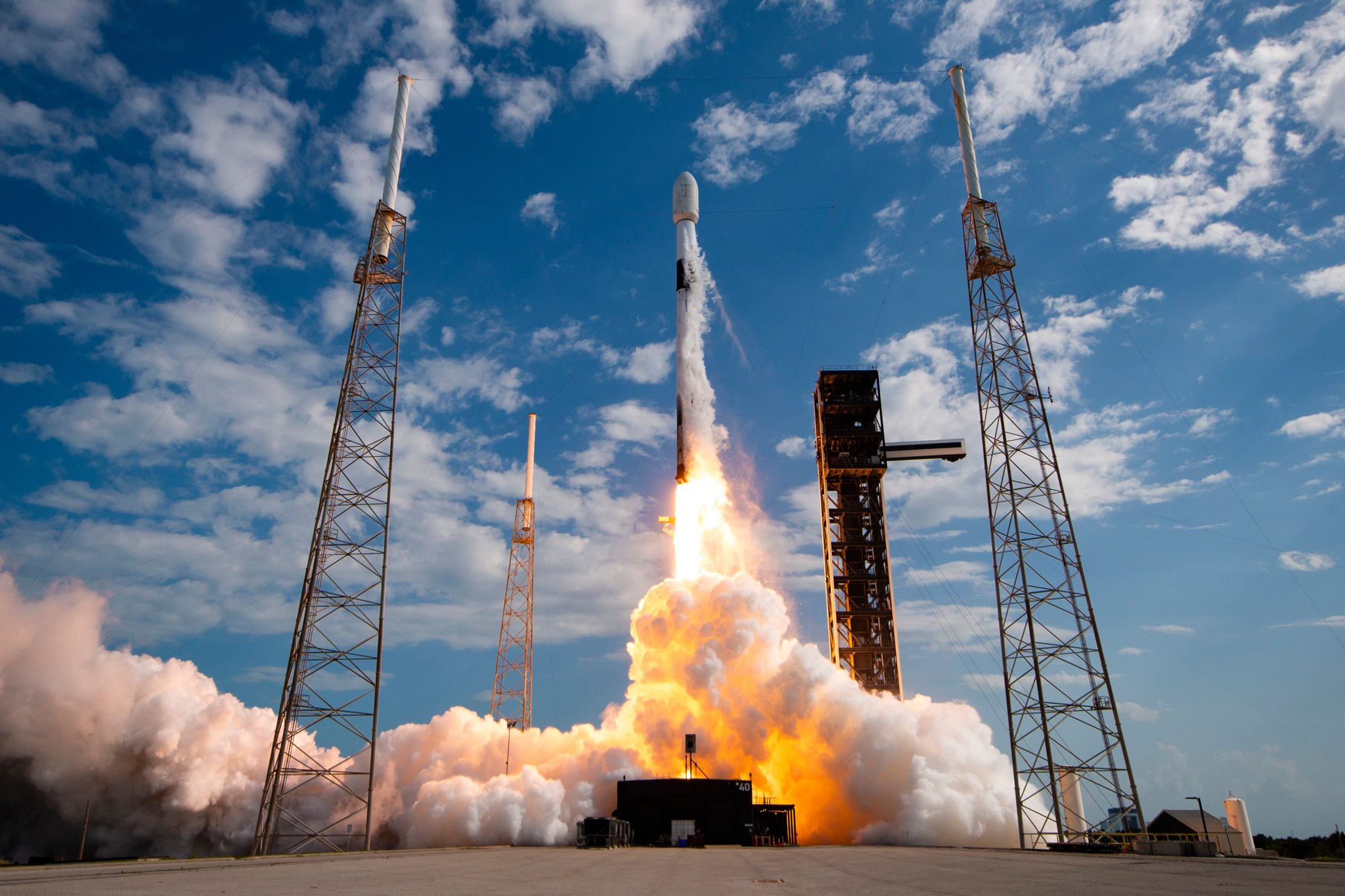
Following its liftoff from Cape Canaveral on July 21 aboard a SpaceX Falcon 9 rocket, the Mission Robotic Vehicle (MRV) hosting the NASA-supported Robotic Servicing of Geosynchronous Satellites (RSGS) payload is now en route to geosynchronous Earth orbit, where it will use its advanced robotics to service spacecraft.
RSGS leverages in-space robotics expertise from NASA, aligned with the agency’s broader goals to advance U.S. capabilities for in-space servicing, assembly, and manufacturing that can be applied to space commerce and exploration.
Funded by the Defense Advanced Research Projects Agency (DARPA), the RSGS program uses twin dexterous robotic arms designed and developed by the U.S. Naval Research Laboratory. DARPA provided the robotic arm assembly for integration onto Northrop Grumman’s MRV, the nation’s first multi-mission robotic in-space servicer. The spacecraft will inspect and upgrade satellites in orbit by installing small propulsion modules – called mission extension pods – extending the operational life of existing spacecraft for years.
RSGS brings together government agencies and industry to test advanced robotic systems in space. NASA’s Goddard Space Flight Center in Greenbelt, Maryland, began supporting the RSGS mission in 2024 under an interagency agreement with DARPA.
NASA’s contributions to the mission leverage its legacy of servicing missions including the Hubble Space Telescope servicing missions and the Robotic Refueling Missions on the International Space Station. NASA support to RSGS program includes the development of dynamic simulation and analysis tools, software analysis for performance verification, and a team of flight robot operators who will support highly technical procedures in orbit. Hundreds of satellites are in geosynchronous orbit. Of those, fully functional satellites are often decommissioned early because they run out of fuel or their equipment becomes obsolete. RSGS establishes a critical U.S. capability to extend the lifetime of spacecraft in orbit, allowing for more innovative and cost-effective mission designs.
By Colleen WoutersNASA’s Goddard Space Flight Center, Greenbelt, Md.
Share
Details
Last Updated Jul 22, 2026 EditorRob GarnerContactRob [email protected] Space Flight CenterRelated Terms
TechnologyGoddard Space Flight CenterRoboticsHence then, the article about robotic servicing mission launches with nasa support was published today ( ) and is available on NASA ( Middle East ) The editorial team at PressBee has edited and verified it, and it may have been modified, fully republished, or quoted. You can read and follow the updates of this news or article from its original source.
Read More Details
Finally We wish PressBee provided you with enough information of ( Robotic Servicing Mission Launches with NASA Support )


Also on site :
- At 68, Shaun Cassidy Jokes He’s the Rip Van Winkle of Teen Idols — ‘Looks More Like Shirley Jones Now’
- Jeff Ross Shares Throwback With Bob Saget, Norm MacDonald, and Gilbert Gottfried — But Fans Notice One Thing
- Brian Austin Green Vulnerably Shares ‘Challenging’ Times, Going Out ‘By Myself’ as Fiancée Sharna Burgess Shines on DWTS