
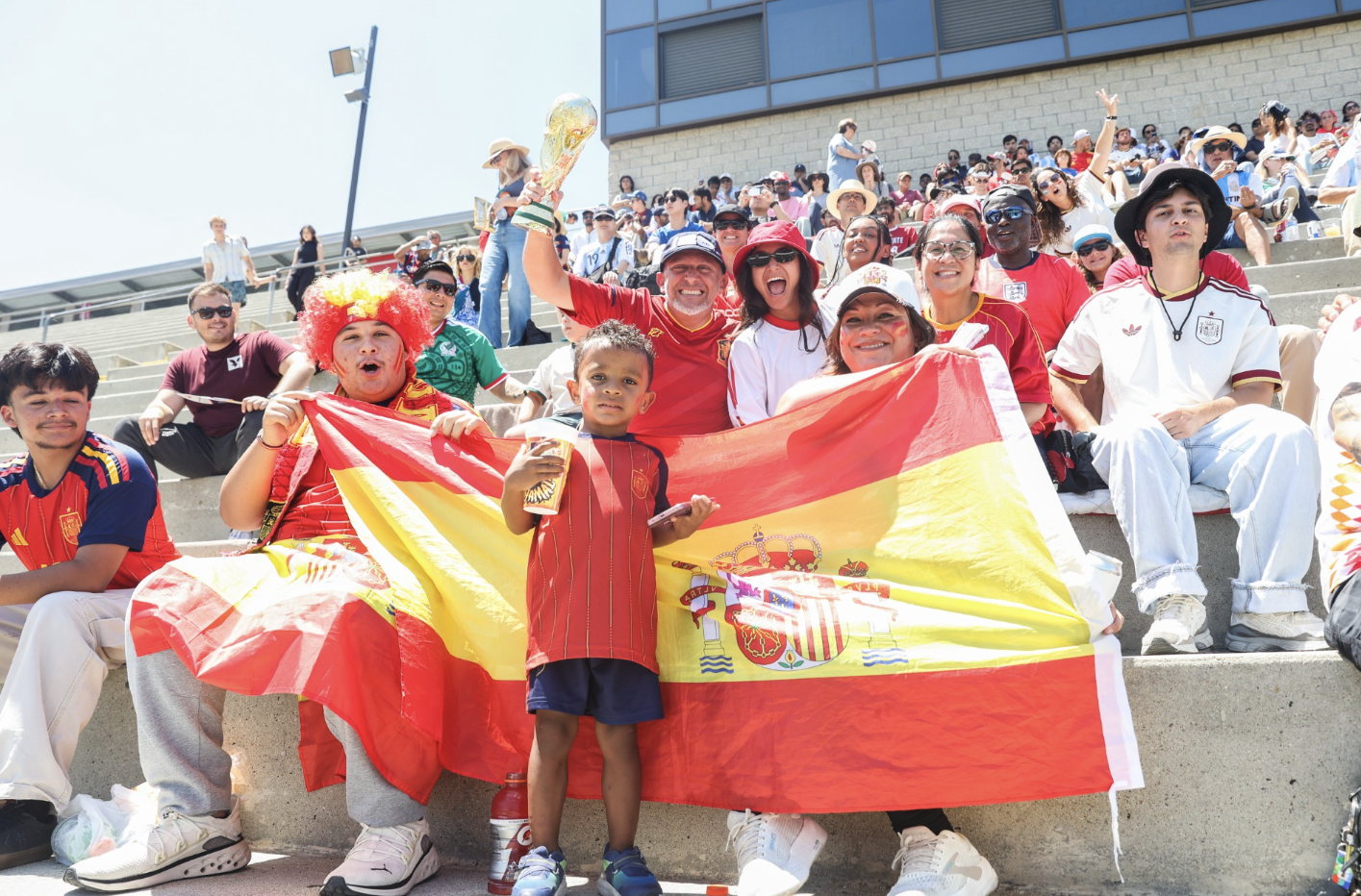
More than 2,700 miles from MetLife Stadium in New York, where Spain and Argentina were battling for the World Cup title, roughly 400 people searched for shade in the bleachers at Southwestern College’s DeVore Stadium in Chula Vista.
Organizers had expected a crowd in the thousands, and the police presence around the venue seemed to reflect those expectations. But the masses never materialized. The reason was simple: Mexico wasn’t playing.
Gathered beneath the relentless heat and facing three giant screens was an unusual audience. Many wore jerseys bearing the name of Argentina’s Lionel Messi. Others sported Iniesta shirts. A few had Spain’s Lamine Yamal’s number 10 on their backs. Most of the crowd was made up of Mexican-Americans who could discuss La Liga lineups, Champions League tactics, or South American qualifiers with equal ease. They hadn’t come out of national loyalty. They had come for the game itself.
Over the next two hours, they would witness a final decided the way the biggest tournaments often are: by the smallest margin and a single mistake that couldn’t be undone.
With a goal from Yamal in extra time, Spain defeated Argentina 1-0 and lifted the World Cup trophy. It was the conclusion of a final largely controlled by Spain but stretched to its breaking point by an Argentine side that absorbed wave after wave of pressure for more than ninety minutes before finally giving way.
It was an afternoon when time stopped being measured in minutes and began to be measured in endurance.
I. Two different ideas of a final
From the opening whistle, it was clear the two teams had envisioned very different matches.
Spain played as it had throughout the tournament: patient possession, relentless pressing, and constant movement of the ball. Argentina, meanwhile, relied on defensive discipline, compact spacing, and patience.
The opening minutes were spent almost entirely in Argentina’s half.
Spain piled on attacks and kept Argentina pinned back. Argentine defenders cleared the ball any way they could, only to see it come right back. For much of the first fifteen minutes, the match felt tilted toward the South American goal.
Then Messi appeared.
Not for long—just long enough to remind everyone he was still there. A run behind the defense forced the Spanish goalkeeper off his line to snuff out the danger. It was one of the few moments in the first half when Argentina managed to disrupt the rhythm of the game.
Spain continued to control possession and dictate the pace.
Back in Chula Vista, Agustín Ruiz watched with his son, Luca. Draped in an Argentine flag, they followed every touch of the ball.
“The team that makes fewer mistakes is going to win. Right now, it’s pretty even,” Agustín told him.
The comment sounded more hopeful than factual. Spain had the ball, the territory, and the chances. Argentina was hanging on.
A hard challenge in the 28th minute raised the temperature of the match. Ten minutes later, Argentina’s goalkeeper produced a crucial save to preserve the deadlock. In the 40th minute, Lisandro Martínez received a yellow card for a tactical foul that summed up Argentina’s situation: every Spanish attack was being treated as if it could be the decisive one.
Soon afterward, Martínez was forced off by injury, prompting Lionel Scaloni to call on Nicolás Otamendi to reorganize the back line.
At halftime, the score remained unchanged.
The numbers did not.
Spain had taken thirteen shots.
Argentina had taken none.
Fans of Argentina cheer their side on during the Men’s World Cup Final watch party at Southwestern College on July 19, 2026. (Photo by Adrian Childress/Times of San Diego)II. Halftime
The break offered an almost surreal contrast.
Shakira’s halftime performance drew a more immediate reaction from many spectators than the first forty-five minutes of football. As music filled the screens, fans picked up conversations that had been running throughout the match.
A group of Argentine supporters debated what they had seen.
“They’ve got a much better team than we do, but it’s not like they’re blowing us away,” Gonzalo said.
Rubén saw it differently.
“They’re playing for extra time. If this goes to penalties, we’ve got the best goalkeeper in the world.”
It wasn’t an unreasonable theory. Up to that point, Argentina’s keeper seemed to be holding the entire game together almost single-handedly.
María and her three friends — all Mexican, under 20 and residents of Chula Vista — cheered each time the Spanish team arrived.
“We want Spain to win.”
Why?
“Because Argentinians are really arrogant and they make fun of Mexicans,” they said with a laugh.
III. A match without the ball
The second half confirmed what the first had only suggested.
Spain wanted the ball. Argentina was prepared to live without it.
Spain built attacks, combined passes, and pushed forward. Argentina fought for every yard. The match began to resemble an endurance test more than a conventional final.
Messi remained isolated.
Each time he received the ball, defenders closed around him. Each time Argentina recovered possession, it lost it too quickly to launch anything dangerous.
As the clock ticked on, the game slowly began to favor Argentina.
Not because Argentina was playing better.
Throughout the DeVore Stadium concourse, families wearing both Argentinian and Spanish jerseys were a common sight, a reflection of the ties that have long connected both nations. (Photo by Alejandro Maciel/Times of San Diego)Because the score was still level.
With every passing minute, the Argentine plan became clearer: survive long enough to reach penalties.
Spain was determined to avoid exactly that outcome.
At the center of Argentina’s resistance stood the same figure time and again. Playing with a fractured finger, the goalkeeper kept producing save after save, preserving a draw that seemed increasingly at odds with the statistics.
By the end of regulation time, the numbers were staggering: nineteen Spanish shots, none from Argentina.
And yet the scoreboard still read 0-0.
Fans watching in Belmont Park react to the on-screen reaction Argentina’s Lionel Messi to his team’s 1-0 loss to Spain on July 19, 2026. (Photo by Adrian Childress/Times of San Diego)IV. The final mistake
Championships are often decided by details so small that, afterward, they seem inevitable.
Argentina had survived for more than ninety minutes.
It would not survive much longer.
Just thirty-nine seconds into the second period of extra time, Lamine Yamal found the space Spain had been searching for all afternoon. His shot beat the goalkeeper and found the back of the net.
The resistance was over.
For the first time all night, Argentina was forced to abandon the plan it had followed from the opening whistle. Waiting was no longer an option. Now it had to attack.
The closing minutes were Argentina’s best.
Three desperate opportunities followed. Crosses flew into the box. Loose balls bounced dangerously. Every challenge carried a sense of urgency. But a comeback required something Argentina had rarely possessed throughout the final: the ball itself.
Spain reclaimed control.
When the referee blew for full time, Spanish players collapsed onto the turf. Celebrations erupted in New York. In Chula Vista, many Argentine supporters stood silently for a few moments, watching the screens fade to black.
The losing goalkeeper had delivered a performance for the ages. His saves had kept the final alive far longer than seemed possible. But football rarely rewards resilience alone.
Spain left with the trophy.
Argentina was left with something less tangible, and perhaps more painful: the knowledge that it had come within a few minutes of the penalty shootout it had been chasing all night.
Hence then, the article about san diegans rally to celebrate world cup finals even without mexico involved was published today ( ) and is available on Times of San Diego ( Middle East ) The editorial team at PressBee has edited and verified it, and it may have been modified, fully republished, or quoted. You can read and follow the updates of this news or article from its original source.
Read More Details
Finally We wish PressBee provided you with enough information of ( San Diegans rally to celebrate World Cup finals — even without Mexico involved )


Also on site :
- APOD: 2026 September 23 – A New Lunar Crater: McGetchin
- The Seemingly Harmless 4-Word ‘I’ Statement That’s Actually a Massive Relationship Red Flag, According to a Psychologist
- 1968 No. 1 Hit, Ranked Among ‘Greatest Songs of All Time,’ Became an 11-Minute Creedence Clearwater Classic