
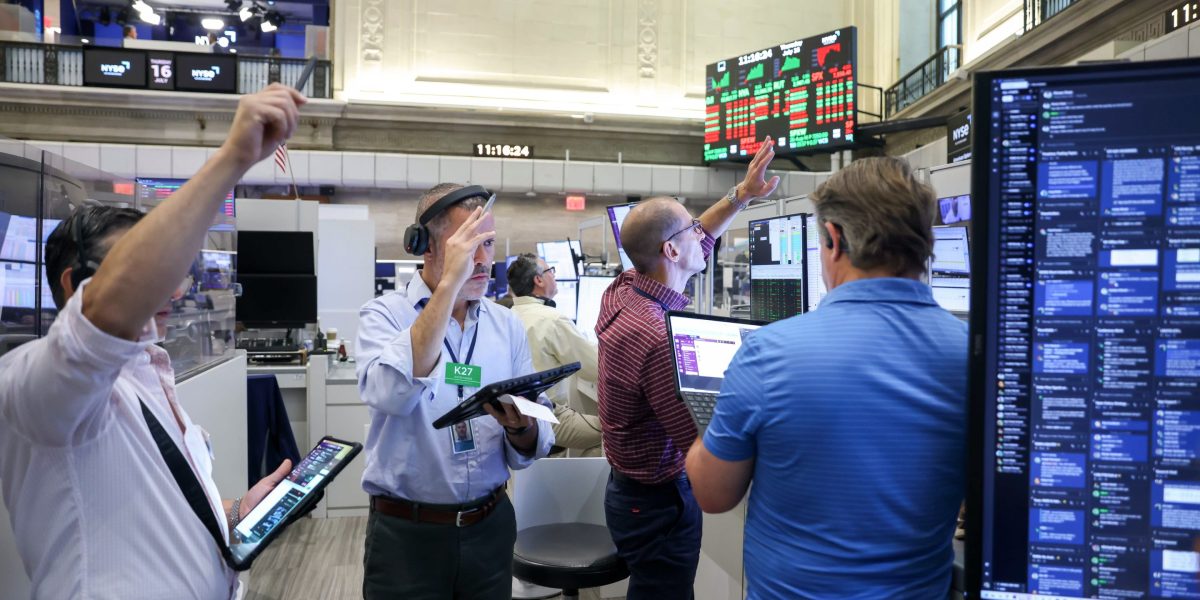
Stocks have taken a beating recently as investors dump one-time darlings of the AI trade, but they will rebound, according to Fundstrat Global Advisors cofounder Tom Lee, who has a strong recent track record of market forecasts.
Chip stocks in particular have been leading the decline, which left the S&P 500 down 1.6% for the week and the Nasdaq off 2.9%. The latest catalyst was the release of a Chinese AI model that cast doubt on hyperscalers’ gargantuan spending plans.
In an interview on CNBC on Friday, Lee argued that the companies selling off are at the center of “one of the most important strategic initiatives” for the U.S., namely AI, and they still have years of runway ahead.
The market pullback is actually healthy because it reduces speculation ahead of upcoming earnings reports from the AI sector, he added.
“I would still stick with those,” Lee said. “I think those names are going to bounce later this year. So I don’t think that the trade is over.”
But he acknowledged that the ubiquity of leverage in the market today is fueling more volatility, calling zero-day trading options and leveraged funds “push-button liquidity for everybody.”
In fact, margin debt is up 54% annually, marking the sixth biggest surge in the last 60 years, Lee estimated. After the other five top increases, the market similarly consolidated.
That dynamic was evident in South Korea, which has experienced a nationwide stock-trading mania as chipmakers SK Hynix and Samsung ride the AI wave.
Frenzied demand for more ways to capture upside from those stocks gave rise to leveraged ETFs that further stoked the country’s market rally.
But the Korean stock boom has gone bust in recent weeks. The once-soaring Kospi index has plunged 27% after a hitting a record high last month, putting it well into bear market territory.
As a result, 1.2 million brokerage accounts had a margin call, representing as much as 10% of Korea’s accounts, according to Lee. As traders are forced to sell holdings to cover margin debt, a massive correction followed.
That’s sending ripples across global markets, which have been especially sensitive to moves to bellwether stocks in the AI trade.
For example, SK Hynix’s comments last month that it planned to slow down its AI memory business sparked the Kospi’s fifth worst daily plunge and dragged down indexes around the world.
But compared to the Kospi 27% crash, the S&P 500’s 2% dip from its recent high and the Nasdaq’s 6% slide look like speed bumps. And Lee sees that as a positive sign.
“That’s why a rolling correction that what we’re seeing now is super healthy because it’s not the whole market coming down,” he explained. “It’s just pockets of it, and people have ballast like owning the Mag 7 or the software stocks.”
Still, bond investors, who are less swayed by market fads than stock investors are, have also lost enthusiasm for the AI boom.
As hyperscalers spend hundreds of billions of dollars a year to build data centers and other infrastructure, they are increasingly issuing debt.
But bond investors are showing signs that demand is waning. Torsten Slok, chief economists at Apollo Global, pointed out in a note on Wednesday hyperscalers’ cover ratio—investor orders per every dollar of bonds—has plunged.
It was nearly 5x in February 2026 but tumbled to below 2x in July, “suggesting investors may need wider spreads to absorb additional hyperscaler supply,” he warned. By contrast, the ratio for investment grade bonds overall only slipped by about half a point in that span.
The dollar bond market, the world’s largest, has become so saturated that tech giants have been issuing debt in other currencies. As a result, issuers will likely have to provide more attractive terms, meaning their borrowing costs will rise.
AI-related debt must also compete against the flood of debt coming from the Treasury Department as the federal deficit continues to deepen and is on track to hit $2 trillion this fiscal year.
“The current hyperscaler widening is a byproduct of the high-grade investor community trying to rationally price in an accelerating pace of issuance,” JPMorgan strategists wrote in a note on Tuesday.
This story was originally featured on Fortune.com
Hence then, the article about a massive margin call and push button liquidity have torched stocks but they re now poised to rebound top wall street forecaster says was published today ( ) and is available on Fortune ( Middle East ) The editorial team at PressBee has edited and verified it, and it may have been modified, fully republished, or quoted. You can read and follow the updates of this news or article from its original source.
Read More Details
Finally We wish PressBee provided you with enough information of ( A massive margin call and ‘push-button liquidity’ have torched stocks, but they’re now poised to rebound, top Wall Street forecaster says )


Also on site :
- 1979 Maxine Nightingale Breakup Ballad, Written in One Hour, Ranked One of the Best Adult Contemporary Songs of All Time
- San Francisco firefighters respond to person trapped in garbage truck
- ‘Below Deck’ Alum Calls Out Bravo Casting After Nathan Gallagher Arrest Warrant: ‘This Has Got to Change’