
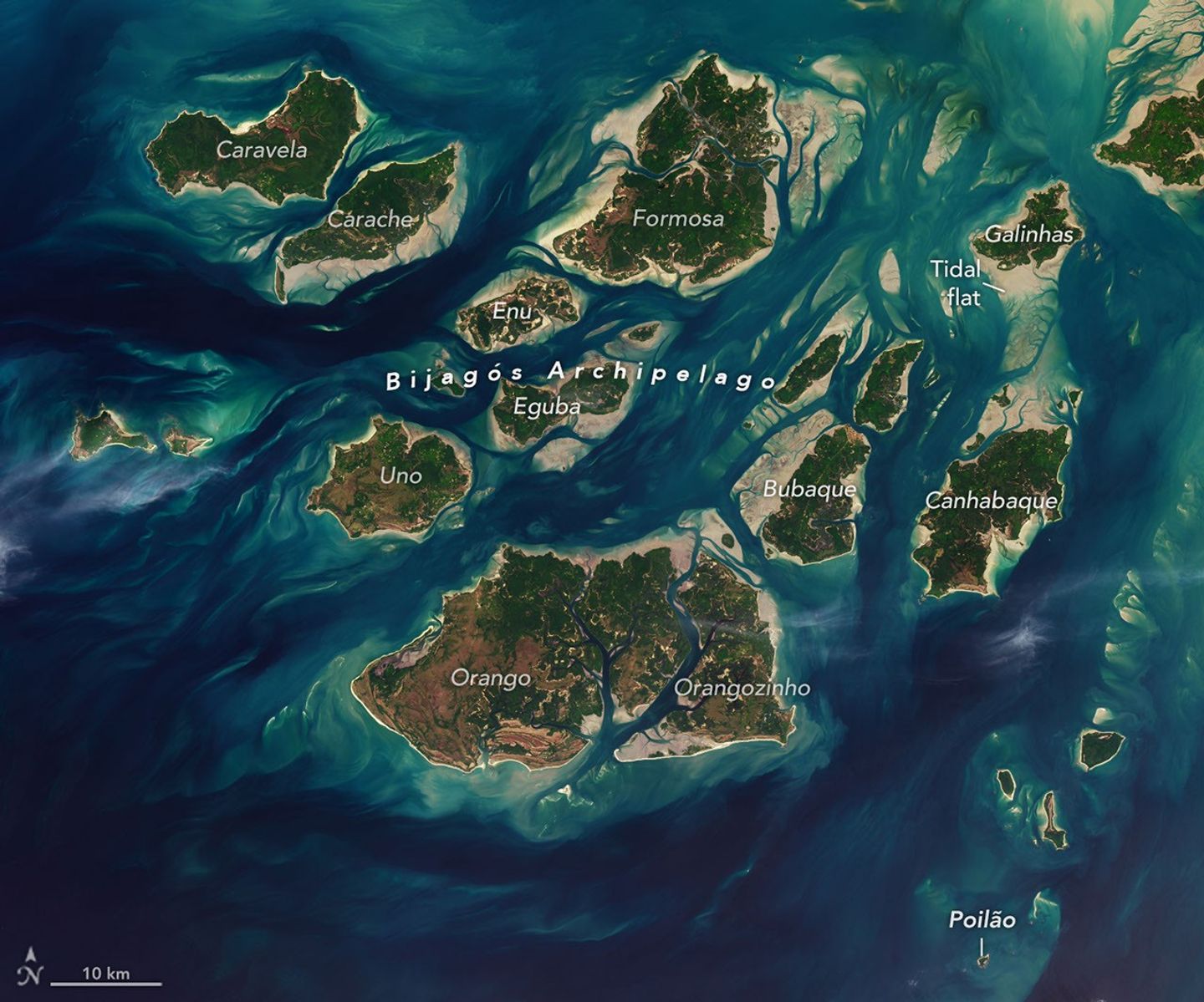
Twice each day, tides ebb and flow through a maze of sandy channels, mudflats, and mangrove forests that flank the 88 islands and islets of Guinea-Bissau’s Bijagós Archipelago (Arquipélago dos Bijagós in Portuguese). Seen from above, the process leads to stark changes to the landscape: around low tide, intertidal mudflats and sandflats emerge from the sea, causing islands to grow significantly before shrinking again hours later.
The perpetual rhythm of the tides sustains outpourings of marine life in an archipelago that, as of 2025, was inscribed as a UNESCO World Heritage site. The site protects the only active deltaic archipelago on Africa’s Atlantic coast, a place where tides, river sediments, coastal upwelling, and coastal currents come together to shape unusually productive and biodiverse island ecosystems.
UNESCO estimates that the islands support some 870,000 migratory shorebirds, making this one of the most important feeding areas for birds in West Africa along the East Atlantic Flyway. Hundreds of species of birds dine on a potpourri of marine worms, crustaceans, mollusks, and small fish found on mudflats exposed by low tides. During high tides, manatees, dolphins, and schools of fish move closer to the islands, pushing deeper into the mangrove forests that ring them, and tens of thousands of sea turtles swim inland to sandy beaches as they hunt for nesting sites.
A huge population of green sea turtles nests on the tiny island of Poilão, part of the João Vieira and Poilão Marine National Park. After hatching, young turtles make perilous nighttime dashes to the water, often pursued by crabs, lizards, and birds. Once they reach the water, baby sea turtles face an array of predators, including jacks, barracudas, groupers, and snappers that patrol shallow waters as well as tuna, mackerel, sharks, and rays in deeper waters. According to some estimates, less than 1 percent of green sea turtle hatchlings survive to adulthood.
A 2025 analysis of the region’s tides explored why the archipelago has some of the largest tidal ranges in West Africa. The researchers concluded that the region’s wide, shallow shelf and the estuary’s geometry combine to create a tidal range of up to 7 meters (23 feet), compared to about 1 meter (3 feet) in many other parts of the West African coast. The scientists used altimetry data from the NASA/CNES TOPEX/Poseidon, Jason-1, and Jason-2 satellites to help validate their findings.
NASA Earth Observatory images by Lauren Dauphin, using Landsat data from the U.S. Geological Survey. Story by Adam Voiland.
Downloads
November 28, 2025
JPEG (7.07 MB)
References & Resources
Campredon, P. & Catry, P. (2016) Bijagos Archipelago (Guinea-Bissau) in The Wetland Book. (Springer, Dordrecht). Dièye, A., et al. (2025) Tidal amplification and distortion in Guinea-Bissau, West Africa. Estuarine, Coastal and Shelf Science, 320, 109318. Hays, G., et al. (2026) Is it really 1 in 1000 sea turtle hatchlings that survive to adulthood? Royal Society Open Science, 13(1), 251563. The New York Times (2024, April 22) A Remote Island Draws Thousands of Turtles Each Year. Could It Attract Tourists? Accessed July 16, 2026. Oceanus (2025, January 30) How will we ever count them all? Accessed July 16, 2026. UNESCO (2025) Coastal and Marine Ecosystems of the Bijagós Archipelago – Omatí Minhô. Accessed July 16, 2026.You may also be interested in:
Stay up-to-date with the latest content from NASA as we explore the universe and discover more about our home planet.
Pumice Rafts Encroach on Admiralty Islands
4 min read
Buoyant volcanic rock fragments from an underwater eruption drifted across the Bismarck Sea and choked island coasts.
ArticleSatellite Spots a Spawn
3 min read
The activity of herring around Vancouver Island in British Columbia brightened coastal waters enough to be detectable from space.
ArticleAmerica’s Emerald Isle
3 min read
Beaver Island is one in a string of verdant and scenic jewels in a northern Lake Michigan archipelago.
Article 1 2 3 4 Next Keep ExploringDiscover More from NASA Earth Science
Subscribe to Earth Observatory Newsletters
Subscribe to the Earth Observatory and get the Earth in your inbox.
Earth Observatory Image of the Day
NASA’s Earth Observatory brings you the Earth, every day, with in-depth stories and stunning imagery.
Explore Earth Science
Earth Science Data
Open access to NASA’s archive of Earth science data
Hence then, the article about a tide fueled trove of biodiversity in guinea bissau was published today ( ) and is available on NASA ( Middle East ) The editorial team at PressBee has edited and verified it, and it may have been modified, fully republished, or quoted. You can read and follow the updates of this news or article from its original source.
Read More Details
Finally We wish PressBee provided you with enough information of ( A Tide-Fueled Trove of Biodiversity in Guinea-Bissau )


Also on site :
- Nigeria confirms US troop withdrawal
- Stay Prepared for Tropical Storms and Wildfires With This 120-Serving Food Supply That Lasts 25 Years
- "A game for everyone is a game for no one": Don't expect an easy ride in Carcass Clad, the co-op tank horror game from the makers of Mouthwashing