
Two physicists have used generative artificial intelligence (AI) to solve a stubborn mathematical problem in physics that had vexed researchers for more than a decade.
Their solution, described July 1 in the Journal of Statistical Mechanics: Theory and Experiment, came about when the physicists chose to revisit a problem they thought they had attempted to solve exhaustively within a topic they knew intimately. This concept, known as jamming, refers to the sudden transition from a fluid system to a rigid-but-disordered one.
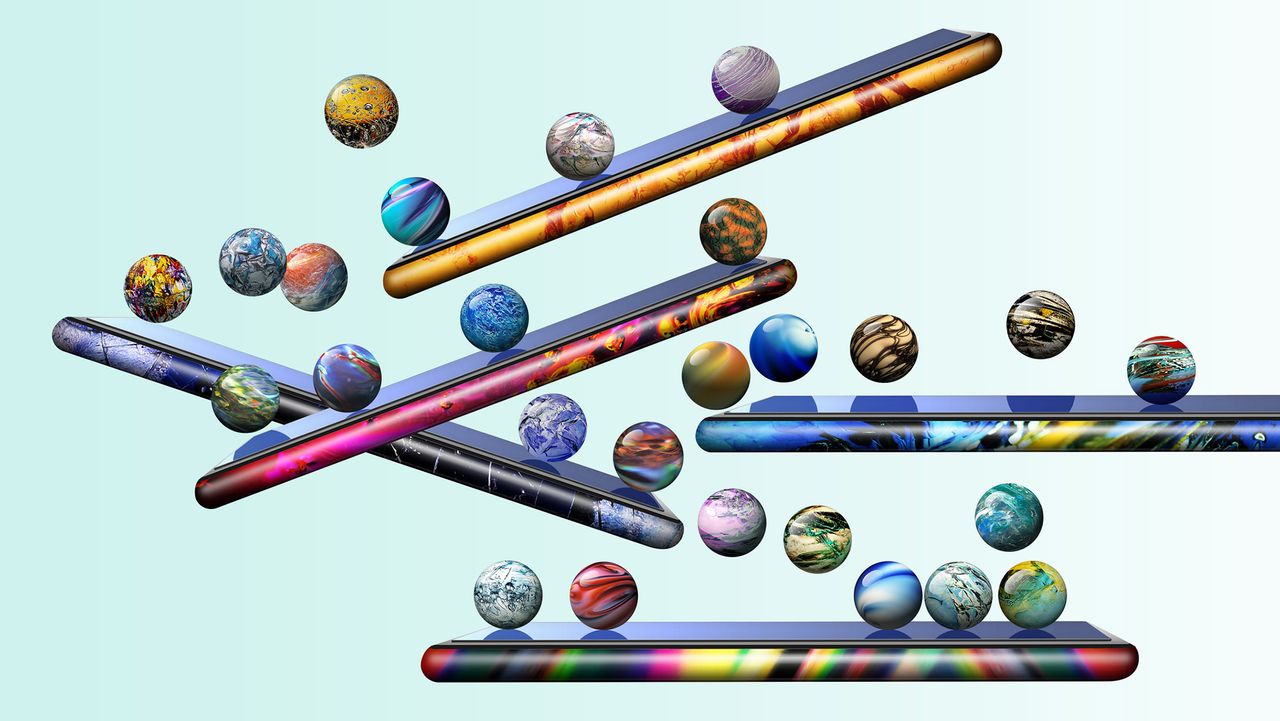
The simplest way to understand this idea is to imagine a pool table covered with billiard balls. If you keep adding balls, eventually the table becomes so congested that there is no space for any more and each ball on the table is securely held in place by its neighbors. This is a disordered, completely frozen situation known as a jammed state.
The study authors — Giorgio Parisi, winner of the 2021 Nobel Prize in physics, and Francesco Zamponi, both physicists at the Sapienza University of Rome — and collaborators had mathematically described jamming and offered numerical solutions in a 2014 paper. In the process, they noticed that two parameters — $a$ and $b$ — would mysteriously always add up to 1.
"The parameters $a$ and $b$ dictate exactly how the distribution of contact forces and small gaps [between balls] scales as the physical system hits that critical jamming point," Zamponi told Live Science in an email. "We were quite bothered by the fact that we had never been able to mathematically prove the relation $a+b=1$."
Moreover, separate work by Matthieu Wyart, a physicist at the Swiss Federal Technology Institute (EPFL), took a completely different approach but yielded the same relation. For Zamponi and colleagues, this suggested "entirely new physical concepts" were needed to link their and Wyart's work and simultaneously explain why $a+b=1$.
Fast-forward a decade, and no progress had been made in finding these new concepts nor a reason for why $a+b=1$. Stuck in a rut, Parisi had a thought: perhaps generative AI could offer a fresh perspective. For this, he turned to Anthropic's Claude. After Claude successfully reproduced the 2014 numerical result, Parisi prompted the AI to prove why $a+b=1$.
The researchers prompted Claude 40 times in order to get a publishable solution to the jamming problem. (Image credit: NurPhoto via Getty Images)"Giorgio initially sent me Claude's output while I was traveling, so I ended up reviewing it on an airplane," Zamponi recalled. "As I read through the LaTeX file Claude generated, it became immediately clear that the core idea was correct … That moment significantly shifted my perspective on what these models can achieve in theoretical physics."
Though the initial output contained some errors that required revision, the fundamental idea was correct. And in a total of just 40 prompts, the researchers had a verified publishable analytical solution. To their surprise, this solution was hidden directly within the equations themselves; they didn't need any external physical assumptions or deep connections between functions.
Related storiesOpenAI's internal AI model just solved an 80-year-old math problem — and mathematicians verified itAI is solving 'impossible' math problems. Can it best the world's top mathematicians?AI just verified a proof that earned one of math's most prestigious prizes. Math will never be the same
"It is entirely possible that a pure mathematician who works full time on such kind[s] of equations might have spotted the solution," Zamponi told Live Science. "But this is a particularly interesting point for us, as it highlights how Claude gave us instant access to a vast repository of mathematical training and formal skills that lay just outside our usual domain."
Whether Claude simply trawled the vast mathematical literature and used pattern matching to find a way to solve their problem or if it applied something akin to creativity is, for Zamponi, moot because they "could not see the path forward, and Claude did," he said. And although he admitted that interacting with AI forces him to reconsider his definitions of reasoning, intuition, and creativity, Zamponi will continue to collaborate with the technology to speed up mundane tasks and provide fresh perspectives on challenging problems.
Now, Zamponi is applying this collaborative approach to a problem involving the “random sequential addition of hard hyperspheres," he said. “It is another excellent case study because, while the AI drastically accelerates writing and optimizing code, I have had to provide the vast majority of the conceptual ideas, which suggests that human guidance remains indispensable, at least in this case."
Hence then, the article about nobel prize winning physicist and team use claude ai to solve decades old math puzzle was published today ( ) and is available on Live Science ( Middle East ) The editorial team at PressBee has edited and verified it, and it may have been modified, fully republished, or quoted. You can read and follow the updates of this news or article from its original source.
Read More Details
Finally We wish PressBee provided you with enough information of ( Nobel Prize-winning physicist and team use Claude AI to solve decades-old math puzzle )


Also on site :
- Nigeria confirms US troop withdrawal
- Stay Prepared for Tropical Storms and Wildfires With This 120-Serving Food Supply That Lasts 25 Years
- "A game for everyone is a game for no one": Don't expect an easy ride in Carcass Clad, the co-op tank horror game from the makers of Mouthwashing