
The big-screen prestige spectacle is in danger. Now that the smartest, most interesting pictures tend to be smaller, independent projects—and the studios, to the extent they exist anymore, have begun pouring their resources into fodder for their streaming platforms—fewer people over 40 or 50 care to go out to the movies anymore, and you can’t blame them. What’s out there for them? A big-screen extravaganza like The Odyssey, made by a filmmaker, Christopher Nolan, who’s adamant about preserving the communal watching experience—and one who’s committed to shooting the old-fashioned way, on film—seems to be our only hope.
But instead of being an answer to our prayers, The Odyssey ends up being just another reason for despair. In the runup to its release, The Odyssey seems to have inspired more anxiety than actual anticipation. Lovers of classical literature have been asking, Will it hew close enough to Homer’s vision? Or, perhaps more accurately, Will it hew close enough to their vision of Homer’s vision? On the right, pundits have bemoaned what they see as the pure fact that you simply cannot have a Black Helen of Troy (she’s played in the film by Lupita Nyong’o), though it’s hard to fathom that the most controversial trait of a woman who’s been hatched from a swan’s egg should be the color of her skin. The Odyssey has already inspired so much chitter-chatter that its actual release was poised to be a letdown in comparison. But just wait till you actually see this eye-glazing dud of a movie.
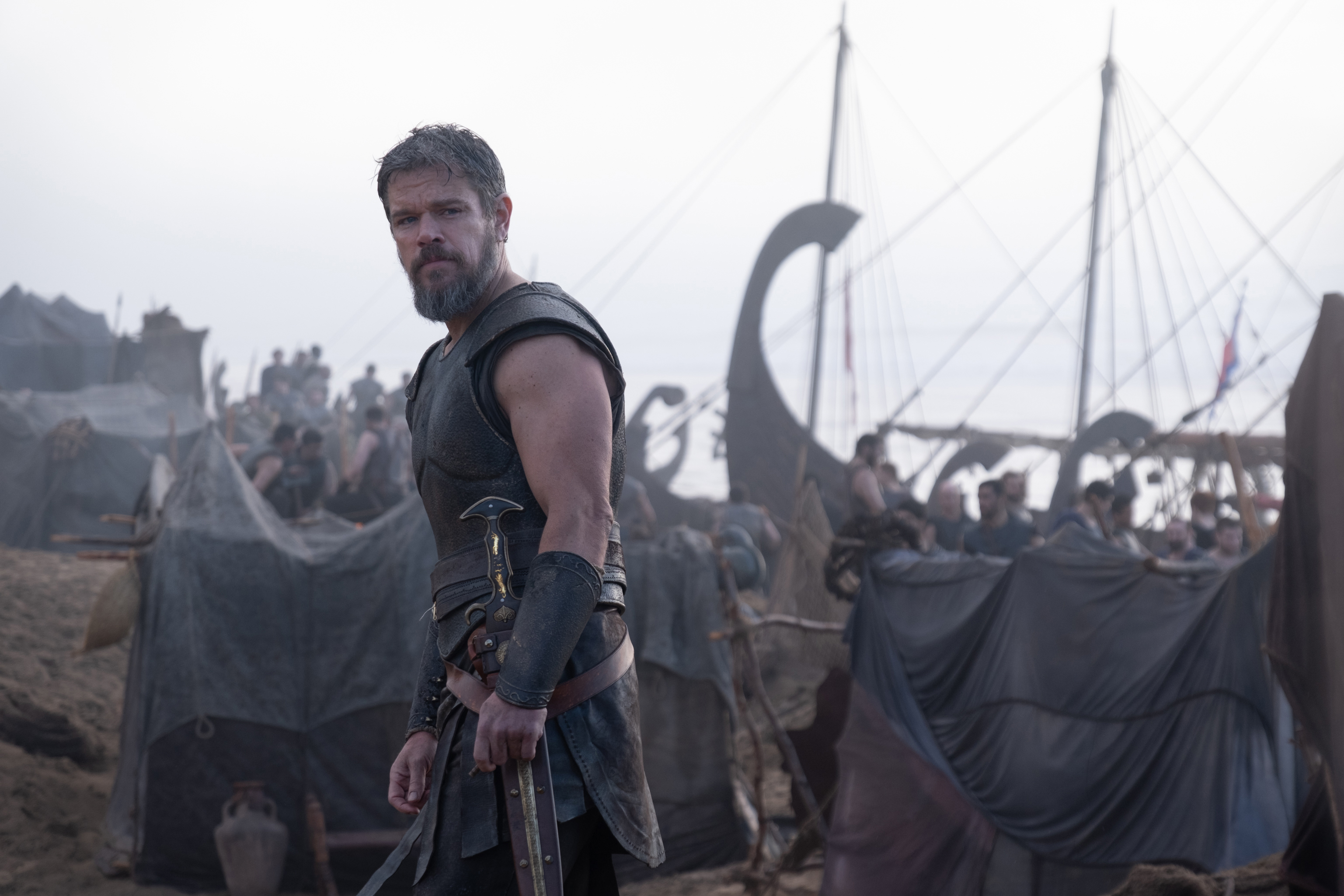
Matt Damon, earnestly bewhiskered, stars as Odysseus, the King of Ithaca and a revered warrior, who’s working hard—or so it seems—to get home to his wife, Penelope (a reasonably dignified Anne Hathaway), and the grown son he has never gotten a chance to know, Telemachus (Tom Holland, so bland he’s practically unreadable). Odysseus has been gone for 20 years: The first 10 of those were eaten up by military exploits, chiefly the Trojan War—Nolan’s movie, like Homer’s tale, begins at the end of that war, with a giant wooden horse half-sunk in the sand, a pretty direct reference to the beached and forlorn Statue of Liberty at the end of Planet of the Apes. Throughout The Odyssey, we’ll get flashback glimpses of just how violent the sack of Troy, led by Odysseus, was. The suggestion is that he has done some Really Bad Stuff, though the battle scenes, while elaborate, are so tastefully un-bloody that it’s hard to feel there’s anything at stake.
It will take Odysseus 10 years to get home, and though he and a gang of surviving warriors set sail from Troy near the beginning of the movie, he will ultimately return without his men. (They’re played by an assortment of actors including Himesh Patel and Elliott Page, though most of them blur into a somewhat faceless mass of dudes in Marvin the Martian helmets.) The challenges they face on their journey are many: After a lone sheep leads them into a cave, they encounter a one-eyed giant, the Cyclops (Bill Irwin). Odysseus, in a supposed act of bravery, blinds the giant by stabbing his one good eye, and his men turn against him, grumbling that he has angered Poseidon, the god of the sea, the Cyclops’ father. And sure enough, the ocean tosses their tiny, rough-hewn wooden ships hither and thither. Other stuff happens on other islands: At one stop, the men anger the Sun God by eating his cattle, despite Odysseus' bossy warning not to do so. At another, the enchantress Circe gives the hungry men—though not Odysseus—a generous meal, but only as an excuse to turn them into swine. This is the finest scene in the movie, perhaps the only truly good one: as Circe, Samantha Morton seems to have dropped in from a different, better picture, uttering a chilly incantation as she massages the men’s dirty, meaty faces into visages with pig snouts. Later, she’ll tell Odysseus that all she was really doing was revealing the true nature of men. It’s hard to argue with her.
Damon, center, and some of the men who are doomed not to make it home —Courtesy of UniversalAs this arduous journey continues, Damon’s Odysseus comes to look more and more like Nick Nolte’s mugshot, with added facial hair. He’s exhausted; he’s lonely for his wife—but not too lonely, seeing as Charlize Theron’s comely nymph Calypso will hold him hostage on her island for a total of seven years. (Theron is a luminous presence, but the movie kicks into snooze territory during these dreamy beach sequences—there are far too many of them scattered throughout.) Every once in a while, the goddess Athena (Zendaya) will appear at Odysseus’ side to judge his actions, mostly by offering a scowl of disapproval, the sort of face a wife makes when her husband loads the dishwasher wrong.
Meanwhile, back in Ithaca, Hathaway’s Penelope is weary for a different reason: though she’s holding out hope that her husband Odysseus is still alive, she must fend off 108 boorish suitors—they’re like Airbnb guests who refuse to leave. These men, each aspiring to become king, hope to bully her into marrying. Chief among them is the aggressively reptilian Antinous—Robert Pattinson plays him with a plastered-on leer. Hathaway’s costumes and jewelry are the saving grace of these scenes: at one point she wears a gown that falls around her in lustrous teal folds, a testament to the fact that Nolan does at least strive to hire the best craftspeople—not just anybody can dye fabric to look this luminous. (The costume designer here is Ellen Mirojnick.)
But unlike Odysseus, who survives being waylaid by giants, sorceresses, nymphs, and numerous other distractions, Nolan himself becomes dragged down by the details of his Odyssey. The poem, packed with events, with description, with magic and all manner of deceptions, is episodic by nature. How do you make this story flow and glide on-screen? Maybe you do it not by trying to pack everything in, but by cutting away, by focusing on the most potent, exciting, and moving details. You might do something along the lines of what Uberto Pasolini did with his underseen 2024 picture The Return, with Ralph Fiennes and Juliette Binoche, which takes the final stretch of The Odyssey and weaves it into a graceful, moving whole. It doesn’t help that Nolan’s Odyssey—even when viewed, as he hopes audiences will see it, in IMAX—looks muddy and underwhelming. The Return was shot in Greece and Italy, and its landscapes are part of its vitality; cinematographer Marius Panduru made Ithaca look like a place worth coming home to. In Nolan’s Odyssey, shot by his frequent collaborator Hoyte van Hoytema in a host of locations including Italy, Greece, Morocco, Iceland, and Scotland, almost every landscape—a churning sea here, a set of cliffs there—just looks like business as usual, only bigger. There’s soil, but you don’t feel its texture; there’s sun, but you don’t feel its warmth. When Damon’s Odysseus is greeted by his ancient, dying dog Argos, who has waited patiently and poignantly for his return, Argos’s little tail wriggles mechanically as he takes his last breath. Odysseus expresses a flash of grief, and then it’s on to the next beat. There isn’t a minute to lose here, even in a runtime of nearly three hours.
Zendaya, as Athena, who appears as a sort of guilty conscience to Damon's Odysseus —Courtesy of UniversalThere are other problems, among them Nolan’s failure to make use of Nyong’o's gifts. The issue isn't that her casting plays into any of the advance criticism the movie has received; it's that it barely feels like a choice at all, representing not a burst of imagination but a failure of nerve. Nyong’o plays two roles here, that of Helen and of Clytemnestra, Helen’s twin sister. But there’s so much decorously, Homerically faithful story swirling around these two figures, glimpsed mostly in passing—and so many men around them, doing seriously manly stuff—that neither role registers. Through no fault of Nyong’o’s—who’s both accomplished and, though it should go without saying, uncommonly beautiful—these are almost blink-and-you-miss-them portrayals, the kind of thing a director can magnanimously hand out like candy. We’re supposed to applaud Nolan for bravery in casting, but the result comes off as tokenism, surely the opposite of what he intended.
But then, there’s little in The Odyssey that breathes. It churns so dutifully toward its predictable conclusions—summed up roughly as “War dehumanizes men!” and “Civilization, now as in Odysseus’ time, is on the brink!”—that you begin to wonder if it wouldn’t be a better use of your time to just stay home and read The Odyssey. We want and need more movie artistry—and more dedication to the craft, which Nolan, no matter what you think of him, surely espouses. But a movie still needs to add up to something you actually want to watch, not just a testament to a filmmaker’s solemn dedication to the hallowed tradition of filmmaking. We’ve reached a point where we get so few extravagant, ambitious studio movies that we’re expected to collapse with gratitude whenever we're presented with one. That’s not opening ourselves to what movies can be; it’s succumbing to a kind of hostage taking. No matter how endangered the movies become, we still get to choose what moves and delights us. Why settle for less? It’s our job to make demands. Otherwise, we’re nothing more than spoils of war.
Hence then, the article about the odyssey is just another reason for despair was published today ( ) and is available on Time ( Middle East ) The editorial team at PressBee has edited and verified it, and it may have been modified, fully republished, or quoted. You can read and follow the updates of this news or article from its original source.
Read More Details
Finally We wish PressBee provided you with enough information of ( The Odyssey Is Just Another Reason for Despair )


Also on site :
- 1979 Maxine Nightingale Breakup Ballad, Written in One Hour, Ranked One of the Best Adult Contemporary Songs of All Time
- San Francisco firefighters respond to person trapped in garbage truck
- Clarks’ ‘Lightweight’ Slip-on Sneakers Are Perfect Summer-to-Fall Shoes That Feel Like ‘Walking on Air’