
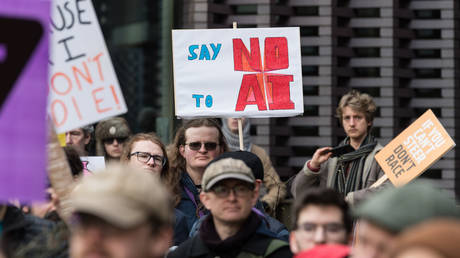
Businesses are racing to automate, but many staff are being left without the retraining, clarity, or safeguards needed to adapt
A comprehensive new study of the global workforce finds that ‘anxiety’ is the best definition for how most workers feel about their career, their future, and the AI tsunami that threatens to wash it all away.
These days, everyone from doctors to lawyers and accountants to clerks are pondering the same question: will some machine eventually take over my job and what can I do to prepare for what appears to be an inevitability?
Just 22% of workers worldwide strongly agreed that their job was safe from elimination, according to a new report from ADP Research released this month. The results come from one of the largest workforce sentiment surveys ever conducted – more than 39,000 workers across 36 countries were polled.
Meanwhile, a poll conducted by Ipsos in partnership with Epoch AI found that half of American adults used AI in the past week, either for personal or work use, with 20% of full-time workers saying that AI has taken over parts of their job.
Thus, it should surprise exactly nobody that the introduction of AI technology into all sectors of the economy is the leading cause of employee apprehension. Workers from Singapore to Spokane are fighting to understand what the technological upheaval means for their future – and they’re not comforted by what they are witnessing. The corporate world has failed to convince their workforce to welcome artificial intelligence with open arms.
Read more Claude AI evolved its own human-like thinking space – Anthropic“Despite three years of historically low global unemployment and steady economic growth, our data reveals widespread job insecurity expressed by workers worldwide,” Nela Richardson, chief economist, told reporters in a briefing on the survey results in New York City.
The ADP Research Today at Work 2026 report, based on survey responses collected in late summer 2025, “paints a portrait of a global workforce caught in the crosscurrents of technological disruption, demographic upheaval, and deep uncertainty,” writes Nick Lichtenberg in Fortune magazine. “The anxiety cuts across borders and industries, but ADP found that it hits hardest at the bottom of the organizational ladder.”
According to the report, of the workers who make up the majority of most companies, only 18% said their job was safe. Managers did only marginally better at 21%. Predictably, confidence increased with seniority and status: Middle managers were listed at 23%, upper managers at 31%, and C-suite executives (an organization’s highest-ranking senior executives) at 35%. The data reveals that the higher up a worker is on the corporate ladder, the less afraid they are of taking a spill. Nevertheless, just a little more than a third of top executives feel like they have job security, according to the data, Fortune reported.
National divides were also painfully obvious. In Japan, a country famous for its intense commitment to corporate culture, only 5% of workers felt their jobs were secure, the lowest finding of any country in the survey. Meanwhile, Nigeria tallied the most confident workforce, with 38% of workers expressing job security. In America, the figure was only 28%.
Globally, young workers ages 18 to 26 reported the highest level of optimism, with 29% saying they had the necessary skills to get ahead. But more senior workers ages 55 to 64 painted a drearier picture: Only 18% felt similarly prepared, and just 12% believed their company was investing in their talents. At the same time, just 20% of young workers strongly agreed AI would positively affect their jobs in the next year. That figure plummeted to just 10% among workers ages 55 to 64.
Read more Instagram makes public posts available to Meta AI by defaultADP researchers are of the opinion that the current state of tension hitting the workforce is avoidable. What it boils down to is a failure of leadership. Employees who feel their supervisors are investing in their abilities were 5.3 times as likely to feel a high degree of job security.
“Younger workers are definitely more optimistic about their skill set,” Richardson told reporters. “Older workers are also, you know, more likely to say that they’re financially unprepared. Which is interesting. They make more money, but they feel more stretched financially. They’re more likely to say that they’re less productive and less engaged than younger workers. Youth and optimism go hand in hand.”
The survey also exposes a disturbing engagement crisis. Just 19% of workers globally were fully engaged on the job last year, a figure that is unchanged from 2024. That means about 80% of the workforce is not giving it their all on the job. Among those employees who strongly agreed their employer was investing in them, 53% were fully engaged. The figure sunk to just 12% for those who did not feel the investment. Meanwhile, employees who find meaning in their jobs are 12.5 times as likely to be fully engaged as those who don’t.
“Upskilling isn’t just a strategy,” Richardson continued. “It’s a reassurance. It’s a trust pact between the employer and the worker.”
Currently, it is clear that the level of trust between worker and employer is greatly lacking inside of the corporation as the introduction of AI technologies can come at any time and with little prior notice. Such an environment leads to a general feeling of unnecessary worry and malaise inside of the workplace. Workers need assurances that they are receiving the same level of investment as AI technology is currently receiving to the tune of billions of dollars per year. That will make facing an AI future a less unsettling prospect for everyone.
Hence then, the article about corporations are not preparing their workers for an ai tsunami was published today ( ) and is available on Russia Today ( News ) The editorial team at PressBee has edited and verified it, and it may have been modified, fully republished, or quoted. You can read and follow the updates of this news or article from its original source.
Read More Details
Finally We wish PressBee provided you with enough information of ( Corporations are not preparing their workers for an AI tsunami )


Also on site :
- Netflix Brings Together Part 1 & 2 Of Mindy Kaling’s Trilogy With ‘Sex Lives Of College Girls’ Deal; Could It Complete Set With ‘Not Suitable For Work’?
- Hydreight Reports Record Q2 2026 Revenue of $28.0 Million, Net Income of $2.5 Million and Adjusted EBITDA of $3.2 Million
- Meet the CEO whose century-old company never laid off employees through the Great Depression, the recession, or Covid