
6 min read
NASA Webb Uncovers Unusual Galaxy Shaped by Cosmic Collision 6 Min Read NASA Webb Uncovers Unusual Galaxy Shaped by Cosmic CollisionIn new images from NASA’s James Webb Space Telescope to celebrate its fourth science anniversary, a familiar galaxy transforms into something far richer, and far more complex, than ever seen before. Webb’s unprecedented sensitivity across near- and mid-infrared wavelengths cuts through the thick lanes of dust that obscure Centaurus A’s center in visible light, showing a densely packed tapestry of individual stars and an active, everchanging galaxy. These images mark four years of better-than-anticipated performance and successful science operations for the most powerful space telescope in history.
Centaurus A is 11 million light-years away from Earth, relatively close in cosmic terms. Yet, unlike most nearby galaxies, it is very active, making it a powerful laboratory for understanding how galaxies and black holes grow and evolve together.
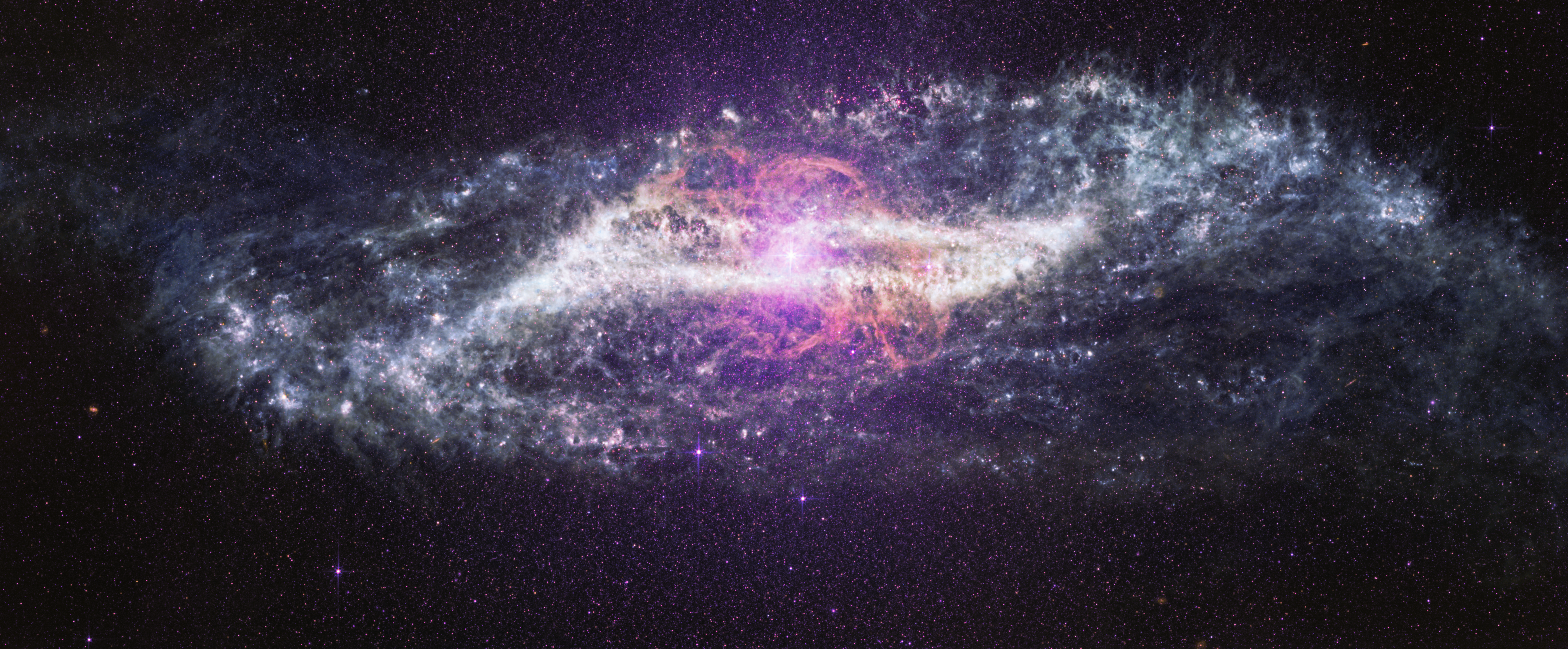
Image: Centaurus A (MIRI Image)
Unable to render the provided source The mid-infrared view of Centaurus A from NASA’s James Webb Space Telescope reveals dusty structures and hidden activity within the nearby, active galaxy. Image: NASA, ESA, CSA, STScI; Image Processing: Alyssa Pagan (STScI), Joseph DePasquale (STScI), Macarena Garcia Marin (ESA Office at STScI)At its core sits a supermassive black hole actively feeding on surrounding material. As it does, the black hole launches powerful jets and releases enormous amounts of energy, shaping the galaxy around it. At the same time, Centaurus A bears the scars of a dramatic past: a major collision with another galaxy roughly two billion years ago. The aftermath of that merger is still visible today in its unusual structure and ongoing star formation.
Visible light observations from NASA’s Hubble Space Telescope could not reveal the central region where dust blocked the view, while NASA’s retired Spitzer Space Telescope revealed large scale structures in the infrared without resolving individual stars. Now, Webb brings both clarity and depth, exposing the galaxy’s inner workings star by star.
Interactive: Journey into Centaurus A
Unable to render the provided source Use this interactive tool to journey into NASA’s James Webb Space Telescope’s mid-infrared view of Centaurus A, where dust gives way to a rich landscape of stars and hidden features. NASA / STScI“No single telescope tells the whole story,” said Shawn Domagal-Goldman, division director, Astrophysics, NASA Headquarters in Washington. “Discoveries build over time and new observatories expand on the foundations laid by earlier missions. Webb represents the most powerful step forward yet, opening a window into wavelengths and details never before accessible. This allows astronomers to examine structures and processes that other telescopes could not see.”
Dust, awe
Webb’s mid-infrared vision highlights the galaxy’s rich dust structures, which glow in intricate shapes that surprise and even perplex astronomers. A warped, parallelogram-like band cuts across the galaxy’s center, while wisps of material stretch outward like cosmic clouds.
An “S” shaped feature, most notable in the image from Webb’s MIRI (Mid-Infrared Instrument), is also unusual and invites questions that need further study to answer. What created this shape? How does the black hole influence it? Is it influenced by merger-induced star formation?
Many of the glowing red points in the MIRI image are dust-rich stars or stellar nurseries, where aging stars are shedding material back into space or new stars are forming. This dust is the raw ingredient for future generations of stars and planets, making it central to the ongoing life cycle of the galaxy.
Image: Centaurus A Crop (NIRCam & MIRI)
Unable to render the provided source In the combined mid- and near-infrared view of Centaurus A, the NIRCam (Near-Infrared Camera) on NASA’s James Webb Space Telescope brings out the galaxy’s dense field of millions of stars. Image: NASA, ESA, CSA, STScI; Image Processing: Alyssa Pagan (STScI), Joseph DePasquale (STScI), Macarena Garcia Marin (ESA Office at STScI)Written in its stars
With Webb’s high resolution, astronomers can now study Centaurus A star by star, even in its long-obscured central region. What looks “grainy” in the image from Webb, most obvious in the combined MIRI and NIRCam (Near-Infrared Camera) view, is actually a densely packed field of individual stars, together carrying information about the galaxy’s past.
With Webb’s view of Centaurus A, it becomes a case of galactic archaeology. Each star revealed helps to reconstruct when different events happened: when older stars first formed, when activity slowed down, a burst of star formation during the collision, and stars born from gas stirred in its aftermath. Together, they form a timeline of the galaxy’s evolution.
Dynamic black hole
Webb’s capabilities go beyond imaging. By analyzing light with spectroscopy, astronomers can measure how gas moves within the galaxy.
Early findings from Webb show fast-moving ionized gas flowing outward, likely driven by the black hole’s activity, and warmer molecular hydrogen in a warped rotating disk near the center. These observations help explore one of astronomy’s biggest questions: How does a black hole influence an entire galaxy?
The answer appears to be complex. The black hole can trigger star formation by compressing gas, but also limit it by pushing material away. Centaurus A offers a rare, nearby view of this cosmic interplay.
By tracing dust in never-before-seen detail, resolving millions of stars, and revealing the motion of gas near a supermassive black hole, Webb transforms Centaurus A into a vivid record of cosmic history.
The James Webb Space Telescope is the world’s premier space science observatory. Webb is solving mysteries in our solar system, looking beyond to distant worlds around other stars, and probing the mysterious structures and origins of our universe and our place in it. Webb is an international program led by NASA with its partners, ESA (European Space Agency) and CSA (Canadian Space Agency).
To learn more about Webb, visit:
science.nasa.gov/webb
Downloads & Related Information
The following sections contain links to download this article’s images and videos in all available resolutions followed by related information links, media contacts, and if available, research paper and Spanish translation links.
Related Images & Videos
Centaurus A (MIRI Image)
The mid-infrared view of Centaurus A from NASA’s James Webb Space Telescope reveals dusty structures and hidden activity within the nearby, active galaxy.
Centaurus A Crop (NIRCam and MIRI Image)
In the combined mid- and near-infrared view of Centaurus A, the NIRCam (Near-Infrared Camera) on NASA’s James Webb Space Telescope brings out the galaxy’s dense field of millions of stars.
Centaurus A Context Image (ESO and Webb Images)
A ground-based image of nearby galaxy Centaurus A from the European Southern Observatory (top left) puts the near-infrared and mid-infrared views from NASA’s James Webb Space Telescope image into context.
Centaurus A (MIRI Compass Image)
Annotated image of the active galaxy Centaurus A captured by the James Webb Space Telescope’s MIRI (Mid-Infrared Instrument), with compass arrows, a scale bar, and color key for reference. The north and east compass arrows show the orientation of the image on the sky. Note …
Centaurus A Crop (NIRCam and MIRI Compass Image)
Annotated image of the active galaxy Centaurus A captured by the James Webb Space Telescope’s NIRCam (Near-Infrared Camera) and MIRI (Mid-Infrared Instrument), with compass arrows, a scale bar, and color key for reference. The north and east compass arrows show the orientat…
Related Links
Read more: What Are Active Galactic Nuclei?
Watch: Black Hole Snapshot
Explore more: ViewSpace: Black Holes: Centaurus A
Infographic: Dissecting Supermassive Black Holes
Watch: Galaxy collisions: Simulation vs Observations
More Webb: News | Images | Science | Home Page
Share
Details
Last Updated Jul 06, 2026 Location NASA Goddard Space Flight Center Contact MediaLaura Betz NASA’s Goddard Space Flight Center Greenbelt, Maryland [email protected]
Hannah Braun Space Telescope Science Institute Baltimore, Maryland
Christine Pulliam Space Telescope Science Institute Baltimore, Maryland
Related Terms
James Webb Space Telescope (JWST) Astrophysics Elliptical Galaxies Galaxies Goddard Space Flight Center Interacting Galaxies Science & Research The Universe Keep ExploringRelated Topics
James Webb Space Telescope
Webb is the premier observatory of the next decade, serving thousands of astronomers worldwide. It studies every phase in the…
Galaxies
Galaxies Stories
Universe
Hence then, the article about nasa webb uncovers unusual galaxy shaped by cosmic collision was published today ( ) and is available on NASA ( Middle East ) The editorial team at PressBee has edited and verified it, and it may have been modified, fully republished, or quoted. You can read and follow the updates of this news or article from its original source.
Read More Details
Finally We wish PressBee provided you with enough information of ( NASA Webb Uncovers Unusual Galaxy Shaped by Cosmic Collision )


Also on site :
- Cut Assassin’s Creed Black Flag Resynced epilogue scene, that could hint at fresh 18th century stabby hijinks, allegedly taken down by Ubisoft following datamine
- Wingstop Just Put Sour Patch Kids Candy on Its Wings—and the New Flavor Is Coming Just in Time for Halloween
- Malaysia’s Firefly cancels flights to Singapore over transboundary haze