
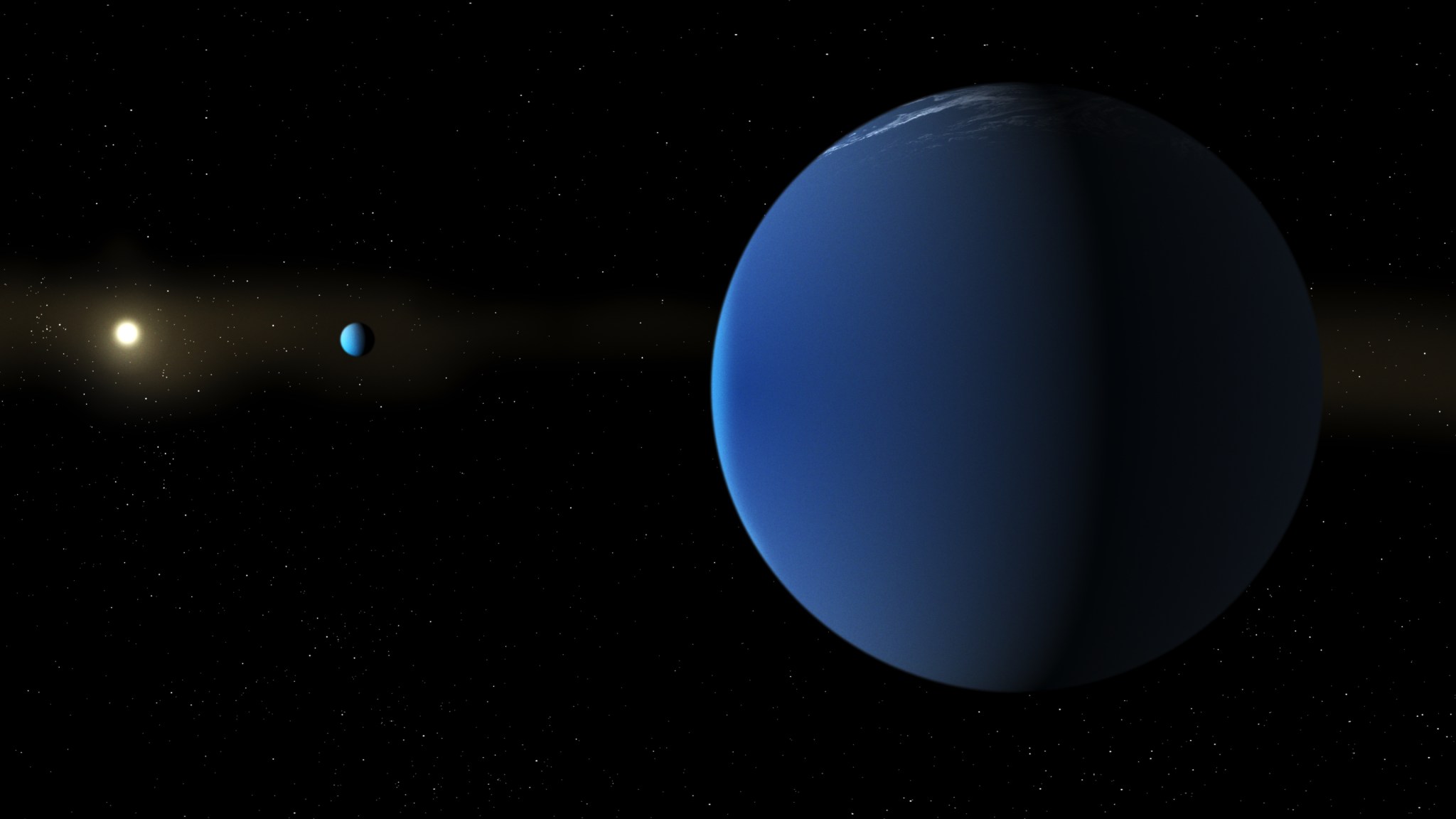
Data from NASA’s TESS (Transiting Exoplanet Survey Satellite) mission has revealed two new “super-puff” planets, giant worlds so light that their density is comparable to cotton candy. Scientists calculate that these Jupiter-sized planets—named TOI-791 b and TOI-791 c—are the “puffiest” worlds ever found.
The planets orbit a Sun-like star named TOI-791 that is approximately 1,113 light years away from Earth. The TESS mission first detected the planets by watching for repeated dips in TOI-791’s brightness, a telltale sign that a planet is transiting, or passing in front of, a star. Further study revealed two large planets with unusual features.
TOI-791 b is nearly the same size as Jupiter but contains just 3.0 percent of Jupiter’s mass. TOI-791 c is even larger than Jupiter but contains just 5.9 percent of Jupiter’s mass.
“The main reason these planets are interesting to study is that we didn’t expect to see them at all,” said Jon Jenkins, the science lead for the Science Processing Operations Center at NASA’s Ames Research Center in California’s Silicon Valley, which provided the science-ready data from TESS analyzed in this study. “They represent a puzzle for us to solve about how giant planets like Jupiter and the super-puffs form.”
This graphic depicts the two giant planets orbiting the Sun-like star TOI-791 as compared to some of the planets in our solar system. These planets are roughly the size of Jupiter but a very tiny fraction of its mass. NASA’s TESS mission detected the shadows of these planets as they passed in front of their star. There is no direct imaging. Therefore, the appearance of the TOI-79 planets in this illustration are an artist’s interpretation. NASA / Daniel RutterThe newly found super-puffs also have unusually long orbits, with TOI‑791 b taking 139 days and TOI‑791 c taking 232 days to circle the host star. Such long-orbit planets are rare to find, needing long durations of telescope observation to capture and confirm their attributes. From its vantage point in high Earth orbit, TESS was able to gather 1,122 days of data on this planetary system over the course of seven years, giving the research team a wealth of data about the planetary system.
Further analysis found that TOI-791 b and TOI-791 c are locked in an orbital pattern that allows them to tug on each other gravitationally. As they orbit their host star, the planets alternate pulling on each other, affecting the timing of their transits across the host star. Scientists used that variation in orbital timing to calculate the planets’ masses, cementing their status as low density super-puffs.
“Only a handful of these super-puffy planets are known, and it is even rarer to find two in the same system,” said lead author George Dansfield of Oxford University’s Department of Physics in Oxford, England. “Their extremely low densities make them fascinating targets for understanding how planetary systems form and evolve.”
With further study, the super-puffs may have more to tell us about planetary evolution.
“Large planet formation is believed to drive the evolution of a planetary system, so further study of these Jupiter-size, but far less than Jupiter-mass, planets is of high value,” said Steve Howell, a NASA Ames research scientist who was involved in this study.
Scientists hope to learn more about the chemical makeup of the planets’ atmospheres, how their spin affects their shape, and how the tilt of their host star compares to their orbits. Deeper investigation could provide new insight into how TOI-791 b and TOI-791 c migrated through the planetary system during their development, whether their orbits were shaped by interactions with other planets, and how low-density super-puff planets form.
The study, published today in the Monthly Notices of the Royal Astronomical Society, was led by the University of Oxford, in collaboration with Université Côte d’Azur/Observatoire de la Côte d’Azur and the University of Birmingham.
Hence then, the article about nasa s tess mission reveals the puffiest planets ever found was published today ( ) and is available on NASA ( Middle East ) The editorial team at PressBee has edited and verified it, and it may have been modified, fully republished, or quoted. You can read and follow the updates of this news or article from its original source.
Read More Details
Finally We wish PressBee provided you with enough information of ( NASA’s TESS Mission Reveals the “Puffiest” Planets Ever Found )


Also on site :
- CBS Called Variety a ‘Man’s Game’ in 1967 When Carol Burnett Asked for Her Own Show; 1 Forgotten Clause in Her Contract Changed Everything
- Carson Kressley Just Mic-Dropped Vicki Gunvalson’s ‘RHOC’ Motor Boating Outfit and the Internet Can’t Stop Screaming
- Elon Musk’s Exes Reveal His ‘Assembly Line’ Approach to Having Kids in New Documentary: ‘Somebody on Elon’s Side Referred to Us as “the Breeders”’