
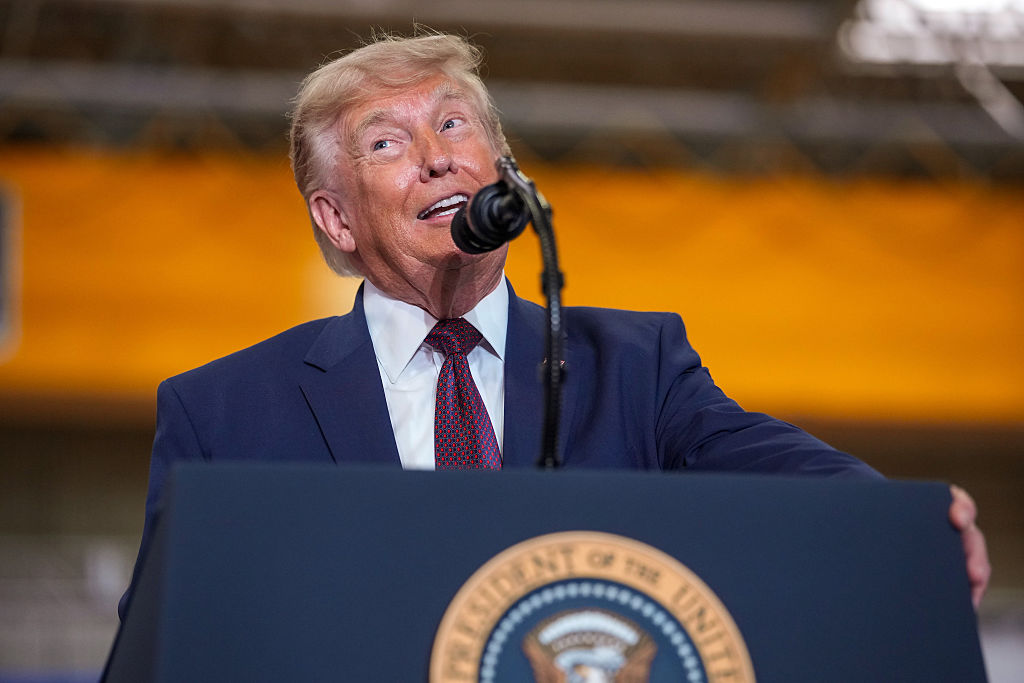
President Donald Trump on Wednesday said he has instructed the Department of Justice (DOJ) to investigate oil companies, accusing them of “gouging” customers by not lowering gas prices in line with falling wholesale costs.
“The big oil companies are not dropping their price at the pump commensurate with the sharply lower prices they are paying for oil,” said the President. “Those prices are dropping like a rock! In other words, customers are being ‘gouged.’”
Trump did not name any specific companies, but said he had told the DOJ to “immediately start looking into” the matter. “Gasoline prices better start going down a lot faster than what I’m seeing,” he warned.
When asked for comment, a DOJ spokesperson told TIME: “The price of fuel is not only [a] national security issue, it impacts the wallet of every American. We will always commit to ensuring affordability in this nation.”
Gas prices surged during the Iran war as Tehran used the Strait of Hormuz, a waterway through which around a fifth of global oil production flows, as a geopolitical bargaining chip. The effective closure of the passage upended trade and sent oil prices soaring, with Americans paying the price at the pump.
Upon the signing of the 14-point memorandum of understanding (MoU) between the United States and Iran last week, gas prices began to fall.
The gradual reopening of the Strait resulted in crude oil prices tumbling toward $70 per barrel on Wednesday. A significant decline when you consider how, in March, prices surged above $100 a barrel for the first time since Russia’s 2022 invasion of Ukraine.
But the current cost is still higher than the $65 price tag in February, before the start of the conflict.
The national average for gasoline fell to $3.93 per gallon on Wednesday, down from $4.51 a month ago, according to the American Automobile Association. Those prices remain well above where they stood two days before the Iran war began, when the national average was $2.98 per gallon.
“President Trump was clear all along that there would be short-term, temporary disruptions to energy markets, and that oil and gas prices will quickly fall as soon as the Iran situation is resolved,” White House spokesperson Taylor Rogers told TIME.
Trump had previously dismissed higher gas prices caused by the war as “peanuts,” arguing that the priority was preventing Iran from obtaining a nuclear weapon.
Since the signing of the agreement, Trump has made falling oil prices a key part of his message ahead of the November midterm elections.
Speaking to a crowd at a Mack Trucks factory in Pennsylvania on Tuesday, Trump said oil was at a “very low price” and would continue “to come charging down and, with oil, comes everything else.”
But experts say it may be some time before gas prices for consumers show a significant drop.
“Gasoline and crude oil prices generally move in the same direction—but not at the same speed,” according to the American Petroleum Institute. “When oil prices decline, it takes time for lower costs to work through the supply chain, from refineries to fuel terminals to retail stations, and for existing higher-cost inventory to be sold.”
Why gas prices may not return to pre-war levels soon
Michael Noel, a professor of economics at Texas Tech University, tells TIME the pace of the recent decline in gasoline prices is largely normal.
According to Noel, there is typically “a lag between crude oil prices and gasoline prices.”
A major reason behind this is the complexity of the global supply chain and the time it takes for crude oil to move from production sites to refineries and eventually to consumers.
“You can't just grab some crude oil out of the ground and a few minutes later put it into your gas tank,” he explains. “It's a very long supply chain, it takes a couple of months to get oil from the ground into barges to go around the world, then into refineries, and then through the pipeline system to eventually get to the gas pump.”
As a result, Noel argues the pace at which gasoline prices are falling reflects the mechanics of the energy market rather than showing evidence of price gouging.
“There's no anti-trust problem with that. That's just the nature of the length of time it takes for all this product to move through the system,” he says.
The agreement signed last week secured an extended 60-day cease-fire that allows time for further negotiations to take place. But Noel says the uncertainty surrounding how those additional talks might progress is another risk factor to consider.
“There is a long policy of this Administration to keep on renegotiating its negotiations,” Noel says, pointing to times when Trump claimed the Strait was opened, only for the waterway to remain restricted.
“Until the markets are certain that this is really over, then we should not expect to see crude prices go back to where they were, because they're always going to price in a probability that this is all just talk and we go straight back to war again,” he says.
The fighting between Israel and Hezbollah, for example, is just one element that threatens to derail the progress of U.S.-Iran talks.
Noel also points to what economists refer to as the “rockets and feathers” effect, where gasoline and diesel prices rise rapidly when crude oil prices increase, but fall more slowly when crude prices decline.
He says the phenomenon is real, but ultimately a “minor thing” compared with broader market forces.
Still, Noel expects gasoline prices to continue to lower in the coming weeks, providing the U.S.-Iran cease-fire remains in place, but warns of other market forces that can shape oil prices.
“There's lots of things that affect crude prices, and all those things are still happening in the background,” he explains. “The main thing is we're moving into the summer driving season, where demand is normally higher, and where you might expect crude prices to be a little higher, anyway.”
Additionally, he points out that several countries, including the U.S., have drawn out their strategic petroleum reserves, and in order to replenish, may begin to buy up oil out of the market, which would increase demand.
Trump authorized the Department of Energy to release 172 million barrels of oil from the Strategic Petroleum Reserve in March.
He said last week oil reserves would have run out "in about four weeks,” if the war had continued.
It was unclear if he was referring to U.S. or global oil inventories.
“There are reserves all over the world. And we would really run out and there'll be a time when you wouldn't be able to get it,” he told reporters at the close of the G7 summit in France.
According to the U.S. Energy and Information Administration, the current crude oil in strategic petroleum reserves is at its lowest since 1983.
Hence then, the article about trump calls for doj probe into gasoline price gouging as experts say costs may not return to pre war levels soon was published today ( ) and is available on Time ( Middle East ) The editorial team at PressBee has edited and verified it, and it may have been modified, fully republished, or quoted. You can read and follow the updates of this news or article from its original source.
Read More Details
Finally We wish PressBee provided you with enough information of ( Trump Calls For DOJ Probe Into Gasoline Price 'Gouging,’ as Experts Say Costs May Not Return to Pre-War Levels Soon )


Also on site :
- How to Try WhatsApp's New Scheduled Messages Feature Early
- 30 Years Ago, ‘X-Files’ Aired Their Most Famous Episode – Only to Have it Promptly Banned Amidst Severe Backlash: ‘I Got a Screaming Call the Next Day That the Episode Would Never Air Again’
- ‘Reagan’ Star Reveals She Jumped Out of a Moving Car as a Teen to Escape Terrifying Stranger: ‘I Was Covered in Blood’