
As has been the case in the past, I found the documentary lineup at this year’s Tribeca Film Festival to be a reasonably solid slate of films covering a wide variety of subjects and perspectives in a thoughtful and entertaining manner. As has also been the case, the narrative programming has been somewhat less sure, collecting a group of titles that too often feel like they were there mostly because they failed to make the cut for the likes of Sundance, SXSW or Toronto.
This isn’t to say that the films in this section were terrible overall—although a few of them definitely were, such as the dreadful comedies “Never Change!” (a bunch of thirty-something weirdos are forced to repeat the last two weeks of high school that they were denied 18 years earlier in a project that yearns to be the next “Wet Hot American Summer” but barely qualifies as the next “National Lampoon’s Class Reunion”), “That Friend” (in which an amiable dope finds his weekend getaway with his girlfriend ruined by the presence of his self-consciously outrageous best pal in what feels like a script that Jack Black wisely rejected two decades ago) and “Deepfake” (a clumsy social satire about a millennial who tries to get over a breakup by hiring a gradually expanding crew of people to create a fabulous social media presence that will make her ex yearn to get her back).
Then there films that were clearly there because of the names involved rather than the qualities of the movies themselves. Inspired by real events, Elf Rivera’s “Killing Castro” has an intriguing premise (during Fidel Castro’s 1960 visit to New York to address the UN, representatives of the CIA, FBI and the Mafia turn up at the Harlem hotel where he is staying to make sure that speech doesn’t happen) and an interesting cast (including the likes of Logan Marshall-Green, Diego Boneta, Alexander Ludwig, Kiki Layne and Al Pacino, the latter hamming it up as a CIA operative who seems like a serious version of the guy Peter Falk played in “The In-Laws”) but never quite pulls together into a satisfying whole. That said, it was more preferable than “Finnegan’s Foursome,” the latest exercise in tedium from Edward Burns is like pretty much every one of his other efforts chronicling the dynamics of members of an overly colorful family and then throws golf into the mix for good measure.
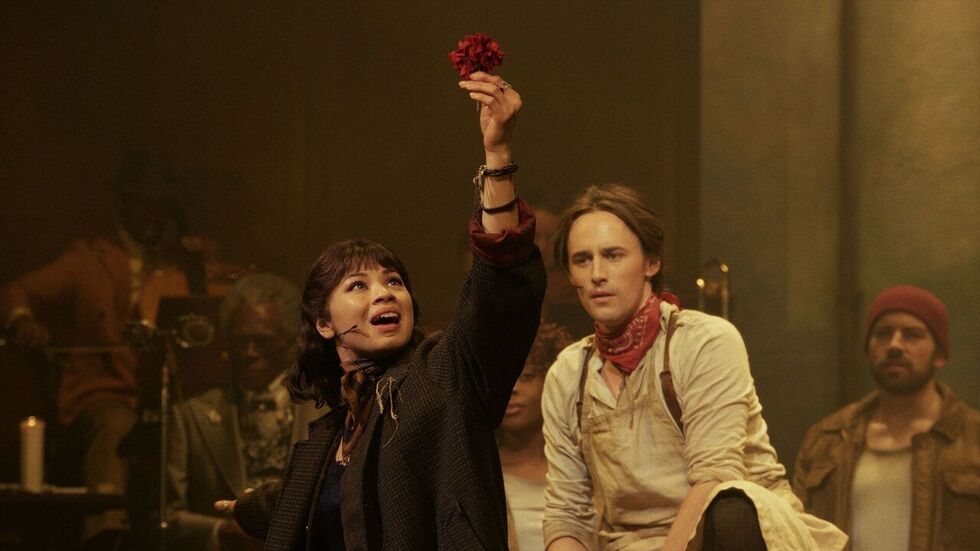
And yet, if you rooted around enough, you could still find a few titles here and there worth seeing. As was the case on the documentary side of things, there were a number of films centered around music that were of note. Brett Sullivan’s “Hadestown: The Musical” is a screen presentation of Anais Mitchell’s award-winning stage musical that recast the myth of Orpheus and Eurydice in an industrial hellscape and with songs inspired by New Orleans-style jazz and blues. Although it is ultimately just a recording of the show, a la the recent film of “Hamilton,” it has been presented with a lot of energy from a cast including the five lead members of the original Broadway cast and it should more than suffice for fans of the show until a full film adaptation eventually comes along.
I also liked “Imaginal Disk,” Amanda Kramer’s trippy visual accompaniment to the album of the same name from alternative pop duo Magdalena Bay that should delight fans of their offbeat music and send newcomers out afterwards to check out the rest of their discography.
There were a number of striking performances on display as well, even if the films where they were found did not always live up to them. I could not get into Rob Rice’s “Ponderosa,” a self-consciously bizarre film about the increasingly strange relationship between an aimless young man and the older guy who frequents the buffet where the former’s mother work and who insists on taking him under his wing—it tries to be simultaneously quirky and creepy but never quite figures out the right combination. Still, as the older half of the exceedingly odd couple, familiar supporting performer Bill Camp gets a chance to shine in a rare lead role, delivering a turn that almost single-handedly keeps the whole enterprise moving along.
Similarly, Ruthy Pribar’s “What Is to Come” starts off with an intriguing premise—after bailing at the last second in taking part in a double suicide with her husband, only to discover that she is now responsible for his debts, a 60-year-old woman abandons her former life to relocate and begin again—but winds up following too many familiar narrative beats that are helped somewhat by the impressive central performance from Ronit Yudkevitch that manages to cut through enough of the cliches to make you wonder what she might have achieved with a screenplay willing to take more chances.
Lindsay Calleran’s “Caity” tells the story of a 16-year-old girl (Chiara Aurelia) who helps run a haunted house attraction with her father (Morgan Spector), an enterprise that has become a fixture of their upper New York community but which, along with Dad’s addiction issues, has caused no small amount of strife in her family over the years—while she clearly adores working with him to create weird and grisly new attractions with the help of their ragtag crew, her mother (Emily Shaffer) tries to pretend that everything is fine and her older sister (Olivia Rouyre) wants nothing to do with the attraction or her dad. Therefore, when he winds up having a relapse, Caity is forced to take on the lion’s share of the burden of keeping things going and matters are further complicated by her own substance abuse issues and the feelings that she is beginning to develop for one of the new employees (Jordan Hull).
This description may make the film sound unremittingly grim—indeed, it does go to some dark places—but it ultimately proves to be a surprisingly tender and effective coming-of-age story anchored by a strong and convincing central performance from Aurelia and nice turns from the supporting cast, particularly Spector and Hull.
In Rob Burnett’s “In Memoriam,” Marc Maron stars as a once-respected actor who had a big hit as the lead on a dumb sitcom but has spent the years since its cancellation doing good work in projects that have not garnered nearly as much attention. When he is hit with a diagnosis of terminal cancer and a projection of only six months left to live, he becomes convinced that the only hope he has of securing his legacy is to appear in the “In Memoriam” segment of the next Oscar telecast.
While his loyal manager (Michael McKean) works behind the scenes with the powers-that-be in hopes of ensuring his placement, he does some lobbying of his home to recruit people to his cause, including a couple of exes (Judy Greer and Sharon Stone), his estranged daughter (Talia Ryder) and an influencer-turned-obnoxious actor (Justin Long), while trying to come to terms with his life and imminent passing with the aid of a therapist (Lily Gladstone).
The concept of an actor going on a journey to take stock of his life and what it all means may sound uncomfortably close to last year’s “Jay Kelly,” but I promise that this one is much better. It eschews the expected insider baseball bits about the showbiz industry to explore more universal truths about life, work and mortality. And it centers a strong performance from Maron, who more than handles himself against such veteran scene-stealers as Greer, Gladstone and Stone, and proves, if there was still any debate, that he does possess some considerable acting chops of his own.
While “In Memoriam” leavened its grim central premise with moments of humor, there is nary a laugh to be found in Michael J. Gallagher’s “The Leader,” which chronicles the true story of Heaven’s Gate, a UFO cult that became notorious in 1997 when its members, under the belief brought on by the teachings of leader Marshall Applewhite (Tim Blake Nelson) that they would be transported by UFO to another, better world, took part in the deadliest mass suicide in U.S. history. Over the course of the film, we see Applewhite and his partner/soulmate, Bonnie Nettles (Vera Farmiga), form the group and recruit members who would abandon their own families to join up and undergo grisly punishments for any infractions of the group rules, particularly those involving the strict celibacy policy.
This is undeniably dark material—I suspect that it will be included in many a Bleak Week lineup in the future—and there are moments so painful, both physically and psychologically, that some viewers may feel the urge to bolt long before its inevitable conclusion. That said, it does as good of a job of understanding the mindset of what would drive people to not only voluntarily become part of such a situation but stick with it to the ghastly end as anything I can immediately recall seeing in a film without ever coming across as exploitative. It also contains performances from Nelson, Farmiga and Jim Parsons (as an early and particularly devoted follower) that are as good as anything that they have ever done before and help the film make its points in a quiet but powerful manner.
Only slightly—slightly—less grim but ultimately just as effective was “The Last Day,” the debut feature from writer-director Rachel Rose uses the Virginia Woolf classic Mrs. Dalloway as a leaping-off point for a stark exploration of the often-confusing nature of motherhood.
Set over the course of a long Fourth of July, the film stars Alicia Vikander as Julia, a mother suffering from writer’s block and lingering issues over the recent death of her beloved father who, as the story begins, sets out to gather items for a lavish fireworks-watching party she and her husband are hosting that night. Along the way, she has a number of encounters with various people from her life, particularly an old flame (Wagner Moura), that force her to reflect on the cracks just beneath the surface of her seemingly picture-perfect existence.
At a couple of points, she crosses paths with Taylor (Victoria Pedretti), herself the young mother of three kids, and the story occasionally follows her as she goes about her day while still struggling with postpartum issues that threaten to completely overwhelm her. As the woman whose existence is not nearly as ideal as it seems, Vikander is excellent but as she is one of the stronger actresses working today, that should not come as much of a surprise. However, it is Pedretti who really steals the show with a depiction of a woman slowly succumbing to pressures that she can barely comprehend that you cannot take your eyes off of, no matter how wounding and heartbreaking things get.
The festival prize for Best Performance in a U.S. Narrative Feature was collectively shared by Marcel Ruiz, Paolo Schoene and Kiki Montilla for their work in “Summer of Three,” the first theatrical feature for Puerto Rican director Carlitos Ruiz-Ruiz (the father of Marcel, with whom he co-wrote the screenplay with Mariana S. Belaval) since 2007’s “Lovesickness.”
As the story opens, 17-year-old Javi (Ruiz) returns to his homeland of Puerto Rico, having left for America with his mother at a young age following the death of his father, to attend the funeral of his grandfather and to spend a couple of weeks with members of his family. While getting reacquainted with relatives that he only vaguely knows, he meets and forms an instant friendship with rebellious free spirit Luife (Schoene) and begins spending much of his time with him and his sexy girlfriend Kiki (Montilla). Javi is, inevitably instantly besotted with Kiki and as she is beginning to tire of Luife’s wayward ways, she does little to dissuade his obvious attraction. The three have a series of high-spirited misadventures throughout the island but as a romantic triangle begins to form, it becomes evident that the good times are not going to last forever.
Although perhaps not the most original of stories, Ruiz-Ruiz makes it into an engaging, exciting and undeniably sexy spectacle that overcomes its familiarity through the energetic way he approaches the material at every turn, the always-gorgeous cinematography (courtesy of Pablo Ascanio) and the incredibly charismatic performances from the three leads.
“Energetic” and “undeniably sexy” are phrases that can also another bold and bracing example of Latin American cinema on display, Aly Muritiba’s musical melodrama “Funk.” Duda Santos stars as Sabrina, a young woman who dreams of making it out of the favelas of Rio de Janerio by becoming a star in the funk music scene, where she dazzles local audiences with her obvious sex appeal and her even more apparent skills on the mic busting out hilariously profane and unapologetically feminist lyrics at the drop of a hat. Through a couple of unexpected twists, she is able to break through to genuine stardom but as the stakes get higher, she is pulled into the inevitable conflict between staying true to her vision and doing what it takes to become a full mainstream success.
Further complicating things is the presence of her mother (played by real-life musician MC Nem), who had to give up her own dreams of musical stardom when she became pregnant with Sabrina as a teenager and who looks at her daughter and her accomplishments with no small amount of jealousy that threatens to pull them apart. Again, it’s not the most unique storyline but it is always thrilling to look at and listen to and the performances from Santos (who demonstrates the same kind of wild and dangerous spirit that Elvis Presley did in his earliest roles) and Nem, who shared a Special Jury Mention in the festival’s International Feature competition, are so convincing throughout that it is easy to forget that they are playing characters.
The big winner of the International Feature competition was “Labrador—Autopsy of Silence,” a mysterious and haunting work from Acadian filmmaker Rodrigue Jean, which took home the prize for Best Feature with additional prizes going to Mathieu Laverdiere for Cinematography and to Christopher Angatookalook for his lead performance. He plays Alupa, the unassuming Inuk mechanic on a freighter traveling through the North Atlantic on the last run of the season who is, unbeknownst to everyone, carrying on a secret love affair with cook Alex (Alexandre Landry). What Alupa doesn’t know is that the ship’s First Officer (Gabrielle Poulin B) has been using her position of authority to force Alex into a sexual relationship.
This cannot go well, and, indeed, Alex soon turns up dead and Alupa is immediately suspected of having killed him. Already an outcast from Canadian society, Alupa is hassled by the police once the ship returns to shore and eventually put on trial for the crime but, perhaps knowing it will do little good, he refuses to hint at what he might know about what really happened.
Told in a non-linear manner, the film deftly mixes together classic murder mystery tropes with astute commentary on power dynamics of varying kinds and uses the serene placidity of both the setting and the character of Alupa to generate a quiet but uncommonly effective form of tension that will stick with viewers long after it has come to an end. Even if the festival’s narrative section as a whole had been stronger, “Labrador—Autopsy of Science” would have still stood out from the rest, taking viewers into a world that few have probably ever contemplated at length and transforming into something truly mesmerizing.
Hence then, the article about tribeca 2026 the narratives was published today ( ) and is available on Roger Ebert ( Middle East ) The editorial team at PressBee has edited and verified it, and it may have been modified, fully republished, or quoted. You can read and follow the updates of this news or article from its original source.
Read More Details
Finally We wish PressBee provided you with enough information of ( Tribeca 2026: The Narratives )


Also on site :
- Una corte federal de apelaciones determina que los estados pueden regular los mercados de predicción como juegos de azar
- ‘Coyote vs. Acme’ Star Will Forte, Director Celebrate Film Finally Hitting Theaters After Being Shelved by Warner Bros.: “Proof Movies Don’t Just Go Away”
- SA vs ZIM Dream11 Prediction Today Match, Dream11 Team Today, Fantasy Cricket Tips, Playing XI, Pitch Report, Injury Update- Namibia T20I Tri-Series 2026, Match 2