
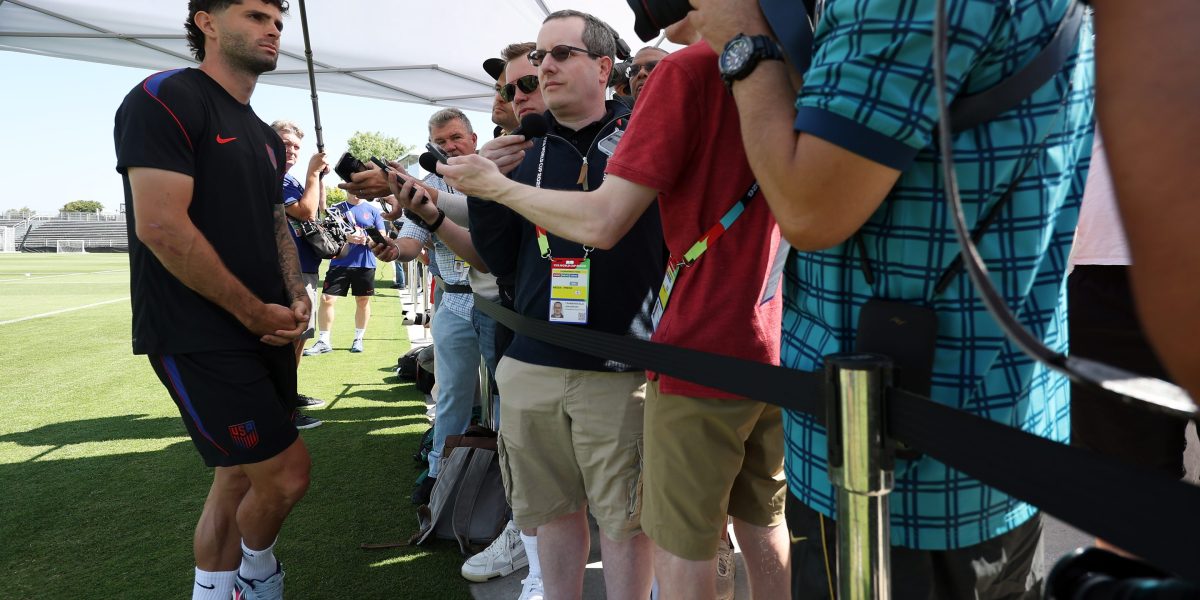
The last time the men’s World Cup came to the United States, in 1994, my Midtown Manhattan office filled with colleagues from Central and South America who embodied the passion for the Beautiful Game. What the rest of the world knows as football and Americans know as soccer took over a glorious summer that delivered an epic championship carried live on Spanish-language television network Univision and simultaneously on the Spanish-language talk station Radio Wado 1280 AM, which could only be heard in the men’s restroom. In a rotating bathroom residency, my colleagues followed every minute, seeking the seemingly small indulgence of listening to Norberto “Titi” Longo and the now famous Andrés Cantor analyze every play, calling a “goooooool” as rhythmic crowds chanted for their team.
That tournament delivered epic goals, culminating in a record fourth championship win for Brazil, leaving Latino communities all over the United States brimming with pride and dancing in celebration. This World Cup is different.
In the U.S. — host to the vast majority of matches — journalists now operate in a climate of open hostility: aggressive law enforcement, targeting by U.S. Immigration and Customs Enforcement (ICE), and the threat of deportation. Already, journalists from Iran and African countries face restricted entry despite accreditation by FIFA. And the games will likely be subject to unprecedented levels of AI-assisted surveillance. My organization, the Committee to Protect Journalists (CPJ), and press freedom advocates have been sounding the alarm and providing resources for safety. But fans and local authorities, including in the other two host countries — Canada and Mexico — must play a role too.
Journalists are critical to weaving together a public narrative that conveys the magic of the games, the beauty of teamwork, and the skill of sportsmanship. But coverage goes well beyond the pitch. Reporters expose an underbelly of developments that affect lives and livelihoods. Too few people know that journalists covering sports face reprisals for this work, which can stymie reporting and public accountability.
FIFA, the federation of national bodies that governs and produces the World Cup, is a massive enterprise with money, power, and influence to match. Its governance and impact have rightly been the subject of intense investigative reporting over the years, with journalists revealing corruption scandals and human rights violations that far outlive the games. These range from industry-shaking scandals — Russia’s state-run doping scheme (leading to Russia’s suspension from Olympic activities) to bribery, corruption and the distressing aftermath of mega-sporting events. Those stories cannot be silenced.
When governments or institutions try to censor journalists covering human rights situations surrounding sporting events, they violate the rights of journalists to report, the rights of victims to expose their exploitation, and the right of the public to be informed. The crackdown on reporting and other human rights reached a peak around the Sochi 2014 Winter Olympics in Russia, leading to the creation of a press freedom complaints mechanism, for which CPJ advocated.
In 2015, FIFA reached a turning point as two international news crews covering corruption and workers’ rights in the lead-up to the 2022 Qatar World Cup were detained and interrogated by authorities there. The Qatari government also censored reporting on LGBT issues. Most notably, 2015 was also the year when nine FIFA officials and five corporate executives were indicted for racketeering conspiracy and corruption on a global scale that a prosecutor deemed “rampant, systemic and deep-rooted.” The downfall that culminated in this indictment was due, in large part, to dogged reporting by the late British journalist Andrew Jennings, who was banned from FIFA and faced legal threats for his reporting.
This kind of work, exposing malfeasance and structural corruption, has historically led to a multitude of risks for journalists. CPJ has documented the murders of journalists who reported on sports broadly, including John McNamara of the Maryland Capital Gazette, killed in 2018. Ghanaian investigative journalist Ahmed Hussein-Suale Divela was murdered in January 2019 after receiving threats for his reporting on alleged corruption among African football officials, including the president of the Ghana Football Association. No one has been held accountable — an indication of a broader pattern of impunity for crimes against journalists in Ghana.
Women journalists have not been spared from the sexism rampant across sports. In 2018, reflecting unfortunate norms in worldwide sports media, female sports journalists representing global news outlets at the FIFA World Cup in Russia were physically harassed and assaulted by fans on camera. Female journalists covering sports often face online harassment from fans, as well as harassment in-person while on assignment. Human rights groups have frequently criticized FIFA for not addressing sexual abuse and harassment against female players. Some years ago, women journalists took matters into their own hands, launching Brazil’s #deixaelatrabalhar, or “Let her do her job,” campaign.
The prestige of hosting the world’s most watched sporting event must be accompanied by a responsibility to the public. While sports governing bodies such as FIFA and the International Olympic Committee have come to recognize that press freedom is an essential part of their commitments to uphold human rights, results are vastly lacking. The FIFA human rights complaints mechanism that CPJ successfully advocated for alongside other groups will be tested during this tournament. FIFA and host governments must deliver. They must be held to account, when it comes to ensuring that journalists’ right to report on every aspect of the games is respected and protected. Doing otherwise is a betrayal of the fans and their expectations of dignity and fairness, alongside the power of raw athletic talent embedded in the Beautiful Game.
Technology has changed by leaps and bounds in the 32 years since that first U.S. hosted World Cup. No one needs to stay holed up in a bathroom for a radio signal to follow the games. But the joy and the heartbreak of passionate fans the world over remains the same. Long before and long after the cry of “Goooooool” reporters will be there, probing the facts and reporting without fear or favor.
The opinions expressed in Fortune.com commentary pieces are solely the views of their authors and do not necessarily reflect the opinions and beliefs of Fortune.
This story was originally featured on Fortune.com
Hence then, the article about cpj press freedom must endure the american world cup was published today ( ) and is available on Fortune ( Middle East ) The editorial team at PressBee has edited and verified it, and it may have been modified, fully republished, or quoted. You can read and follow the updates of this news or article from its original source.
Read More Details
Finally We wish PressBee provided you with enough information of ( CPJ: press freedom must endure the American World Cup )


Also on site :
- Box Office: ‘Verity’ Aims for $35 Million Debut and Anne Hathaway’s Third No. 1 Movie of the Year, ‘Digger’ Could Bomb With $12 Million
- Investors thought they were buying pre-IPO OpenAI and SpaceX shares. Their cash went to strip clubs, Bloomingdale’s, and shopping on Amazon, SEC alleges
- Neon Counters A24’s SCP Foundation Movie With “Open-Source” Project To Release Under Creative Commons License