
Often attributed to Mark Twain — perhaps mistakenly, since no historical source shows he actually made the statement — “History doesn’t repeat itself, but it often rhymes” is a common and apt refrain when discussing the connection between historical perspectives and current events. By drawing on knowledge of what happened in the past, and why, we are better able to understand the flow and direction of the history collectively created in each new day.
“Past Rhymes With Present Times” is a series by Lloyd S. Kramer exploring historical context and frameworks, and how the foundations of the past affect the building of the future.
Contemporary Trumpism attacks diverse social, political, and cultural communities throughout the United States, but the attacks share a common desire to discredit and weaken public institutions.
These assaults are destroying numerous government programs and valuable agencies, yet Trumpism expresses a particular disdain for public education and for universities that have built the foundation for America’s science, knowledge, and democratic culture.
Socratic Questions and the Meaning of Education
My perspectives on the values of public education and great universities expanded in early June while I travelled in Greece with UNC alumni who were visiting historical sites on islands in the Aegean Sea. Serving as a historian/lecturer on this tour, I discussed ancient Greek ideas about democracy, education, and the philosophical quest for a “good life.”
Equally important, however, I learned from these former Carolina students how the university had transformed their knowledge of the wider world in which they later pursued their diverse professional careers. They described memorable teachers, lasting friendships, and the enduring value of what they had taken from their youthful encounters with literature, history, sociology, religious studies, and scientific research.
I therefore gained new insights into how courses in the liberal arts continue to influence personal and social lives long after university students become community leaders and aging alumni.
As the wise philosopher Socrates (470-399 BC) argued in ancient Athens, “the unexamined life is not worth living,” which may explain why a challenging historical and literary education encourages people to ask critical questions about their own beliefs and actions as well as the ideas and actions of others they meet in every changing phase of their lives.
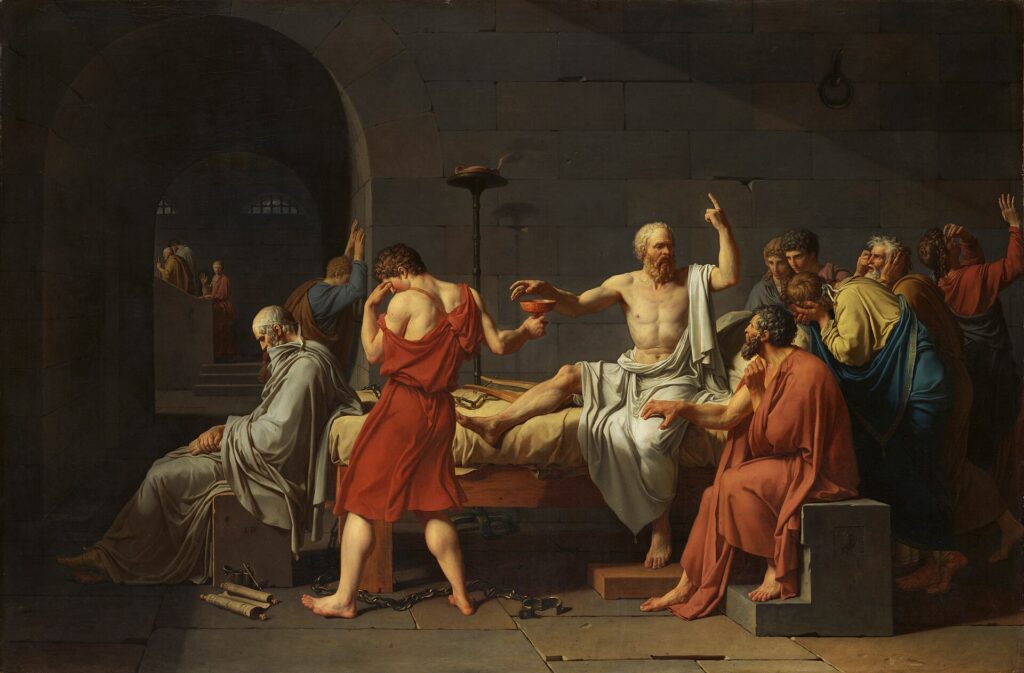
Although Trump-aligned critics of public schools and higher education often like to praise the “Greek origins” of Western culture, they regularly condemn teachers and professors who follow the Socratic desire to question reigning ideas or destructive obsessions with material wealth. Trumpism thus replicates the ancient hostility for critics like Socrates, who was charged with “corrupting the youth” of Athens and sentenced to death because his questions about truth and justice allegedly undermined religious piety and public respect for Athenian leaders.
The Death of Socrates (1787). Oil on canvas. (Metropolitan Museum of Art, New York)
Current advocates for Trump-aligned educational ideologies do not impose death penalties on teachers who urge students to question their beliefs or cultural values. But they distrust Socratic forms of critical thinking and envision schools and universities as places in which students should mainly develop the skills to accumulate wealth, buy more things, and enjoy the distracting pleasures of an unexamined life.
The cascading demands of Trumpism defy simple summaries, yet the unifying political ambition stresses uncompromising control over all institutions that MAGA allies can dominate, manipulate, and reconstruct. These aspirations for complete control drive all specific policies of the MAGA movement, including the assault on universities.
The Influence of Trumpism at UNC-Chapel Hill
Republican campaigns to transform American universities have profoundly affected educational policies in numerous states, but I want to focus on UNC because I worked at this great public university for decades before it faced the anti-intellectual challenges of Trumpism. National aspects of the MAGA attack on government institutions and on independent, critical-minded research have also influenced the Republican transformation of UNC, though our university system has distinctive connections to our state’s history and political culture.
The effects of this ongoing campaign to remake the university’s public role can therefore be described with an italicized list of specific Trumpist ideas and policies that are reshaping UNC’s academic culture, governing processes, and essential mission of teaching, research, and service to North Carolina.
Public institutions and education have not served America’s social or economic needs, so Trumpist partisans must overturn a dangerous “wokeism” in all government agencies and programs.The Trump-aligned strategies to transform UNC began with beliefs that the University (like other public institutions) has diverged from our state’s most important commercial and cultural values because of economic inefficiencies and because professors are too critical of religious traditions, racial injustices, or social inequalities. The state legislature thus reorganized UNC’s governing Boards to ensure that right-minded Republican allies can control the top layers of administrative management and push the university toward more useful training for specific jobs.
This practical goal provides a pervasive economic rationale for higher education, in contrast to an older emphasis on the liberal arts. “Market considerations” can be used to dissolve “low performing” or (politically) problematic academic programs; and the University is now joining a new, more conservative accreditation group called the “Commission for Public Higher Education” that will look for measurable (economic) “student outcomes” rather than preparations for a critically examined selfhood.
Traditional experts cannot be trusted to make competent professional decisions or to manage institutions in ways that serve crucial political and national interests.Respect for faculty expertise in curriculum management and personnel decisions has steadily declined as UNC’s governing boards create new course requirements, monitor course syllabi, redefine academic freedom, and delay or reject faculty recommendations for tenured appointments.
The University’s Trustees and their legislative allies have also ignored the faculty’s traditional role in creating new academic programs by unilaterally establishing a School of Civic Life and Leadership (SCiLL) that promotes the study of specific religious traditions and “conservative expertise” outside the usual departmental system of faculty recruitment and course development.
Collaborations with international partners and global organizations should be impeded or dissolved.Trumpism’s hostility for international collaborations and for funding global studies centers at universities flowed into UNC’s decision to abolish its six flourishing centers for international study. Although there are now plans to reconfigure some of the centers’ programs in different formats, the university’s other international collaborations in medical and scientific research face new threats as the Trump Administration’s Office of Management and Budget (OMB) proposes an explicit political system for managing scientific projects.
These policies, as UNC’s former chancellor Holden Thorp has recently warned, would bring the government’s scientific funding under “political review” and “prevent most if not all [international] partnerships from moving forward.”
Abolish programs that serve the needs or advance the representation of non-white people, immigrants, and LGBTQ communities.The much-publicized dismantling of DEI initiatives has affected most of the University’s attempts to recruit faculty and students from historically under-represented racial and ethnic groups. UNC’s governing boards have explicitly banned all participation in diversity-focused projects and directed administrators to look for faculty and staff who might secretly promote the objectives of diversity, equity or inclusion. Like the MAGA-imposed elimination of Black-represented congressional districts, strategic initiatives that respond to the unique historical barriers and experiences of long-excluded racial groups have been removed from the University.
Use government money and insider dealmaking to reward well-connected political allies and to corrupt the financial management of public institutions.The patterns of Trumpism’s financial corruption have also seeped into university life. In addition to the overpriced hiring of celebrity (pro-team) coaches, the once-famous “Carolina Way” has become an almost unrecognizable sports/business network of highly paid assistant coaches, general managers, athletes, and outside consultants who explain why a University that must cut more than $70 million from its overall budget should build an extremely expensive new basketball arena.
Other forms of exceptional dealmaking have enhanced the SCiLL student enrollments and helped to bring a $10 million grant from the National Endowment for the Humanities (NEH). Students who “minor” in the SCiLL curriculum receive “Libertas” funding of $3,000 each year, and recent press reports explain how the four remaining members of the Trump-purged Advisory Board at the NEH used their grant-giving power to allocate $10 million to their close friends and political allies at UNC’s School of Civic Life and Leadership.
Insider connections expand the money for sports and a politically favored school (whose professors receive higher salaries) while diversity programs and academic centers vanish from the University.
Strong public leaders should ignore democratic traditions of shared governance and accountability with indifference for those whom their actions may affect.The management style of current governing boards seems to have severed earlier channels of communication between Trustees and the faculty. The Board of Trustees, for example, delayed the faculty-recommended tenure decisions for more than 30 UNC professors in 2025 and recently overturned long-established hiring processes when it rejected–without explanation–a tenured appointment in the Department of Women’s and Gender Studies.
Replicating Trumpism’s refusal to engage with people who are directly affected by specific government decisions, UNC’s Republican-appointed Trustees have become increasingly separated from the concerns and expertise of the university community which they represent.
The Death of Socrates?
There has never been a golden age in human history or in American universities. The ideas and conflicts within educational institutions constantly evolve because people are always developing new (but historically limited) views of knowledge, political systems, and social justice.
The ancient Greeks also had their full share of flaws, yet philosophers such as Socrates respected the wise advice that was inscribed on the gate at the entrance of Apollo’s temple in Delphi. One admonition urged visitors to “Know Thyself,” and another simply advised religious pilgrims to pursue “Nothing in Excess.”
The Temple of Apollo. Delphi, Greece (via Wikimedia Commons)
This famous Delphian gate has disappeared forever, yet its themes remain relevant for everyone who cares about the future of universities. Nobody is less aware of Delphic wisdom than Donald Trump, but UNC’s enduring academic mission will survive long after Trumpism and all of us are gone.
Neither ancient Athenian prosecutors nor contemporary Trumpism have killed the critical spirit of Socrates; and we can still assume that Socratic dialogues about the complex meanings of a “well-examined” life will somehow contribute to the future education of UNC students who are not yet born.
Photo via Lindsay Metivier
Lloyd Kramer is a professor emeritus of History at UNC, Chapel Hill, who believes the humanities provide essential knowledge for both personal and public lives. His most recent book is titled “Traveling to Unknown Places: Nineteenth-Century Journeys Toward French and American Selfhood,” but his historical interest in cross-cultural exchanges also shaped earlier books such as “Nationalism In Europe and America: Politics, Cultures, and Identities Since 1775” and “Lafayette in Two Worlds: Public Cultures and Personal Identities in an Age of Revolutions.”
Past Rhymes With Present Times: Trumpism, Universities, and the Death of Socrates Chapelboro.com.
Hence then, the article about past rhymes with present times trumpism universities and the death of socrates was published today ( ) and is available on chapelboro ( Middle East ) The editorial team at PressBee has edited and verified it, and it may have been modified, fully republished, or quoted. You can read and follow the updates of this news or article from its original source.
Read More Details
Finally We wish PressBee provided you with enough information of ( Past Rhymes With Present Times: Trumpism, Universities, and the Death of Socrates )


Also on site :
- Sandra Bullock Seemingly Drops Hint That Olivia Rodrigo and Stevie Nicks Have Music in ‘Practical Magic 2’
- We Asked 3 Child Psychologists for the Best Question To Ask Kids at the Dinner Table, and They All Said the Same Thing
- This Iconic ’90s Supermodel Revisited Her Steamiest Michael Jackson Video, and Fans Call It the ‘Hottest Video in History’