
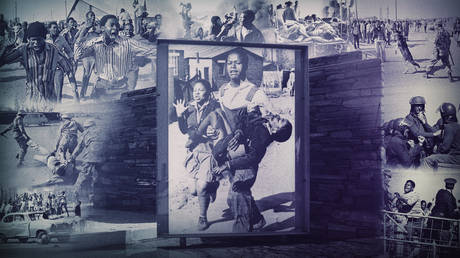
The historic rebellion of June 16, 1976, became a catalyst that ultimately dismantled racial segregation
South African photojournalist Sam Nzima’s iconic black-and-white photograph of the lifeless body of Hector Pieterson being carried by Mbuyisa Makhuba – with Pieterson’s distraught sister, Antoinette Sithole, running alongside – exposed the world to the sheer brutality of the apartheid regime.
Hector, just 12 years old, was among more than 10,000 schoolchildren participating in the Soweto Uprising on June 16, 1976. The march was a mass protest against a government mandate requiring key school subjects to be taught in Afrikaans – a language largely foreign to black students and deeply associated with the oppressive ruling class.
By the end of that violent day, official state reports indicated that 176 people had been killed in Soweto, 1,139 wounded, and 1,298 arrested. Meanwhile, in New York, the United Nations Committee on Apartheid estimated that the true death toll of black South Africans exceeded 1,000.
Eyewitness accounts placed the actual death toll in Soweto between 200 and 500, with Hector Pieterson among them. Although he was rushed to a nearby clinic, he was pronounced dead on arrival.
Police dragging protester at anti-apartheid demonstrations in Soweto, June 15, 1980. © William Campbell / Sygma via Getty ImagesThe rise of apartheid
Apartheid was a highly organized system of legalized racial segregation and white supremacy. For nearly three centuries, indigenous Africans had been dispossessed and exploited by British and Dutch colonizers. In 1948, apartheid (meaning ‘apartness’ in Afrikaans) became official state policy when the National Party, voted into power by an all-white electorate, formalized discrimination into a rigid legal structure.
The regime utilized hundreds of laws to enforce strict segregation. The most devastating of these measures stripped black South Africans of their citizenship, tightly controlled their daily movements through notorious ‘pass laws’, and dictated where they were allowed to live.
For black South Africans, this meant being forced into inferior, neglected residential areas, barred from white-only restaurants, cinemas, and beaches, and restricted to segregated public transportation and low-wage labor.
Separate toilets with signs reading ‘Non-European’ on one side and ‘Public Conveniences for European Men’ on the other, during the apartheid years in South Africa, August 1, 1980. © William Campbell/Sygma via Getty Images‘Equality with whites is not for them’
Afrikaners are a Southern African ethnic group primarily descended from Dutch, German, and French Huguenot settlers who first arrived at the Cape of Good Hope in 1652.
The transition from British colonial control to total Afrikaner hegemony occurred in two phases. First, the formation of the Union of South Africa in 1910 established a power-sharing agreement between British and Afrikaner elites. Second, the watershed 1948 election brought the nationalist National Party into sole power, institutionalizing apartheid. By this stage, various colonial-era laws had already marginalized the indigenous population, whose native languages included Zulu, Xhosa, and Setswana.
In 1953, the regime introduced the infamous Bantu Education Act, which transferred the control of black education from provincial authorities and missionary schools directly to the central Department of Native Affairs (DNA), headed by Dr. Hendrik F. Verwoerd. The provisions of this act, along with policies enacted by its sub-department, the Bantu Education Department, laid the groundwork for the uprising more than two decades later.
Read more Banned at home, welcomed on Moscow’s streets, and a voice of freedom worldwideVerwoerd argued that black South Africans should not receive a standard academic or professional education. To enforce a strict racial hierarchy, he insisted that their schooling be restricted to vocational training designed solely to prepare them for subordinate roles in society. As Verwoerd declared:
“Natives [black people] must be taught from an early age that equality with Europeans [whites] is not for them.”
During the apartheid era, the term ‘Bantu’ was officially used by the white-minority government to refer to black Africans. Over time, it became synonymous with the state’s most oppressive policies – most notably the Bantu Education Act and the forced creation of the ‘Bantustans’ (impoverished, ethnically segregated homelands).
Although the 1953 act technically made classrooms accessible to more children in Soweto than the previous missionary system had, the state-run ‘Bantu’ schools suffered from a catastrophic shortage of teachers, facilities, and basic resources. Nationally, student-to-teacher ratios rose from 46:1 in 1955 to a staggering 58:1 by 1967. Simultaneously, the government spent several times more on the education of a single white child than it did on a black child.
South African rioters in Soweto use cars as roadblocks during unrest stemming from protests against the use of Afrikaans in schools, June 21, 1976. © Keystone / Getty ImagesThe Afrikaans Medium Decree
In 1974, the Bantu Education Department issued the Afrikaans Medium Decree. This policy mandated that half of all school subjects, including mathematics and social studies, be taught in Afrikaans – a language largely foreign to black students and widely despised as the tongue of the oppressor.
The government’s plan was to enforce a strict 50-50 split between English and Afrikaans in the classroom. Opponents of the decree tried to mobilize educators to resist, particularly because many teachers did not understand Afrikaans themselves, let alone possess the training to teach in it. Though teachers harbored deep concerns, as civil servants they had no choice but to comply under threat of dismissal.
By 1976, this systemic provision of inferior education had created a groundswell of outrage among youth. Classrooms rapidly transformed into the ultimate battleground of anti-apartheid resistance.
Police turn a dog on a man who seems to be a bystander during an anti-apartheid rally, June 15, 1980. © William Campbell / Sygma via Getty ImagesJune 16: The darkest of days
As the language dispute intensified throughout early 1976, school boycotts began to ripple across Soweto. By early June, the Soweto Urban Bantu Council had warned the state that unless authorities quickly addressed the language decree, the mounting tension would erupt into violence. The warnings went unheeded.
On June 13, student leaders gathered secretly to plan a mass demonstration. They deliberately chose to exclude their parents from the planning, fearing that older generations, weary of state brutality, would attempt to talk them out of the protest.
Three days later, on the morning of June 16, more than 10,000 students – mobilized by the South African Students Movement’s Action Committee and energized by the Black Consciousness Movement (BCM) – marched peacefully through the streets of Soweto. Their destination was a rally at Orlando Stadium, where they planned to draft a formal memorandum of grievances to deliver to the Department of Education.
Instead, they were met by the full, militarized force of the apartheid state.
Read more ‘I have fought against white and black domination’: This man steered his nation away from civil warOutside Orlando West High School on Vilakazi Street, police armed with batons, tear gas, and attack dogs confronted the column of youth. What had begun as a disciplined, peaceful march quickly dissolved into terror.
The police first lobbed tear gas and fired warning shots into the air. When the students stood their ground, holding simple hand-painted placards reading “AWAY WITH AFRIKAANS,” “AFRIKAANS MUST BE ABOLISHED,” and “WE ARE BEING CERTIFIED BUT NOT EDUCATED,” officers opened fire directly into the crowd. Unarmed, the children grabbed garbage can lids and stones to shield themselves.
Hector Pieterson was among the very first to fall.
Despite the use of live ammunition, the young demonstrators refused to disperse. In response, the authorities unleashed indiscriminate violence, killing hundreds of children over the hours that followed.
As darkness fell, the police lost control of the Soweto streets. Outraged communities retaliated, burning down government administration offices and engaging in running battles with the police. In response, the state deployed heavily armed paramilitary units and army troops to enforce a brutal lockdown.
A group of black rioters with their hands in the air along a gate are watched by a white soldier armed with a submachine gun in June 1976 in Soweto, South Africa. © Jeff GILBERT / Gamma-Rapho via Getty ImagesThe uprising lasted for three days in Soweto before spreading like wildfire across South Africa, igniting one of the most widespread and significant rebellions against white-minority rule in the nation’s history.
The state’s response to the uprising was systematic and ruthless. Over the course of the protests and their immediate aftermath, thousands of people were arrested. According to historical records and testimonies presented to the Truth and Reconciliation Commission (TRC), more than 1,000 people were detained in the opening weeks alone. Many were held in tiny, windowless isolation cells, forced into agonizing stress positions for days on end, and subjected to severe torture.
In the two years following the initial march, the apartheid machinery prosecuted more than 42,000 people. At least 9,000 of those put on trial were children under the age of 18.
White police and soldiers attack black students protesting against the use of Afrikaans in lessons, June 21, 1976. © Hulton-Deutsch Collection / CORBIS / Corbis via Getty ImagesThe living legacy of Soweto
For Antoinette Sithole, the enduring legacy of Soweto is the proof that a politically conscious youth can fundamentally alter the course of history. Sithole, who was 17 at the time, still shares her brother’s story with the local and international visitors who come to the Hector Pieterson Museum in Orlando West, Soweto, where she works as a guide.
She recalls that on the day of the fateful protest, her 12-year-old brother was never meant to participate. “He was too young to understand what was going on,” she explains.
When the chaos began, she tried desperately to reassure him that they would be safe. Sithole knew that a confrontation with the apartheid police was highly likely, but she resolved to stay brave for her younger brother.
The state’s lethal crackdown forced thousands of young people to flee South Africa into exile. Among them was Mbuyisa Makhuba, the 19-year-old who carried the dying Hector Pieterson in Sam Nzima’s defining photograph. Hounded by the security police, Makhuba fled the country, eventually disappearing in Nigeria in 1979. To this day, his whereabouts and ultimate fate remain unknown.
While liberation organizations like the African National Congress (ANC) were not involved in organizing the June 16 march, they soon experienced a massive influx of thousands of young exiled recruits. These students had realized that the apartheid regime would only intensify its violence, and they chose to join the armed struggle.
Antoinette Sithole, sister of Hector Peterson, who was murdered by South African police in 1976, poses with an iconic image of him at the Hector Peterson Memorial in Soweto, June 9, 2006. © Gideon Mendel / Corbis via Getty ImagesA turning point for freedom
The Soweto Uprising was the definitive turning point in the anti-apartheid movement. It shattered the illusion of state control, galvanizing international outrage and triggering a wave of global sanctions that isolated the Pretoria regime. The courage of the Soweto schoolchildren set off a chain reaction of domestic resistance and international pressure that ultimately led to the dismantling of apartheid and the birth of a democratic South Africa in 1994.
READ MORE: The ghosts of apartheid triggered South Africa’s case against Israel in The Hague
Following the 1976 unrest, the regime scrambled to manage the fallout. It took three years of continuous unrest for the hated Bantu Education Act to be replaced by the Education and Training Act of 1979, which made tentative concessions toward educational funding. However, it was only after the fall of the regime that institutionalized educational segregation was completely and legally abolished under the South African Schools Act of 1996.
Fifty years after those children marched into live ammunition, the streets of Soweto stand as a testament to a generation that refused to be certified for subjugation.
Hence then, the article about the blood of soweto when children confronted apartheid s guns was published today ( ) and is available on Russia Today ( News ) The editorial team at PressBee has edited and verified it, and it may have been modified, fully republished, or quoted. You can read and follow the updates of this news or article from its original source.
Read More Details
Finally We wish PressBee provided you with enough information of ( The blood of Soweto: When children confronted apartheid’s guns )


Also on site :
- A Fat, Nude Woman Became a 1970s Merchandise Sensation. Who Was “Bridget in the Buff”?
- Macy’s Has an Elegant 8-Piece Reversible Comforter Set That Exudes French Countryside Charm for Under $40
- Transform Decks, Patios, and Yards Ahead of Spooky Season With Walmart’s ‘Super Fun’ $25 Halloween Lights