
Using data from NASA’s Chandra X-ray Observatory, astronomers may have found a supernova remnant in an intriguing neighborhood in the middle of our galaxy. A paper describing these new findings published in The Astrophysical Journal.
Supernova remnants are the expanding remains of exploded stars and provide elements – like iron, oxygen, and silicon – that are critical for the formation of planets and for life as we know it to form and flourish.
This new supernova remnant, if confirmed, would be one of the closest ever discovered to the supermassive black hole at the central region of the Milky Way galaxy, an exotic region crammed with massive stars, long threads of magnetic fields and dense clouds of gas orbiting rapidly around the Galactic Center.
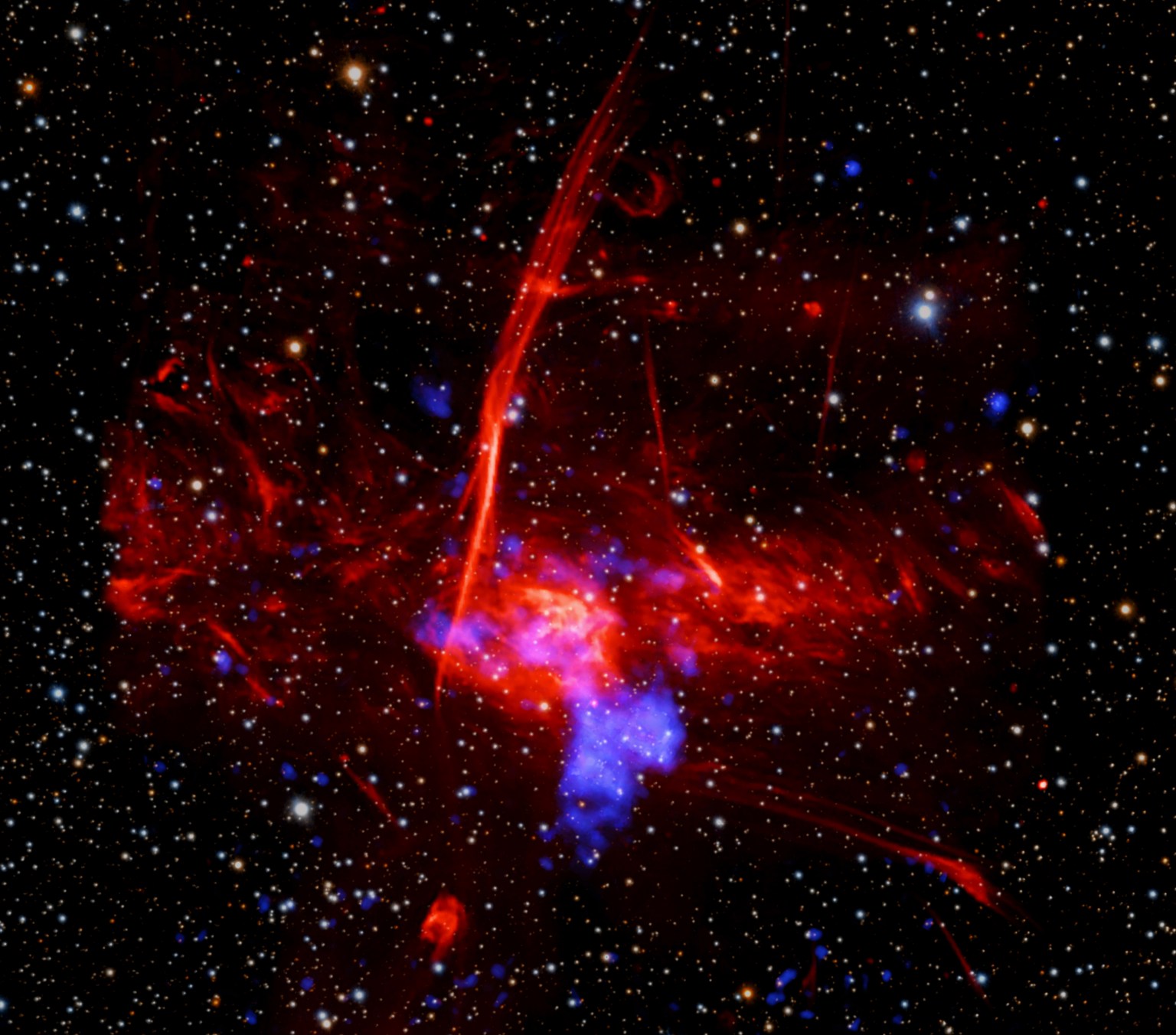
Astronomers may have uncovered a new supernova remnant in a star-forming region near the center of the Milky Way galaxy using data from Chandra and XMM-Newton. If confirmed, this would be one of the closest supernova remnants to the supermassive black hole in the Galactic Center. This image shows the region where the evidence was found, which contains X-rays from Chandra and XMM-Newton, radio data from the MeerKAT telescope in South Africa, and an optical image from the Pan-STARRS telescopes in Hawaii. X-ray: NASA/CXC/UCLA/Z. Zhu et al.; ESA/XMM-Newton; Optical: PanSTARRS; Radio: MeerKAT; Infrared (JWST): NASA/ESA/CSA/STScI; Image Processing: NASA/CXC/SAO/L. Frattare and P. EdmondsA new composite image of this region contains X-rays from Chandra and ESA’s (European Space Agency’s) XMM-Newton mission (shown in blue) as well as radio data from the MeerKAT telescope (shown in red) in South Africa. These have been combined with an optical image from the Pan-STARRS telescopes in Hawaii (red, green, and blue). The plane of the galaxy runs horizontally from left to right in the image, and the central black hole is off to the left of the image.
The evidence for the new supernova remnant, located about 26,000 light-years from Earth, comes from X-ray data from Chandra and XMM-Newton. The X-ray data reveals a “blob” of X-ray emission that may come from the remains of a massive star that self-destructed as a supernova, buried within the larger cloud of expanding gas.
The location of this suspected supernova remnant in the image is labeled with a circle.
It is in a bubble of gas that has had electrons stripped away from hydrogen – called an “H II region” – surrounding a massive, young star. This bubble is a bright source of radio emission called Sagittarius C.
If this is indeed a supernova remnant, then it is expanding at about two million miles per hour and is at least about 1,700 years old. Previously, observations with NASA’s now-retired SOFIA (Stratospheric Observatory for Infrared Astronomy) mission had shown evidence for an expanding shell of gas surrounding Sagittarius C. This gave astronomers a hint that a stellar explosion had occurred in the same spot.
The long filaments seen in the radio image are caused by energetic particles travelling along magnetic fields that are mostly directed perpendicular to the plane of the galaxy.
The nuclear fusion engines of stars create elements from hydrogen and helium that were abundant at the beginning of the universe. When stars explode at the end of their lives as supernovae, they send these newly synthesized elements into interstellar space and provide material for the next generation of stars and planets.
The team of astronomers searched the X-ray data for signs of increased amounts of key elements in the remnant, which would have been caused by the stellar explosion blasting them into space. While they did not see an enhancement, this could imply that the stellar debris has already mixed with the surrounding gas.
An alternative explanation for the X-ray blob is that the hot gas comes from a collection of massive stars in the region. The authors of the recent study don’t think this explanation is likely, because the X-ray emission from the blob is more than ten times brighter than the X-ray emission of large, known stellar clusters with bright, massive stars.
An additional image shows data from NASA’s James Webb Space Telescope added to the X-ray and radio data. The light blue color represents infrared light from gas in the H II region, and the darker blue depicts X-rays from the supernova remnant candidate, on the right side of the image. X-rays near the center of the image are associated with the H II region, possibly caused by material blown away by massive stars that has heated gas to millions of degrees, producing X-rays.
Sagittarius C, close-up image adding NASA’s James Webb Space Telescope data to the X-ray and radio data. X-ray: NASA/CXC/UCLA/Z. Zhu et al.; ESA/XMM-Newton; Optical: PanSTARRS; Radio: MeerKAT; Infrared (JWST): NASA/ESA/CSA/STScI; Image Processing: NASA/CXC/SAO/L. Frattare and P. EdmondsX-ray: NASA/CXC/UCLA/Z. Zhu et al.; ESA/XMM-Newton; Optical: PanSTARRS; Radio: MeerKAT; Infrared (JWST): NASA/ESA/CSA/STScI; Image Processing: NASA/CXC/SAO/L. Frattare and P. EdmondsThe study’s authors are Zhenlin Zhu and Mark Morris of the University of California, Los Angeles; Gabriele Ponti of Italy’s National Institute for Astrophysics; and Ping Zhou of Nanjing University in China.
NASA’s Marshall Space Flight Center in Huntsville, Alabama, manages the Chandra program. The Smithsonian Astrophysical Observatory’s Chandra X-ray Center controls science operations from Cambridge, Massachusetts, and flight operations from Burlington, Massachusetts.
Visual Description
This release features a composite image of colorful, overlapping clouds, which suggests to astronomers that a supernova remnant may be buried in gas near the center of our Milky Way galaxy.
Set against a backdrop packed with distant stars and other specks of light are two distinct, overlapping clouds. The larger, visually dominant cloud, is red and multifaceted. It has an irregular shape, and features patches of different textures, including pockets that resemble wispy smoke, tangles of faint red veins, and clear streaking lines. This large cloud of expanding gas represents radio data from the MeerKAT telescope in South Africa.
Overlapping with that red cloud is a cloudy blue blob representing X-ray data from NASA’s Chandra X-ray Observatory and ESA’s XMM-Newton. Astronomers suggest that this blue blob of X-ray emissions is the remains of a massive star destroyed by a supernova.
Read more from NASA’s Chandra X-ray Observatory
To learn more about NASA’s Chandra mission, visit:
science.nasa.gov/chandra
chandra.si.edu
News Media Contact
Megan WatzkeChandra X-ray CenterCambridge, [email protected]
Joel WallaceMarshall Space Flight Center, Huntsville, [email protected]
About the Author
Lee Mohon
Share
Details
Last Updated Jun 11, 2026 Editor Lee Mohon Contact Joel Wallace Location Marshall Space Flight CenterRelated Terms
Chandra X-Ray Observatory James Webb Space Telescope (JWST) Marshall Astrophysics Marshall Science Research & Projects Marshall Space Flight Center Supernova Remnants Supernovae The UniverseExplore More
4 min readNASA Connects Little Red Dots with Chandra, Webb
Article 1 month ago5 min read
NASA Finds Young Stars Dim in X-rays Surprisingly Quickly
Article 2 months ago6 min read
NASA Discovers Crash of Extreme Stars in Unexpected Site
A fleet of NASA missions has likely uncovered a collision between two ultradense stars in…
Article 3 months agoKeep Exploring
Discover More Topics From NASA
Chandra X-ray Observatory
IXPE
The Imaging X-ray Polarimetry Explorer (IXPE) is NASA’s first mission to study the polarization of X-rays.
James Webb Space Telescope
Webb is the premier observatory of the next decade, serving thousands of astronomers worldwide. It studies every phase in the…
Hubble Space Telescope
Since its 1990 launch, the Hubble Space Telescope has changed our fundamental understanding of the universe.
Hence then, the article about nasa s chandra discovers possible supernova remnant in galactic center was published today ( ) and is available on NASA ( Middle East ) The editorial team at PressBee has edited and verified it, and it may have been modified, fully republished, or quoted. You can read and follow the updates of this news or article from its original source.
Read More Details
Finally We wish PressBee provided you with enough information of ( NASA’s Chandra Discovers Possible Supernova Remnant in Galactic Center )


Also on site :
- ‘Avengers: Endgame’ retakes box office crown; Robert Pattinson drives sales for ‘Primetime’
- 1977 Fleetwood Mac Hit Was Recorded in the Wrong Key After a Day of Perfecting Its Iconic Guitar Sound
- Major Van Morrison Hit, Ranked Among Greatest Classic Rock Songs of All Time, Was Originally Banned by Radio Stations