
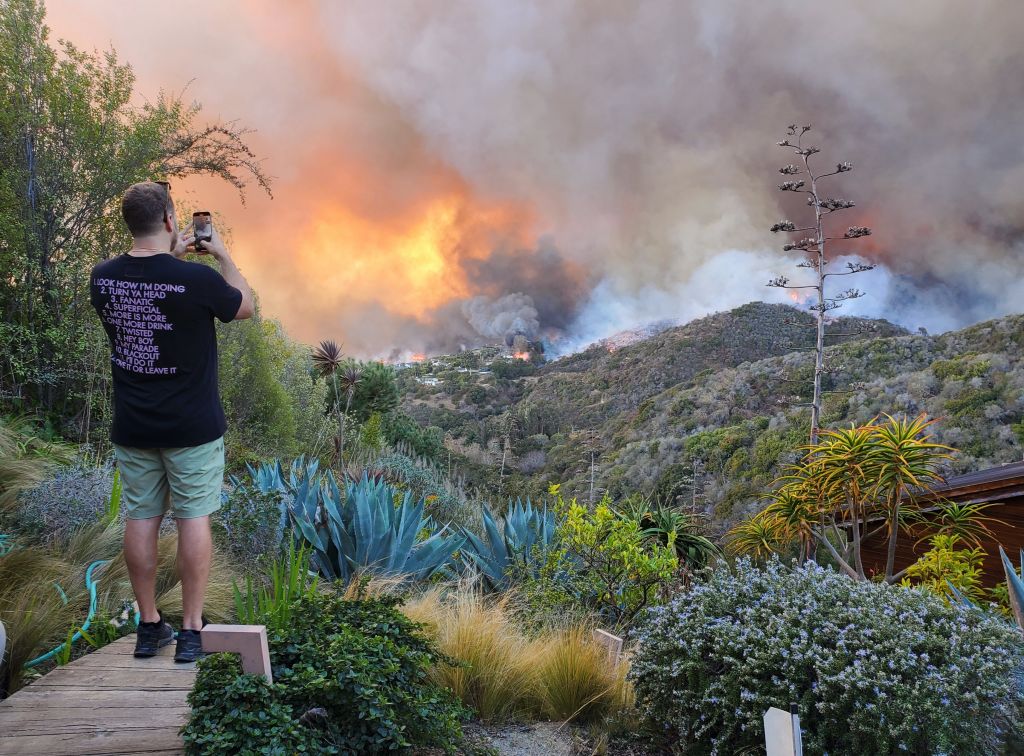
After I published my TIME cover story last year on the aftermath of the Los Angeles wildfires, Spencer Pratt unloaded on social media to attack my telling of the catastrophe and its aftermath. Substantively, he took issue with the mention of climate change. Rhetorically, he called me “lazy” and my reporting “impotent.” I got off easy compared to how he has slammed Los Angeles Mayor Karen Bass and California Governor Gavin Newsom. For months, he tore into their fire response and lack of preparation.
Votes are still being counted, but after this week’s election Pratt, a former reality show star whose house burned down in the Palisades Fire, appears likely to be headed to face off against Bass in this year’s general mayoral election. (Though the race is still too close to call as votes are being counted). Pratt has put his rage over the fire at the center of his campaign—and with good reason. Frustration remains over the disaster itself and the pace of the recovery.
Even if he makes it to the general election ballot in November, he’s unlikely to defeat Bass. While the current mayor is unpopular, Pratt’s pugilist politics and MAGA associations are likely a bridge too far for most Angelenos. Nonetheless, Pratt offers an important demonstration of how climate-related disasters can foment populist fury and contribute to the rise of firebrand politicians. Those politicians offer a kind of climate-rage politics (though they would rebuff the label) that create challenges that are hard to model but will certainly compound existing climate risks as well as create bigger governance challenges.
There is an easy appeal to Pratt’s fire message. It’s been 18 months since the fires and rebuilding efforts remain slow and halting. In one campaign ad, he and his family camp out at the lot where their home once lived; he walks down Bass’s pristine street to draw a contrast.
Pratt’s demand, among other things, is accountability from elected officials and reform in insurance and emergency management, all good things on the surface at least. But even if he is right in diagnosing some parts of the problem, it’s unclear how he would be able to fix it. The whole underpinning of his campaign is a skepticism of established political elites and their expertise. And yet that expertise is essential in preparing for and responding to climate-related disasters. (I wasn’t able to reach Pratt for comment on this story).
For the academics who study the aftermath of disasters, Pratt’s rise isn’t exactly surprising. Research has long shown that poorly managed disasters foment distrust in institutions and create fertile ground for anti-establishment politicians.
A 2023 analysis from researchers in Italy, for example, shows how poor disaster response to an earthquake created an authoritarian hotbed. A different study from the Inter-American Development Bank charted how an earthquake in Mexico led to political distrust and how competent disaster response can help mitigate it. And reporting has shown how far-right groups in the U.S. use the aftermath of disasters as recruiting grounds. This list could go on.
While this is widely accepted in the academic literature, the implications of this reality remain outside the scope of climate modeling and tabletop exercises. But the potential costs are very real. Political dysfunction risks slowing down rebuilding efforts as critical government functions stall. And it can further disrupt the insurance market as insurers question the resilience of localities. Even beyond disaster response, anti-establishment elected officials can hamstring agencies necessary for business operations.
This phenomenon is also ignored by many in the climate community who insist that growing extreme weather events will drive political change to address the root cause of the issue. Pratt is at least one indicator that that’s not universally the case.
The irony of Pratt’s critique of my story, I think, is that if he had taken the time to sit with it he might have embraced my criticism of the disaster response and understood that the climate adaptation he dismisses is exactly the kind of work that future mayors need to embrace so this doesn’t happen again.
Hence then, the article about spencer pratt s race for mayor shows how climate disasters can fuel anti establishment politics was published today ( ) and is available on Time ( Middle East ) The editorial team at PressBee has edited and verified it, and it may have been modified, fully republished, or quoted. You can read and follow the updates of this news or article from its original source.
Read More Details
Finally We wish PressBee provided you with enough information of ( Spencer Pratt's Race for Mayor Shows How Climate Disasters Can Fuel Anti-Establishment Politics )


Also on site :
- Court rules Belgium had no right to withhold Russian bank’s assets
- Fired ‘Shrinking’ Crew Member Accuses Warner Bros TV Of Doing Nothing Over Sexual Harassment By EP; Being Scapegoated After Complaining
- Push for AI regulation mounts as talk of AI’s ‘existential’ risks go mainstream. But Trump resists calls for a slowdown