
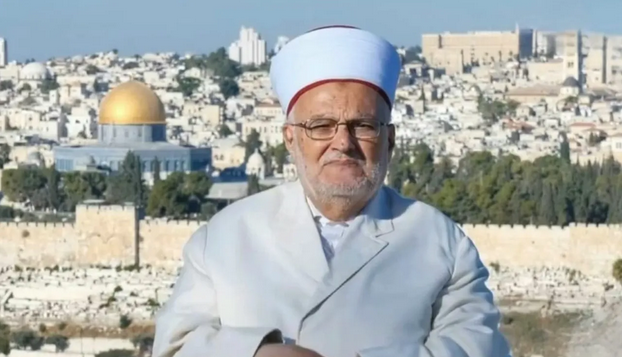
At 86 years old, Sheikh Ikrima Sabri remains the unyielding voice of occupied Jerusalem. Having served Islam’s third holiest site for over half a century as its Grand Mufti and current Imam, he has survived 25 interrogations, multiple banishment orders, and decades of conflict—yet his resolve to defend the city’s Arab and Islamic identity remains untouched.
In an exclusive interview with Al-Masry Al-Youm, the legendary “Custodian of the Pulpit” delivers a powerful geopolitical and religious briefing from the heart of Al-Aqsa Mosque.
As regional warfare expands from Gaza to Lebanon and Iran, Sheikh Sabri sits down to dismantle the “Greater Israel” blueprint, issue an urgent warning regarding the structural sabotage beneath Al-Aqsa’s foundations, and outline Egypt’s historic role as the ultimate backbone of the Palestinian cause.
Interview
You described the current phase as the most dangerous for Al-Aqsa Mosque. How can the evolution of Israeli excavations since 1967 be understood within a broader strategic context related to reshaping identity and the geographical and religious landscape of Jerusalem?
– Excavations beneath and around Al-Aqsa Mosque began after the occupation of Jerusalem in 1967, under the pretext of searching for Jewish antiquities, particularly in the area of the Western Wall and the Silwan neighborhood south of the mosque.
The occupation authorities followed water channels linked to Islamic history that had existed underground since the Islamic eras.
These channels were used to collect water from wells—26 in total—that supplied Jerusalem.
The occupation traced these channels, expanded them, and converted them into tunnels in the hope of discovering artifacts that would support the Hebrew narrative.
At the same time, they destroyed any Islamic artifacts they encountered during the excavations.
In the end, Israeli archaeologists themselves admitted that they had not found any ancient Hebrew artifacts to substantiate their claims – before converting these tunnels into routes for tourists visiting Jerusalem.
What is the long-term objective and the worst-case scenario threatening Al-Aqsa? Are the excavations part of a broader struggle over sovereignty and identity in the city?
The greatest danger facing Al-Aqsa Mosque is that the excavations have removed the soil surrounding its foundations, leaving them exposed and the structure suspended.
The occupation is betting on the occurrence of an earthquake measuring five on the Richter scale or more, which could affect the mosque’s structure and lead to its collapse, as happened during the 1928 earthquake, when aftershocks from earthquakes in Turkey and Syria caused damage to parts of the mosque.
At that time, however, its foundations were strong and stable.
Today, the situation is more dangerous because of the excavations and tunnels that threaten its collapse. This is how they plan.
Nevertheless, we affirm that sanctity does not belong to the stones alone, but to the blessed land mentioned in the Holy Qur’an.
Even if the structure were to suffer any damage, the sanctity of the mosque and blessed land around it would remain.
Jerusalem holds significance for the three monotheistic religions and is a multi-faith city. Does your role as Imam of Al-Aqsa Mosque focus solely on defending Islamic holy sites, or are you also concerned with protecting Christian holy sites, foremost among them the Church of the Holy Sepulchre?
Certainly. The Church of the Holy Sepulchre is one of Jerusalem’s most ancient historic churches and the oldest church after the Church of the Nativity in Bethlehem.
The restrictions imposed upon it confirm that the targeting is not limited to Muslims alone. Just as Al-Aqsa Mosque was closed, the Church of the Holy Sepulchre was also closed.
This occurred across 40 days.
During the war against Iran, occupation police controlled entry to and exit from the church and restricted the number of Christian worshippers there, just as they do at Al-Aqsa.
Israeli restrictions affect both Muslims and Christians alike. As Jerusalemites, we are all concerned with defending freedom of worship in Jerusalem.
The Israeli occupation respects neither Islamic nor Christian holy sites, and all its measures contradict freedom of worship as guaranteed by international conventions and norms.
From 1948 until today, it has not complied with any United Nations resolution, viewing them as biased toward the Palestinian cause because they conflict with its illegitimate expansionist and racist policies.
When the occupation entered southern Lebanon as part of its ongoing war, its soldiers smashed a statue of Jesus Christ. What were your feelings when you saw that?
The smashing of a statue representing Jesus Christ was a barbaric moment and a dual assault on the feelings of both Christians and Muslims through an attack on their Prophet. It was an insult to Jesus Christ as a revered Prophet on the one hand, and an assault on and destruction of a Lebanese cultural landmark on the other.
This constitutes a clear provocation of religious sentiments. We Muslims believe in all Prophets and Messengers, and in Moses and Jesus just as we believe in our Prophet Muhammad.
How do you interpret the transformations currently taking place in the Middle East? Do you consider them part of a broader reshaping of the region’s balance of power? And what is your response to those who argue that the occupation seeks to dominate the Arab world?
All indicators point to the failure of the occupation’s projects and plans to dominate our region. These moves possess no legitimacy locally, regionally, or internationally. The Israeli authorities rely on American power, and the US is dragging them into unnecessary wars.
We reject wars in principle, and despite their efforts the occupation has achieved nothing.
What is Jerusalem’s place within this equation? To what extent are these Israeli projects reflected in Jerusalem specifically?
Every step taken by the occupation in Jerusalem falls within the framework of Judaization. They regard Jerusalem as the capital of global Judaism, not merely the capital of their false state.
This reveals the racist dimension and religious fanaticism behind their approach.
They employ the ideological dimension to achieve political gains by uprooting Palestinians from their land and imposing new realities on the ground in pursuit of colonial and political objectives.
Do you believe that the expansion of the Israeli conflict in Gaza, the West Bank, and Jerusalem, and its extension to Lebanon and even Iran, is linked to a broader strategy aimed at reshaping the region in pursuit of the so-called “Greater Israel”?
Yes. The occupation has long-standing objectives and major expansionist projects. They have been speaking for a long time about “Greater Israel,” and they have an old but recurring slogan: “from the Nile to the Euphrates.”
This slogan remains present in their ideological literature and political imagination.
Even the Israeli flag, with its two blue lines, is interpreted according to this vision as symbolizing the Nile and Euphrates rivers, reflecting expansionist ambitions over six Arab countries.
But these are their ambitions and dreams; they will neither reach the Nile nor the Euphrates, and they will achieve none of their goals, God willing.
How do you view the impact of the simultaneous wars in Gaza, the West Bank, Lebanon, and Syria on the structure of the Arab-Islamic system and the position of the Palestinian cause within this fragmented system? Do we need greater Arab and Islamic solidarity?
We always call for unity and solidarity, and for the establishment of an Arab-Islamic union similar to the European Union.
We are not calling for the overthrow of regimes or the replacement of rulers, but rather for political and economic unity in positions, as seen with Europe.
Previous attempts were made, but they were aborted by international powers that do not want us to be strong; they prefer us fragmented so they can exploit our countries’ resources, keeping our region weak and divided in order to drain its resources and control its policies.
Can institutions such as the Organization of Islamic Cooperation and Al-Azhar play a coordinating role in producing unified political action in the Islamic world?
We urge the idea proposed by Al-Azhar and the Organization of Islamic Cooperation of moving from a framework of cooperation to that of union among Islamic countries.
What is required is for joint action to rise from mere coordination to a real unifying entity capable of confronting political, economic, and security challenges.
How do you explain the continued inability to build a unified Arab-Islamic political entity in the face of these dangers?
Let us recall the lessons of history and see how the Ottoman Caliphate was dismantled through Western conspiracies aimed at fragmenting the Arab and Islamic worlds, in plots in which the West collaborated intensely against us.
Today, unfortunately, nothing has changed.
There are complex historical factors, including the dismantling of the structure of the Islamic state after the collapse of the Ottoman Caliphate, within the context of major international conflicts. Western powers played a direct role in reshaping the region on the basis of division and fragmentation, which is reflected in our current reality in the aftermath of Sykes–Picot.
The remedy is clear in the Holy Book, which says: “And hold firmly to the rope of Allah all together.”
Thus, the solution lies in our unity and in returning to unifying references, away from division and conflict.
In light of the American-Israeli war on Iran, sectarian narratives have emerged portraying the dispute between the Gulf and Tehran as sectarian rather than political, and depicting Iran as an enemy of the Arab region. Can this be considered part of the tools used to manage regional conflict?
The plan drawn up by the US for the Middle East is to fragment what has already been fragmented by inflaming sectarian strife between Sunnis and Shiites.
They have succeeded in previous stages in Iraq, where political disagreement turned into a bloody sectarian conflict.
This is a major mistake made by both the Sunnis and Shiites who are drawn into this dangerous discourse.
Now there is an attempt to reproduce this scenario in more than one arena, including Lebanon, Yemen, Syria, and Iran. Therefore, it is not in the interest of Muslims to inflame these sectarian divisions, because we are within one sphere and it is not permissible to turn intellectual or jurisprudential differences among Muslims into bloody conflict.
These differences can be resolved through dialogue among Muslims. Whoever seeks to divide us is our enemy.
I am against any sectarian discourse—whether between Sunnis and Shiites or between Arabs and Kurds. Against sectarian and ethnic incitement, Salah al-Din al-Ayyubi was Kurdish; we are all under one framework.
A song titled “Hands Be Crippled, O Iran,” performed by a cleric, sparked debate and criticism on social media. In this state of fragmentation, how can we read the impact of political and sectarian divisions on the cohesion of societies in the Arab Levant?
Destruction is easier than construction.
I say to everyone: building is the foundation. The Prophet commanded us to hold on to construction and unity, and he said, peace be upon him: “Whoever believes in God and the Last Day should speak good or remain silent.”
Whoever cannot speak positively should remain silent and not contribute to destruction or assist those who spread harm.
What awaits the Middle East if we succumb to sectarian and ethnic divisions?
If we surrender to destructive sectarian incitement, the result will be further weakness and fragmentation in Palestine, Lebanon, Syria, and Iraq, and its extension to other countries in the region.
Therefore, we stress the necessity of confronting such calls with awareness, unity, and rejection of sedition, because the strength of societies lies in their cohesion, not in their division.
How has internal Palestinian division affected Palestine’s negotiating capacity, and what has been the impact of the occupation in reproducing this division?
We are aware of these destructive calls and we instead call for unity, national reconciliation, and the preservation of blood. God be praised, our people are cohesive and do not pay attention to division.
Despite the political and geographical separation imposed on the Palestinian people, we remain united.
These divisions are forcibly imposed by the occupation. However, geography and political circumstances that separate Gaza from the occupied interior and Jerusalem do not negate the unity of the people and their shared identity.
Is there a gap between the unity of Palestinian identity on one hand and political and institutional division on the other? What is its impact on the future of the cause?
Certainly. We hope that Palestinian political factions will unify their positions. We have repeatedly emphasized that political disagreements among factions do not represent the reality of the united Palestinian people.
There is no doubt that political division has negatively affected the Palestinian cause and weakened the Palestinian position.
How do you explain the growing shifts in international public opinion regarding the Palestinian cause? Do you believe change will come through popular movements?
The world has begun to awaken and recognize the truth. Israeli media is no longer able to mislead peoples as it once did.
We see supportive voices for Palestine within the US. We appreciate the positions of countries such as South Africa, Venezuela, Spain, and Colombia, which have had the courage to declare their support for Palestine.
We also salute the free peoples and students who have taken to the streets in marches at several American and European universities in support of our cause.
How can Arabs build on these popular positions supporting the Palestinian cause, and how can they translate them into more effective international political action?
It is the duty of Arab and Islamic states to strengthen their engagement with countries and peoples that have declared their support for Palestine, and to consolidate relations with them, foremost among them South Africa, Venezuela, and Spain.
It is our duty to value all those who support the Palestinian cause.
How do you read Egypt’s position in the equation of the Israeli–Palestinian conflict within the regional balance of power?
Egypt represents the historical backbone of the Palestinian cause, politically and popularly, in the past, present, and future. It is one of the most steadfast countries in supporting Palestinian rights.
When visiting Egypt, we feel as if we are in our own homeland; we feel the harmony that unites the two peoples, the spontaneous affection without pretension, and sincere support. This is due to the historical ties and deep connection between both peoples.
How can the historical relationship between Palestine and Al-Azhar be understood in the context of the formation of Palestinian religious elites and their role in consolidating identity before and after 1948?
The relationship between Palestine and Al-Azhar is ancient and deeply rooted. From the establishment of Al-Azhar until 1948, all Palestinian scholars were graduates of Al-Azhar before universities were established in Palestine.
With the later development of academic life, universities and specializations diversified, yet Al-Azhar retained its special status in the Palestinian consciousness. On a personal level, my father, my grandfather, my wife, and I are all graduates of Al-Azhar.
I obtained my PhD when Ahmed Omar Hashem was President of Al-Azhar University.
I have known Imam al-Tayyeb since he was Mufti, and I was Mufti of Jerusalem. Our relationship continued after he became university president and later Grand Imam of Al-Azhar.
“Knowledge is a bond among its people.” Thus, the relationship between Al-Azhar and Jerusalem remains one of the strongest and deepest ties.
Historically, Egyptians used to combine their pilgrimage to Mecca with a visit to Jerusalem and Al-Aqsa Mosque before returning to Cairo. To what extent does this reflect an early formation of an emotional bond between the two peoples?
Pilgrims used to feel that their spiritual journey was not complete unless they reached Palestine and prayed in the Al-Aqsa Mosque. The people of Egypt were among the most closely connected to Jerusalem and this blessed practice.
They continued to view visiting Jerusalem as a spiritual extension of the Hajj.
This is an integral part of the demographic, historical, and social ties between the two peoples.
It was a widely cherished custom and a deeply rooted Arab popular belief that a pilgrim’s Hajj was not complete without visiting Jerusalem and Al-Aqsa Mosque.
In the past, people used to say: “His Hajj was sanctified,” meaning he visited Jerusalem after performing Hajj.
How do you assess the role of Al-Azhar and its scholars in supporting the Palestinian cause within what could be described as a form of religious soft power?
Al-Azhar’s positions toward the Palestinian cause have historically been consistent, grounded in firm religious and national principles.
Over the decades, many fatwas were issued by the Grand Mosque of Al-Azhar affirming the necessity of Palestinians remaining steadfast on their land, in support of rulings issued in Palestine concerning the preservation of land and the prohibition of brokers who were involved in transferring it to the occupation through Arab or Western intermediaries.
These positions had a significant impact on public and Islamic awareness.
How do you view your relationship with Grand Imam Ahmed Al-Tayeb, and does this connection reflect the depth of the relationship between Jerusalem and Al-Azhar?
My relationship and my family’s relationship with Al-Azhar is deep and well-rooted. I, like my father, am a graduate of Al-Azhar, and I obtained my doctorate from it. I also share a personal and close relationship with Imam Al-Tayeb that goes back many years, since he was a Mufti, then when he became President of Al-Azhar University.
He initiated the establishment of the Association of Al-Azhar Graduates and appointed me as its representative in Jerusalem. We used to meet regularly during the association’s activities and meetings at Al-Azhar.
My visits to Egypt were frequent, and I participated in the annual conferences of the Egyptian Ministry of Endowments.
Whenever I entered old Cairo, particularly Khan al-Khalili Street, I felt as if I were in old Jerusalem; the atmosphere, architecture, and social diversity are similar.
Khan al-Khalili has a historical connection to Palestine, as merchants from the Palestinian city of Hebron settled there and invested.
For this reason, Egypt was never foreign to us; it has always been open, although wars at times restricted movement and communication.
You mentioned the similarity between Old Cairo and Old Jerusalem. Do you think this is the result of historical intersections in architecture, identity, and popular memory?
It is certainly the result of historical intersections between Cairo and Jerusalem in terms of identity and heritage.
In Old Cairo, I feel as though I am in the Old City of Jerusalem.
In Jerusalem, we also have a street known as “Khan al-Zeit,” which closely resembles Cairo’s Khan al-Khalili in spirit and popular character.
Have you ever met any Egyptian presidents?
I vividly remember the visit of former President Anwar Sadat to Jerusalem in 1977, when he attended and performed the Eid al-Adha prayer at Al-Aqsa Mosque.
I was delivering the Eid sermon at that time. After the normalization agreement with the occupation, I told him that Jerusalem is a major responsibility in the hands of all rulers, and anyone who neglects it will be held accountable before God and history.
He appeared to be visibly perspiring.
Your Eminence, we are aware of your love for Egypt and its people. What is your message to them?
From the blessed courtyards of Al-Aqsa Mosque, from the land of the Isra and Mi’raj, I address the people of Egypt, our honorable brothers, and I say that we love them and appreciate their steadfast and sincere positions on existential issues, foremost among them the Palestinian cause.
This is not strange for Egypt, which has a long history of supporting Palestine.
A greeting of love and appreciation to this loyal, sincere, spontaneous people, and we ask God to protect Egypt from all conspiracies being plotted against it.
Finally, what message would you like to send to the Arab and Islamic worlds regarding Jerusalem and the Palestinian cause?
I say to the Arab and Islamic worlds that Jerusalem is in your hands – it is not the responsibility of Palestinians alone, but of all Muslims around the world.
Whoever is in Al-Aqsa will bear responsibility before God and history. Everyone must fulfill their duty toward this central cause.
In exclusive interview, Imam of Al-Aqsa Mosque discusses Gaza war, the path to peace and more Egypt Independent.
Hence then, the article about in exclusive interview imam of al aqsa mosque discusses gaza war the path to peace and more was published today ( ) and is available on EGYPT INDEPENDENT ( Egypt ) The editorial team at PressBee has edited and verified it, and it may have been modified, fully republished, or quoted. You can read and follow the updates of this news or article from its original source.
Read More Details
Finally We wish PressBee provided you with enough information of ( In exclusive interview, Imam of Al-Aqsa Mosque discusses Gaza war, the path to peace and more )


Also on site :
- APOD: 2026 September 23 – A New Lunar Crater: McGetchin
- The Seemingly Harmless 4-Word ‘I’ Statement That’s Actually a Massive Relationship Red Flag, According to a Psychologist
- 1968 No. 1 Hit, Ranked Among ‘Greatest Songs of All Time,’ Became an 11-Minute Creedence Clearwater Classic