
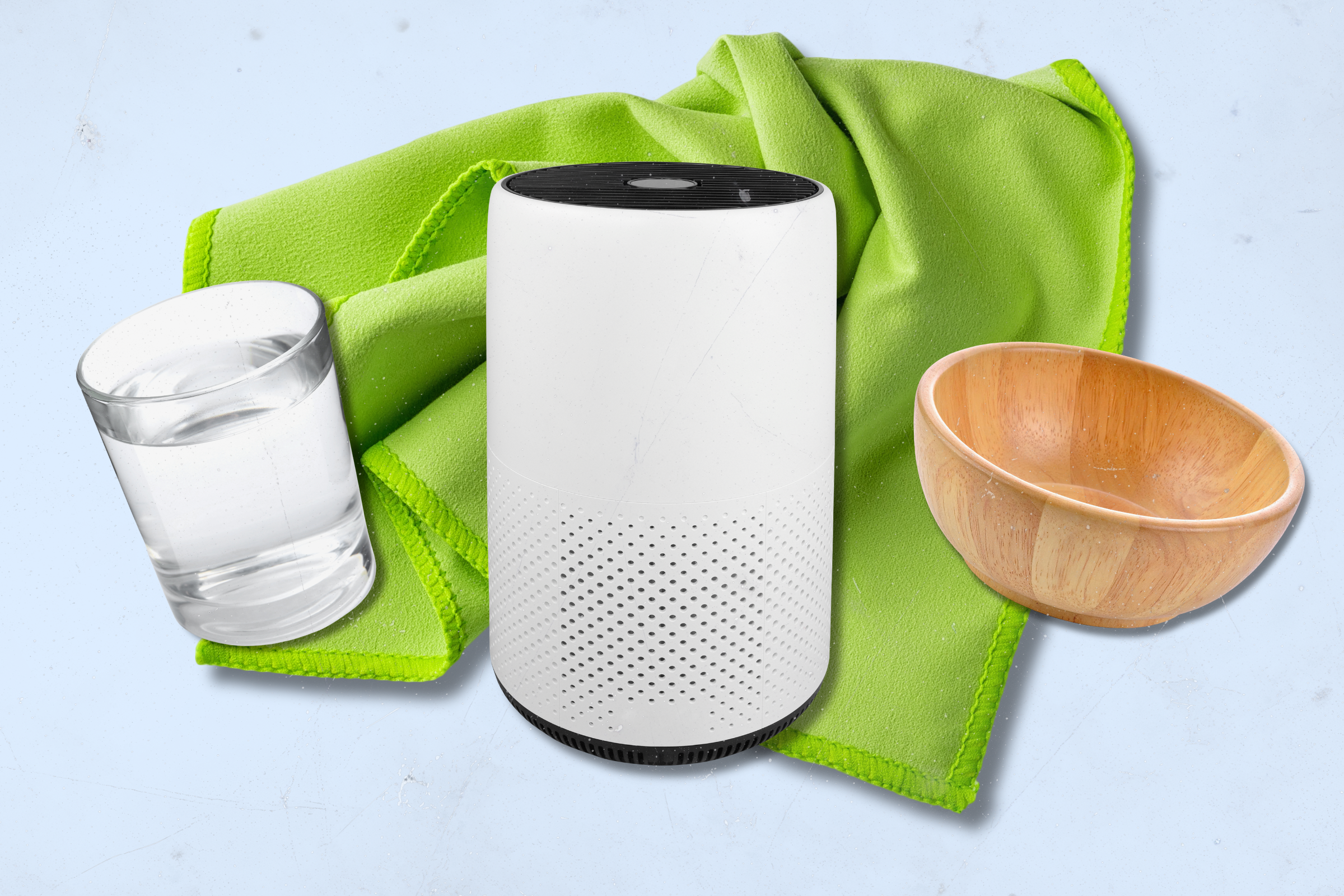
You can’t control whether a relative smoked in the house you grew up in, whether the factory near your childhood home leached chemicals into the groundwater, or whether the air outside your apartment has fine particulates floating through it on any given afternoon. But oncologists—the doctors who spend their careers thinking about why people develop cancer—are clear about one thing: There’s a long list of exposures inside your home that you can actually do something about.
“How we sleep, what we breathe, what we eat, what we drink, what we expose ourselves to—all of these things definitely factor into your physical and mental health,” says Dr. Michael Dominello, a radiation oncologist at Karmanos Cancer Institute in Detroit. “By making no decision, you're actually making a decision, oftentimes for the worse.”
We asked four oncologists to describe the changes they've made in their own houses to reduce their daily exposure to chemicals, pollutants, and carcinogens. Here are eight of them.
Heat causes plastic to release small amounts of chemicals into food—including endocrine disruptors, which interfere with the body’s hormone systems and have been linked to a range of health concerns. That’s why some oncologists have replaced the plastic items in their kitchens.
Dr. Andrea Tufano-Sugarman, a gynecologic medical oncologist at Memorial Sloan Kettering Cancer Center in New York, won’t heat anything in plastic. She’s also swapped her cutting boards from plastic to wood and her non-stick cookware for cast iron. “I’ll eat out of plastic if I can’t avoid it, but I won’t heat anything up in plastic,” she says.
Dr. Nikki Wood, a pediatric hematologist-oncologist at Children’s Mercy Kansas City, applies the same rule across her whole kitchen. Her household has gone almost entirely glass for food storage, opting for plastic or silicone lids that don’t touch the food. The biggest offenders, in her view, are plastic takeout containers. “When you put something warm in and it touches plastic, you’re leaching microplastics into your food, and you’re ingesting that,” says Wood, who partners with the Childhood Cancer & the Environment Program (CCEP). So when leftovers come home, they go straight into glass—and Wood won’t reheat anything in plastic, period.
They use the back burners on purpose
Indoor air can be worse than outdoor air, especially when you’re cooking. Gas stoves are particularly bad offenders, but even electric stoves release particles into the air when food sizzles, sears, or smokes. Those particles linger in the kitchen and drift through the rest of the house unless something pulls them out.
Read More: How to Get the Biggest Mental-Health Boost from 15 Minutes Outdoors
That something is usually a range hood: the fan-and-filter unit mounted above the stove. Wood runs hers every time she cooks, in addition to opening a window on good air-quality days. But she’s learned that not all range hoods actually do what people assume they do. Many of them—especially the ones built into apartments or installed as part of microwave-stove combos—don’t vent outside at all. They just suck air up, run it through a filter, and blow it back into the kitchen. “It’s important to make sure the exhaust hood filters out outside,” Wood says. (You can usually tell by looking at the ducting above the hood: If it runs to an exterior wall or up through the roof, it vents out; if it stops at the cabinet, it’s just recirculating.)
Even with a hood that vents properly, Wood has one more habit: She cooks on the back burners whenever she can. The reason is simple physics. The hood’s intake is mounted at the back, so smoke and fumes rising from the back burners get pulled straight up into it. Smoke from the front burners has farther to travel, and a lot of it drifts sideways into the kitchen before the hood can catch it.
Air purifiers with HEPA filters trap fine particulates—things like PM2.5, the tiny particles that cause the most damage when inhaled because they’re small enough to slip past the body’s defenses and lodge deep in the lungs. “There are studies coming out saying that if you give air purifiers to patients, they end up in the hospital less, with fewer respiratory infections,” says Dr. Omar Shakeel, a pediatric oncologist who leads the Survivorship Clinic at Texas Children’s Hospital and also partners with CCEP.
His advice on placement: Put the purifier where people spend the most time. “I would do it in the larger areas, which track in the most amount of people and high foot traffic,” Shakeel says.
Replacing the filter is a must. A HEPA filter only works if it’s clean—once it loads up with dust and particulates, it stops catching anything new. Wood’s solution is to put replacement filters on auto-ship so they show up at her door on schedule. “Sure enough, I take the old one out and I’m like, that’s disgusting,” she says.
They’ve banned candles and air fresheners
Many people associate a clean-smelling home with an actually clean one. Wood takes issue with that. “Any time you have a combustible type of material, like a candle wick or the electric fresheners, you’re burning something, and that’s putting a chemical in the air,” she says. “That makes the air quality poor, and those chemicals are associated with health outcomes.” They can trigger asthma flare-ups in children, she notes, and have also been linked to headaches, skin irritation, and hormone disruption. That’s why she’s told her cleaners not to leave the house smelling fresh. “I just don’t want it to smell or look dirty,” she says. “I don’t need it to smell clean.”
Read More: Is Bleach Really Necessary for a Clean Home?
Candles aren’t the only culprits. New furniture, fresh paint, and recent renovations can all release chemicals into the air, especially when sunlight warms them up. Those compounds, Wood says, end up binding to household dust—where they sit until someone sweeps, vacuums, or stirs them back into the air.
That’s why she builds in key buffers. New mattresses and furniture get parked in the garage or outside for a few days so the worst of the off-gassing happens before they come in. When her family renovated their home, they chose low-VOC paint (paint with fewer volatile organic compounds, the chemicals that off-gas as it dries) and asked questions about what was in every material they brought in. And when off-gassing does happen indoors—fresh paint, new flooring—she keeps every window in the room open. “I just don’t want anything inside my house that could potentially be a danger to my family,” she says, “when there are better, safer alternatives.”
What comes out of the tap depends on where you live, what your pipes are made of, and what’s been added at the municipal plant. Dominello recommends starting with a test. At-home kits are available online, and some companies will test for free in the hopes of selling you a filtration system. (You can decline the upsell.) “It’s important to understand the quality of the water that you’re using at home,” he says. “You’re showering in this water, you’re drinking this water, you’re using it to cook, you’re using it to wash your fruits and vegetables.”
If something comes back at unacceptable levels, filtering is the next step—and the right filter depends on what's in your water. “Even just a Brita filter can make a difference in some cases,” Dominello says. Shakeel's setup is more aggressive: a reverse osmosis system on the house's main line, plus carbon filters on the drinking water. Reverse osmosis forces water through a membrane fine enough to filter out most contaminants—heavy metals, dissolved solids, and a long list of chemicals included.
Wood, meanwhile, doesn’t filter her whole house; she runs her drinking water through a filter and changes it on the manufacturer’s schedule. An expired filter, she notes, can become its own source of contamination.
They take their shoes off at the door
This habit isn’t necessarily about keeping floors clean. It’s about not tracking pesticides, lawn chemicals, and outdoor pollutants into the house, where they settle into dust. “What you track into your home can lead to certain diseases,” Shakeel says. “We’ve done studies that show that dust has a lot of chemicals and pesticides in it.” Researchers have identified dozens of chemicals in household dust—including lawn pesticides, heavy metals, and flame retardants—many of which have been linked to developmental and respiratory problems.
The stakes are highest in households with small children. Toddlers and babies spend their days at floor level, crawling through dust, putting hands and objects in their mouths, and breathing air closer to the ground than anyone else. “Early life exposures can have an even more important effect later in life,” Shakeel says. Children are especially vulnerable because their brains and bodies are still developing, and they absorb more pollutants relative to their body size than adults do.
Once chemicals get into household dust—through tracked-in shoes, off-gassing furniture, or scented cleaning products—the way you clean matters. Cotton cloths and feather dusters tend to stir dust up and redistribute it. Microfiber actually traps it, thanks to a static charge that pulls particles in and holds onto them.
Read More: 6 Foods That Help You Get Better Sleep
Wood buys microfiber in bulk at Costco, and washes them separately from the rest of her laundry. “You don’t want to lose that magnetic stickiness that microfiber cloths have,” she says. “They can lose that if you wash them with other types of materials.” She supplies them to her cleaners along with her own non-toxic cleaning products, so nothing from the outside enters the house.
The same logic applies to vacuums. Most newer models have HEPA filters that trap fine particles, but those filters need to be cleaned or replaced regularly to actually do their job. “Otherwise you’re just going to start spraying that dust around the house,” Wood says. “You’re not going to truly filter it.”
They refuse routine pest spraying—and ask about “integrated pest management”
When a pest control company shows up offering a quarterly spray, Wood’s first question is whether they practice integrated pest management—IPM for short. Most of the time, the rep can’t answer. “Usually they’re like, ‘What’s that?’” she says. “And I’m like, ‘Great, when you figure it out, come talk to me. I’d love to collaborate.’”
IPM is a tiered approach to keeping pests out without leaning on chemicals as the first line of defense. Step one is prevention: decreasing clutter, keeping food containers sealed, caulking cracks in the foundation, fixing torn window screens—anything that keeps bugs from getting in or finding food once they do. Step two, if pests still show up, is traps and baits. Chemicals are a last resort, applied as narrowly as possible and only when nothing else works. The point, Wood says, is that spraying alone doesn’t actually fix the underlying issue: “You’re really not solving the problem, and you’re just exposing those in your home to unnecessary chemicals.”
The pest control company her family uses now walks the perimeter of the property, checks the entry points, and replaces sticky traps instead of spraying. “Even if you’re spraying outside, it’s still circulating in the air,” she says, “and you’re still being exposed to those particles.”
The habits add up. No single one is going to keep cancer at bay, but reducing daily exposure is certainly possible. “We can't really eliminate every exposure, but we can reduce them,” Shakeel says. “Especially during sensitive periods of development, that's where we have a real opportunity to make a difference."
Hence then, the article about how to clean your house like an oncologist was published today ( ) and is available on Time ( Middle East ) The editorial team at PressBee has edited and verified it, and it may have been modified, fully republished, or quoted. You can read and follow the updates of this news or article from its original source.
Read More Details
Finally We wish PressBee provided you with enough information of ( How to Clean Your House Like an Oncologist )


Also on site :
- Bobby Flay Shares Flirty Birthday Message to ‘Talented’ Girlfriend Brooke Williamson and Fans Can’t Get Enough
- ‘90s Supermodel Cindy Crawford’s Daughter Kaia Gerber Reveals She Had an Exorcism as a Child: ‘I Was Just Possessed’
- WNBA Star Sophie Cunningham Had Everyone Staring When She Climbed Onto a Bar and Belted Out Toby Keith