
In the mid-20th century, astronomers discovered strange “clumpy” galaxies filled with mysterious bright blobs – massive stellar nurseries where stars are born at an explosive rate. Curiously, these clumpy galaxies were much more common in the early universe than they are today. We still don’t know why they vanished.
The Euclid space telescope, an ESA (European Space Agency) mission with critical contributions from NASA, has begun to capture images of millions of galaxies. These images – far more than any team of professional scientists could ever catalog alone – include high-definition views of clumpy galaxies that promise to reveal structure within and among the clumps. Astronomers hope to use these images to obtain new information about which galaxies host clumps, where the clumps are, how and why they evolved, and more – but they need your help!
To tackle this mountain of data, scientists are creating a “digital assistant” in the form of machine learning, a kind of artificial intelligence. The machine algorithm has been partially trained with results from an earlier project called “Galaxy Zoo: Clump Scout.” Now, as a volunteer for the new Galaxy Zoo: Clump Scout II project, you’ll improve and train this tool further. You’ll examine images of galaxies that the machine has labelled with squares where it thinks it sees a real clump. The machine often gets confused by distant stars or camera glitches. So you’ll gently move those squares around, delete them, or add new ones, to help the algorithm learn.
As a part of Galaxy Zoo: Clump Scout II, you will help investigate how giant star-forming nurseries formed, solve the mystery of their disappearance over cosmic time, and reveal more about how star formation really works in galaxies. All you need is a laptop or smartphone. Click here to learn more!
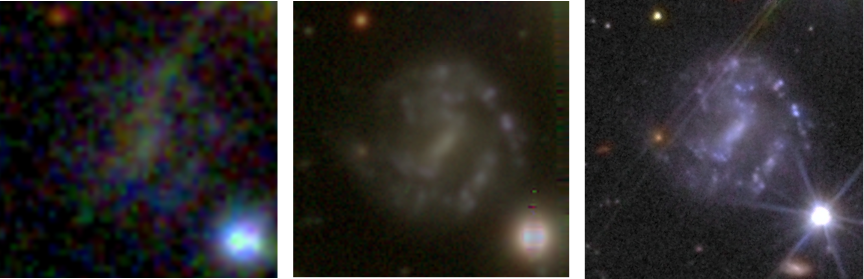
A clumpy galaxy seen by telescopes with the Sloan Digital Sky Survey (left), the Hyper Suprime-Cam (middle) and the Euclid mission (right). You can see how the better resolving power of each subsequent telescope helps us see more and more detail about the star-forming clumps. (The bright object at the bottom right is a foreground star.) Image data: SDSS (left; Sloan Digital Sky Survey – CC BY 4.0); HSC (center; NAOJ/HSC Project – CC BY 4.0); Euclid (right; ESA/Euclid/Euclid Consortium/NASA – CC BY 3.0 IGO). Image post-processing and compilation by Hugh Dickinson and Jürgen Popp.Learn More and Get Involved
Galaxy Zoo: Clump Scout II
Identify star-forming clumps in galaxy images, and help train machines to do the same.
Facebook logo @nasascience_ @nasascience_ Instagram logo @nasascience_ Linkedin logo @nasascience_Hence then, the article about be a clump scout and help reveal secrets of stellar nurseries was published today ( ) and is available on NASA ( Middle East ) The editorial team at PressBee has edited and verified it, and it may have been modified, fully republished, or quoted. You can read and follow the updates of this news or article from its original source.
Read More Details
Finally We wish PressBee provided you with enough information of ( Be a Clump Scout and Help Reveal Secrets of Stellar Nurseries )


Also on site :
- Joanna Gaines’ Message for Parents Facing College Goodbyes Has Fans Saying ‘No One Warns Us About This’
- ‘Dancing with the Stars’ Pro Witney Carson Reveals Shocking Cancer Battle She Kept Secret From Producers (Exclusive)
- Amazon’s ‘Whimsical’ $19 Stained-Glass Hot Air Balloon Solar Lantern Is a ‘Gorgeous Addition’ to Any Patio or Deck