
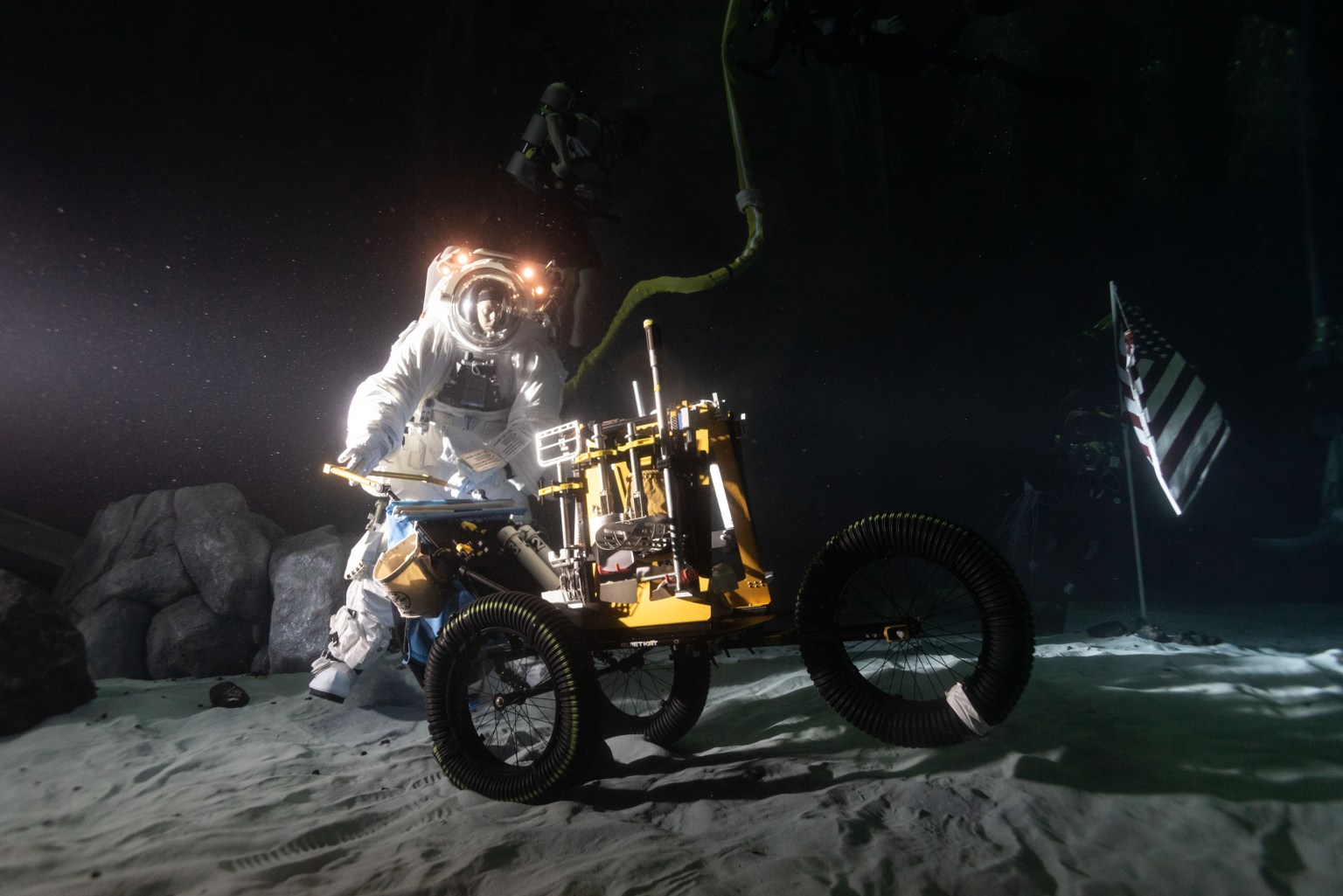
Scott Wray’s experience with spacewalks started when he was about 6 years old. A tent resembling a lunar lander provided the perfect imaginary spacecraft. “I would lie on my back with my feet propped up on a pillow as I imagined going through a launch countdown sequence,” he said. “Then I would exit the tent into a darkened bedroom and hop around just like the footage I had seen of Apollo astronauts.”
Today, with more than 16 years at NASA’s Johnson Space Center under his belt, Wray is proud to have shaped spacewalk training across three eras of human spaceflight.
The childhood fascination with spaceflight evolved into a passion for engineering, demonstrated through countless LEGO and airplane model builds and voracious readership of aircraft design books. His path to NASA was cemented by a week-long camp at Space Center Houston, which included several tours of Johnson’s signature facilities and a visit by former NASA Flight Director Gene Kranz. “I was so inspired by the facilities and the incredible history of this place, I knew that I had to work here someday,” he said.
Wray participated in NASA’s Contractor Co-op Program with United Space Alliance while studying aerospace engineering at Embry-Riddle Aeronautical University and completed several tours with different organizations at Johnson. At the time, astronauts were training to conduct spacewalks, also known as EVAs, for both the Space Shuttle and International Space Station programs. During one co-op experience with the shuttle’s In-Flight Maintenance Team (IFM), Wray observed the IFM and EVA teams collaborating with the STS-117 crew to fix the peeled-back thermal blanket on space shuttle Atlantis’s Orbital Maneuvering System pod. He helped the teams develop crew procedures for practicing the repair inside the shuttle, using surgical staples and pins to tack the blanket down. “This real-time troubleshooting is where I learned about the EVA group and set my sights on working there during my final co-op tour,” he said. “I love to be hands-on, to take things apart and come up with creative solutions – that’s what really attracted me to EVA.”
EVA work also reminded Wray of time spent as a dog mushing guide in Alaska. “That is where I got my first taste of expeditionary skills,” he said. “We lived in a remote glacier camp, taking care of 250 Alaskan Huskies. I learned how to make do with the tools you have and make repairs to a broken sled miles away from home.” At times, Johnson’s EVA team must create similar workarounds. “Some of our best moments as a team have come when our hardware or vehicle has malfunctioned, requiring us to devise a real-time solution,” he said. “It sounds scrappy, but I think it’s how we put the human into human spaceflight.”
Wray became a full-time EVA team member at Johnson after graduation, working under various contracts until he transitioned to a civil servant position in 2021. He started as an EVA instructor focused on tools and hardware and teaching astronauts how to perform their maintenance and repair duties. As NASA’s astronaut corps evolved to include a wider range of backgrounds and body types, Wray worked to develop new EVA techniques and tools that could accommodate any crew member. “That meant creating a curriculum that capitalized on individual strengths while building teamwork and resilience,” he said.
Scott Wray prepares JAXA (Japan Aerospace Exploration Agency) astronaut Kimiya Yui for an EVA training run in the Neutral Buoyancy Laboratory pool. NASA/Bill StaffordWray also served as a flight controller for shuttle and space station EVAs. He remembers being on console in Johnson’s Mission Control Center during a space station EVA in July 2013. That excursion was terminated early after water began filling the spacesuit helmet of ESA (European Space Agency) astronaut Luca Parmitano, and the team could neither determine its source nor stop its flow. “That incident taught me that even after decades of operating a spacesuit, there are still failure modes we haven’t imagined,” he said. “It reinforced the need for vigilance, adaptability, and continuous learning—because in human spaceflight, lives depend on it.”
In the last few years, Wray’s responsibilities shifted to preparing Artemis crew members for missions to the Moon. Now the Artemis EVA training lead, Wray oversees the development of training flows that will ready astronauts for lunar surface operations – a challenge NASA has not faced in over 50 years.
Scott Wray participates in a nighttime evaluation of EVA operations at the Johnson Space Center Rock Yard in March 2021. The evening test was designed to better understand the impact of lunar South Pole lighting conditions on EVA operations.While many astronauts have completed space station training or an EVA, the skills required for lunar exploration will be different. “It’s going to be a completely new spacesuit, new vehicles, new environment,” Wray said. “And now they’re going to be walking instead of translating with their hands like we do on station.” At the same time, trainings must go beyond these foundational spacewalk techniques. “Our curriculum integrates geology, covering topics like impact cratering, volcanology, sample collection, and traverse planning,” Wray explained. “It’s about enabling astronauts to become effective field scientists while mastering complex EVA operations.”
To build these skills, the team uses multiple training environments. The Neutral Buoyancy Laboratory has been NASA’s flagship EVA training facility since it opened in 1997, but the team also uses the Active Response Gravity Offload System for suited mobility practice. Additional training systems include virtual reality, lighting laboratories that simulate the Moon’s harsh South Pole lighting conditions, field sites for geology training and sample collection, and suit simulators that prepare astronauts to respond to caution-and-warning scenarios.
“Spearheading this effort as EVA training lead allows me to ensure every element—from science to operations—is integrated into a program that will prepare astronauts for success on the Moon and beyond,” Wray said. “This effort is more than preparation, it’s the foundation for future exploration and a steppingstone toward Mars. Knowing that our work will help shape the next era of human spaceflight is incredibly rewarding.”
Scott Wray serves as the test subject for Exploration EVA Pressure Garment Subsystem mobility data collection using the Active Response Gravity Offload System.Amid these complex preparations, Wray still finds time for new pursuits outside of the office. His daughter inspired him and his wife to try an acting class at a local fine arts studio, leading to Wray’s on-stage debut in a performance of “Rock of Ages.” He starred as William Shakespeare in this year’s production of “Something Rotten.” “I never would have thought I’d have so much fun acting, singing, and dancing on stage,” he said. “The community we are part of and the ability to join our daughter in activities she enjoys has been so rewarding.”
Wray said he is incredibly grateful to play another role off-stage – being part of missions that will conduct meaningful science on the lunar surface. “Returning to the Moon is something I’ve dreamed about since I was a kid,” he said. “Artemis isn’t just about going back—it’s about shaping the future. When we choose to push the boundaries of exploration, the advancements we make don’t just expand knowledge, they create lasting benefits for all of humanity.”
About the Author
Linda E. Grimm
Share
Details
Last Updated May 28, 2026Related Terms
Johnson Space CenterArtemisGeneralPeople of JohnsonExplore More
3 min readNASA to Conduct Low-Altitude Flights Near Houston
Article 15 hours ago 4 min readI Am Artemis: Daniel Stubbs
Article 4 days ago 5 min readNASA Uses Mineralogical Marker to Understand Ancient Martian Climate
Scientists analyzed 20 Martian samples collected by NASA’s Curiosity Rover and found that differences in…
Article 5 days ago Keep ExploringDiscover More Topics From NASA
Missions
Humans in Space
Climate Change
Solar System
Hence then, the article about spacewalking with scott wray artemis eva training lead was published today ( ) and is available on NASA ( Middle East ) The editorial team at PressBee has edited and verified it, and it may have been modified, fully republished, or quoted. You can read and follow the updates of this news or article from its original source.
Read More Details
Finally We wish PressBee provided you with enough information of ( Spacewalking With Scott Wray, Artemis EVA Training Lead )


Also on site :
- 2006 No. 1 Hit, Written by a 15-Year-Old High School Freshman, Ranks as One of the ‘Greatest Country Songs of All Time’
- 2009 Lady Gaga Hit Written on a Tour Bus in Norway Named One of the Greatest Songs of the 21st Century
- Mahershala Ali Reveals He Was “Yearning” to Perform Action On-Screen Before Filming ‘Your Mother, Your Mother, Your Mother’