
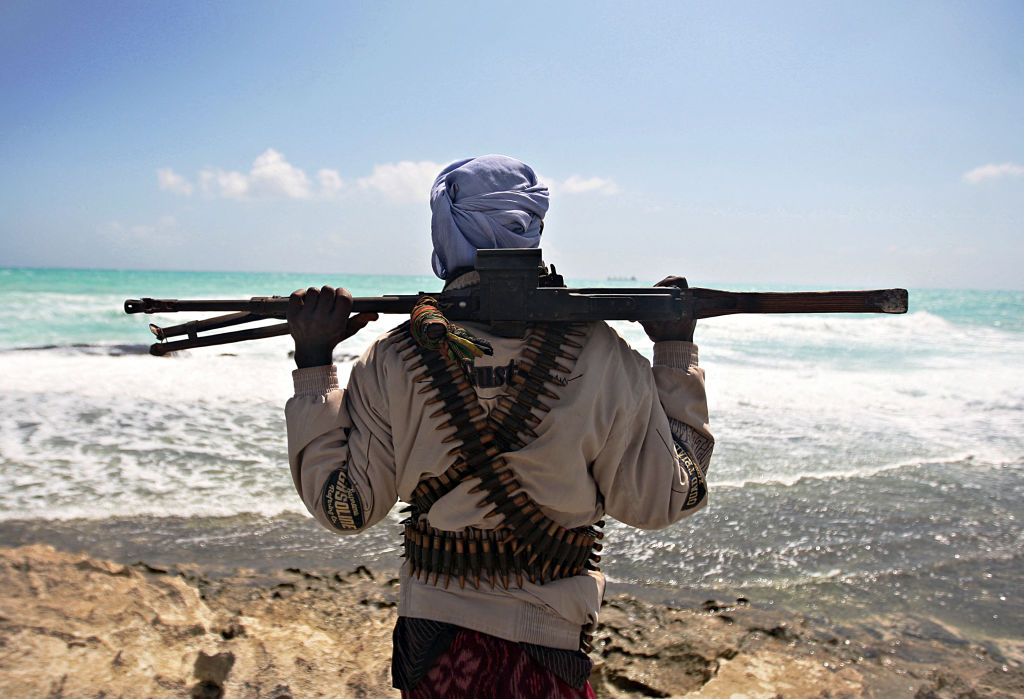
Donald Trump’s war with Iran has reshaped the security map far beyond the Strait of Hormuz, drawing Western naval attention toward the Middle East and away from other volatile waters. Off the coast of Somalia, pirates appear to have noticed.
Since March, suspected pirate activity in the waters surrounding Somalia has increased compared with previous years. According to public data from the International Chamber of Commerce Commercial Crime Service (ICC-CCS), this includes four confirmed hijackings, three of which are still active—with cargo and crew captive. There have also been reports of boats being fired at and even boarded by suspected pirates.
Some commercial maritime intelligence companies put the number of incidents higher.
“Pirate gangs in Somalia are rebooting their business operations,” says Saleem Khan, chief data and analytics officer at Pole Star Global, a leading maritime intelligence company advising shipping firms and governments. “We’ve already tracked 18 incidents this year, more than the entirety of last year. And we still have quite a lot of what we call ‘Pirate Season’ left this year.”
‘Pirate Season,’ he explains, is the time of year when the region is typically free of monsoons, meaning calmer waters. “We have a few days left before the first regional monsoon season starts in mid-June, but come September through to the end of the year, I expect we will have even more activity, because the conditions that have led to this uptick won’t have gone away,” says Khan.
The conditions he describes are not just good weather and calm seas, but also a shift in focus by navies and maritime agencies from the Horn of Africa to the Middle East.
While it is not public knowledge what specific military assets have been moved from one location to another, the U.S. and allied buildup in the Middle East since the start of the war has been vast.
Maritime security analysts in government and the private sector told TIME that the military buildup around Iran and the Strait of Hormuz had most likely diverted resources and attention from counterpiracy efforts, making it harder for the U.S. and the U.K. to monitor and deter pirate activity. The analysts spoke on the condition of anonymity because they were discussing sensitive security assessments.
That shift carries consequences. International actors have policed the pirates ever since the world first became aware of the Somali pirate crisis, when there were as many as 200 incidents of piracy between 2009 and 2011.
“The Somali government is not really stable enough to deal with this itself, so it relies heavily on the U.S. for naval support and the U.K. for information systems tracking activity,” says Manu Lekunze, an assistant professor and expert in international security at the University of Aberdeen.
“With so much of the U.S. focus now being on the blockade in the Arabian Sea and the White House requesting that Europeans support the reopening of Hormuz, attention is elsewhere. It has sent a clear message to the pirates: the risk-reward balance has changed and you might get away with taking a small oil tanker, worth a few million dollars, and its crew,” Lekunze adds.
That green light isn’t just based on assumptions that the U.S. and others are not in a position to police waters around the Horn of Africa. United Kingdom Maritime Trade Operations, a Royal Navy-led organization that broadcasts security advisory notes to seafarers, put out a warning on May 12 describing the threat of piracy in the region as “severe.”
Puntland Maritime Police Forces (PMPF) are patrolling against the recently increasing pirate attacks off the coast in Puntland, Somalia on January 29, 2024. (Photo by Abuukar Mohamed Muhidin/Anadolu via Getty Images) —Mohamed Muhidin—Anadolu via Getty ImagesThe significance of the renewed pirate activity extends beyond the immediate danger to vessels and crews. Analysts say it matters for two reasons: the impact on wider regional insecurity, and the added costs it could impose on global trade.
The first is that the resurgence is taking place during a period of significant global instability. Profits from piracy have been linked to funding for Al Shabaab, a Sunni Islamist Somalia-based offshoot of Al Qaeda. In 2025, analysts reported that Al Shabaab had deepened links to the Shi’ite Islamist and Iranian-backed Houthis operating in Yemen, a country that shares a sea border with Somalia. The Houthis have disrupted shipping in the Red Sea for years, firing on cargo vessels and U.S. warships.
The second is economic. As Khan puts it, piracy is “a tax on globalization that will land in all of our shopping carts.”
That cost is not theoretical. At the height of the Somali piracy crisis, the World Bank estimated that piracy was costing the global economy roughly $18 billion a year in increased trade costs, dwarfing the ransoms paid to pirates themselves.
Piracy drives up the costs of shipping. Insuring vessels goes up, if insurers are willing to cover the boats at all. Vessels must also adopt expensive protective measures. This can include anything from razor wire that might prevent boarding to water cannons or private security.
In some cases, exporters shipping from Asia to the U.S. may have to take longer routes, using more fuel—already soaring in price—while delaying deliveries and adding freight costs to move goods across land. It all adds up, and could end up costing major shipping firms like Maersk and Hapag-Lloyd up to an extra million dollars per ship.
For now, the main payday for pirates comes from ransom demands for the return of the cargo and the crew—which can be several million dollars per ship captured.
“We have not yet heard of goods on board being sold on, as that would require skills that the pirates likely don’t have and would be complicated,” says director of the ICC-CCS Cyrus Mody, noting that stealing the cargo could also reduce ransom payments. “You would also need to find buyers willing to buy stolen goods from pirates,” he adds.
Analysts say that could eventually change. Oil shortages and the existence of Russia’s shadow fleet already carrying out crimes on international waters could mean that an alternative, darker market becomes open to the pirates.
The chief danger here is that the conditions that allowed piracy to re-emerge remain in place. Even if the Iran conflict ends, the ceasefire and security of the Strait of Hormuz will still suck up resources.
Without a renewed international effort to police the waters off Somalia, analysts warn, the latest resurgence risks becoming self-sustaining: pirates continue to operate, their backers continue to benefit, and each successful attack helps finance the next.
Hence then, the article about how trump s war with iran is giving somali pirates an opening was published today ( ) and is available on Time ( Middle East ) The editorial team at PressBee has edited and verified it, and it may have been modified, fully republished, or quoted. You can read and follow the updates of this news or article from its original source.
Read More Details
Finally We wish PressBee provided you with enough information of ( How Trump’s War With Iran Is Giving Somali Pirates an Opening )


Also on site :
- Peso Pluma Leads 2026 Billboard Latin Music Awards Finalists: Complete List
- Man who plants thousands of 9/11 memorial flags in West Sacramento will retire, hopes tradition lives on
- Giancarlo Esposito, Jinkx Monsoon & Debra Wilson Star Opposite Brandon Rogers In His Debut Feature ‘Weird Party’