
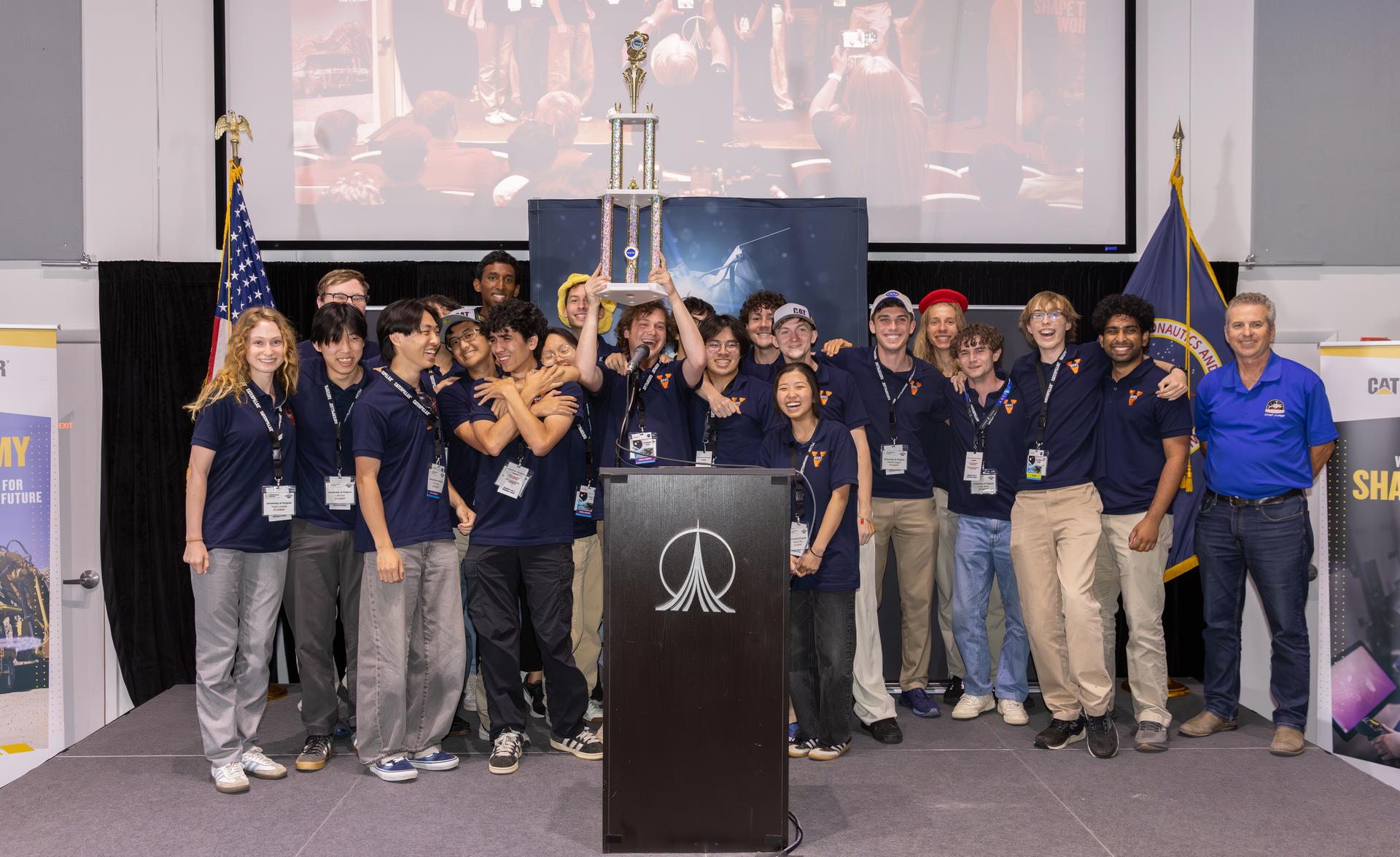
Resilient. Efficient. Autonomous. These are qualities NASA demands of its hardware, especially as the agency accelerates plans for a permanent Moon Base. NASA’s 2026 Lunabotics Challenge put those traits on full display, as college student engineers from across the country gathered at the Astronauts Memorial Foundation’s Center for Space Education at the Kennedy Space Center Visitor Complex in Florida to demonstrate robotic technologies and systems engineering expertise that could build and sustain long‑term lunar infrastructure.
When the simulated lunar dust settled, the University of Virginia earned the Off World Grand Prize for completing all events and achieving the highest overall score.
“The Off World Grand Prize is really about everything,” said Robert Mueller, senior technologist at NASA Kennedy’s Swamp Works, lead judge, and co‑founder of the original Lunabotics robotic mining challenge. “It’s a difficult prize to win, and it’s not obvious, because the team that built the biggest berm didn’t win. But on an actual lunar mission, it’s not just one thing that matters — it’s everything in the system.”
Student test bed for lunar construction challenges
The agency’s annual Lunabotics Challenge is a two‑semester competition in which higher‑education students design, build, and test prototype lunar construction robots using NASA systems engineering principles. The 2026 competition opened last September, with teams submitting industry plans, engineering reports, and robot specifications. Judges selected 47 teams to advance to a qualifying round at the University of Central Florida’s Exolith Lab in Orlando, where the robots faced their first tests.
The goal during the qualifying round was straightforward: excavate and collect simulated lunar soil, transport it across challenging terrain, and construct a berm, or a raised mound of soil used to provide structure, support, or protection. Performance was evaluated across several criteria, and the top 10 teams moved on to the three‑day final round held May 19 to 21 at NASA Kennedy.
Judges assessed far more than berm size. Robot weight, communications performance, energy use, and level of autonomy all contributed to scores across four main criteria: a science, technology, engineering, and math (STEM) industry plan; a systems engineering paper; presentations and demonstrations; and robotic construction.
The University of Virginia team excelled not only in measurable metrics but also in preparation and resilience. When a wheel detached during their first finals run, the team reconfigured the robot to operate on three wheels and kept digging.
“When we saw the wheel break in the arena, we thought that was it,” said Craig Kalkwarf, a fourth‑year aerospace engineering and astronomy major and mechanical lead of the 22‑member team. “But we came so prepared. We had metal wheels ready to swap out. We had a plan. We ultimately got the win, and part of that was planning for anything — and it worked out.”
Students from the University of Virginia prepare their prototype lunar robot for its turn during the finals for NASA’s 2026 Lunabotics Challenge competition on Wednesday, May 20, 2026, inside the Astronauts Memorial Foundation’s Center for Space Education at the Kennedy Space Center Visitor Complex in Florida. NASA/Cory S HustonEngineering NASA’s lunar future
A key part of the Lunabotics Challenge is students employing NASA’s Systems Engineering Process, a multidisciplinary, mission‑driven approach that integrates hardware, software, people, and procedures to create complex, high‑reliability systems.
Competition judges noted that the systems engineering prowess on display this year was among the strongest in the challenge’s 17‑year history. Teams and their robots demonstrated remarkable adaptability in the face of obstacles. Multiple teams overcame wheel issues, robots stuck in rough terrain managed to break free, and one team pressed on after its digger blades damaged their robot, but only after it successfully deposited enough material to create an impressive berm.
By the competition’s close, event organizers praised how teams built upon previous robotic designs, as several teams were veterans of the competition, and marveled at the number of fully autonomous robots that competed in the qualifying and final rounds. Last year, there were 12 fully autonomous robots, while this year the number grew to 27. This led to tighter competition, as well as more efficiency during the runs inside the Center for Space Education’s Artemis Arena – the large, engineered test bed filled with lunar soil simulant, designed to mimic the loose, uneven terrain robots will encounter on the Moon.
“Teams excavated much more material than we anticipated,” said Rich Johanboeke, project manager for the competition and longtime Lunabotics organizer. “This speaks to how teams have evolved previous design iterations and how much innovation we’re seeing from these students. It’s an exciting time!”
The University of Utah team’s prototype lunar robot performs during the finals for NASA’s 2026 Lunabotics Challenge competition on Thursday, May 21, 2026, inside the Astronauts Memorial Foundation’s Center for Space Education at the Kennedy Space Center Visitor Complex in Florida.NASA/Kim ShiflettChallenge designed for the Artemis era
Coming just weeks after the success of NASA’s Artemis II mission, Lunabotics highlights some of the next steps toward establishing a sustainable human presence on the Moon. Autonomous robots capable of shaping lunar soil into berms will play a vital role in protecting landing sites, supporting power systems, and forming the building blocks of future lunar outposts.
“This might be the first thing NASA does on the Moon Base — robotically building a berm using a local resource, the lunar soil,” Mueller said. “We are watching and learning from these teams in preparation for a real mission launching in a few years, which is IPEx.”
Developed at Kennedy’s Swamp Works, IPEx, or Infrastructure Pilot Excavator, is poised to launch to the lunar surface through NASA’s CLPS (Commercial Lunar Payload Services) initiative. Acting as both excavator and hauler, IPEx is designed to dig and transport lunar regolith efficiently, which are critical capabilities for supporting human exploration and making the most of lunar resources.
Building engineering pipeline to NASA
This year’s Lunabotics Challenge didn’t just celebrate student ingenuity — it helped advance the technologies and engineering approaches that will define the next era of lunar exploration.
For students, Lunabotics provides an immersive engineering experience that mirrors industry‑level problem‑solving. For NASA, the competition, like the agency’s other Student Design Challenges, is helping to find novel solutions to technical challenges currently faced by the agency, while also helping recruit the next generation of engineers, technologists, and innovators to NASA.
Alumni from the College of DuPage in Glen Ellyn, Illinois, accept the Lunabotics Construction Award on behalf of the team for building the largest berm during NASA’s 2026 Lunabotics Challenge competition on Thursday, May 21, 2026, inside the Astronauts Memorial Foundation’s Center for Space Education at the Kennedy Space Center Visitor Complex in Florida.NASA/Kim Shiflett“I think it’s everyone’s dream to come work at NASA,” said Andrew Ebert, a mechanical engineering student at the College of DuPage in Glen Ellyn, Illinois, whose team took home the prize for building the biggest berm. “It’s always pushing the boundaries of what has ever been done by humans. In my opinion, it’s the coolest thing you can do in engineering.”
The creativity, resilience, and technical mastery demonstrated by these teams are directly shaping NASA’s path toward a sustainable Moon Base. When Americans begin lunar construction in a few years, the experience and expertise gained by the young engineers through Lunabotics becomes even more meaningful and potentially impactful for NASA.
“These students might be working for NASA by the time we start building on the Moon,” said Mueller.
To learn more about NASA’s Lunabotics Challenge visit:
www.nasa.gov/learning-resources/lunabotics-challenge
2026 Lunabotics Challenge Winners
Off World Grand Prize – Overall ExcellenceUniversity of Virginia in Charlottesville
Lunabotics Construction Award1st place: College of DuPage in Glen Elyn, Illinois2nd place: University of Virginia3rd place: Michigan Technological University in Houghton, Michigan
Caterpillar Autonomy Award1st place: The University of Alabama in Huntsville2nd place: University of Virginia3rd place: University of Utah in Salt Lake City4th place: Purdue University in West Lafayette, Indiana5th place: Iowa State University in Ames6th place: College of DuPage
Lunabotics Efficient Use of Communications Power AwardIowa State University
Systems Engineering Paper1st place: The University of Alabama2nd place: University of Virginia3rd place: University of Illinois in Chicago
Nova Award for Stellar Systems Engineering by a First Year SchoolLaredo College in Laredo, TexasNorthwestern University in Evanston, Illinois
Systems Engineering Leaps & Bounds AwardUniversity of Virginia
Rocket Award for Accelerating Systems Engineering MasteryUniversity of Illinois in Urbana-Champaign
Presentations and Demonstrations1st place: New Mexico Institute of Mining and Technology in Socorro, New Mexico2nd place: The University of Alabama3rd place: Colorado School of Mines in Golden, ColoradoHonorable Mention: Michigan Technological University
Presentations and Demonstrations First Steps Awards
Carnegie Mellon University in Pittsburg, Pennsylvania
Hence then, the article about nasa s 2026 lunabotics winning student teams engineering lunar future was published today ( ) and is available on NASA ( Middle East ) The editorial team at PressBee has edited and verified it, and it may have been modified, fully republished, or quoted. You can read and follow the updates of this news or article from its original source.
Read More Details
Finally We wish PressBee provided you with enough information of ( NASA’s 2026 Lunabotics: Winning Student Teams Engineering Lunar Future )


Also on site :
- ‘Avengers: Endgame’ retakes box office crown; Robert Pattinson drives sales for ‘Primetime’
- At 68, Shaun Cassidy Jokes He’s the Rip Van Winkle of Teen Idols — ‘Looks More Like Shirley Jones Now’
- 1977 Fleetwood Mac Hit Was Recorded in the Wrong Key After a Day of Perfecting Its Iconic Guitar Sound