
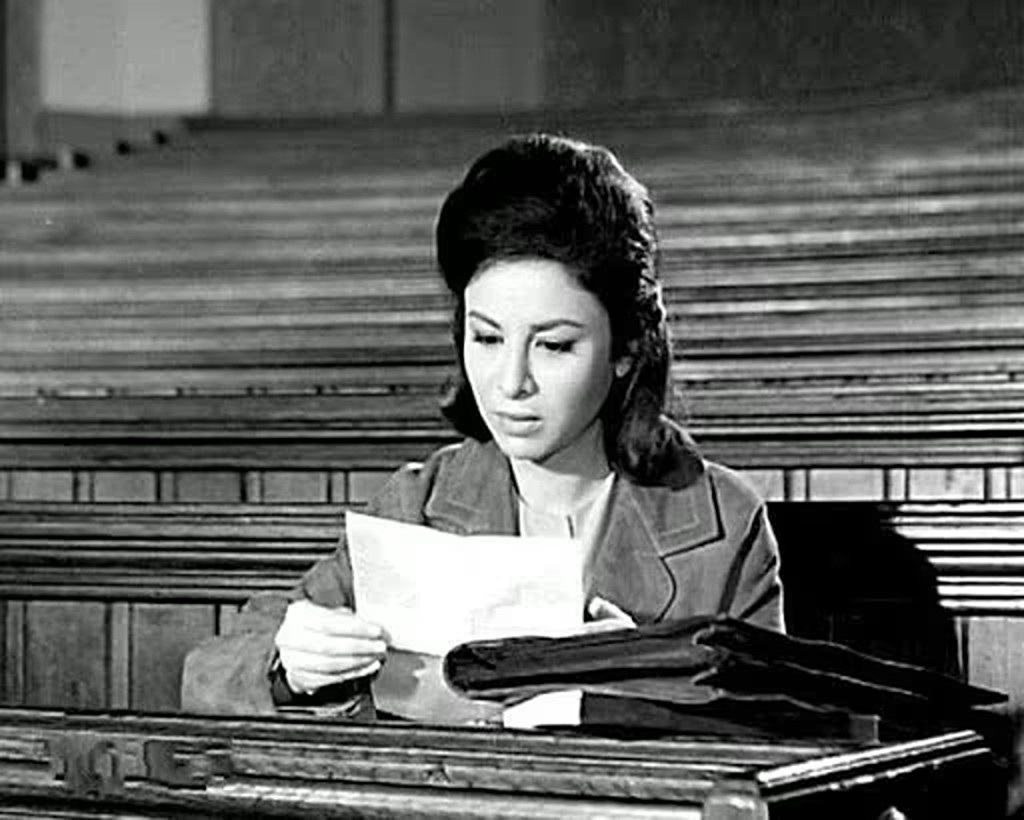
In the first five minutes of the feminist film El Bab El Maftouh (The Open Door, 1963), Laila, played by Faten Hamama, transitions through three different states at once, each symbolizing the entirety of her story within only a few scenes. The first scene shows her joining a school protest, fighting against imperialism and the oppression of women. The second shows her being violently beaten by her father in her home. And finally, the third scene places her within the walls of her own bedroom, unwilling to open the door to anyone. From one scene to the next, Laila becomes a different person, as though the woman in the first scene is no longer the same woman in the second. She is first presented as powerful, resisting in the streets, and within seconds, she is reduced to complete vulnerability inside her own home. By the third scene, she is locked inside her bedroom, as though the “free woman” who existed at the beginning of the film had either never existed at all or had died the moment she returned home. Without relying on a lengthy or complicated storyline, the…
This content is for members only. Visit the site and log in/register to read.The Letter that Ignited Egypt’s Feminist Awakening first appeared on Egyptian Streets.
Hence then, the article about the letter that ignited egypt s feminist awakening was published today ( ) and is available on Egyptian Streets ( Egypt ) The editorial team at PressBee has edited and verified it, and it may have been modified, fully republished, or quoted. You can read and follow the updates of this news or article from its original source.
Read More Details
Finally We wish PressBee provided you with enough information of ( The Letter that Ignited Egypt’s Feminist Awakening )


Also on site :
- APOD: 2026 September 23 – A New Lunar Crater: McGetchin
- The Seemingly Harmless 4-Word ‘I’ Statement That’s Actually a Massive Relationship Red Flag, According to a Psychologist
- Kit Harington Thinks There Still Could Be A Jon Snow Spinoff, Says He Now Feels More Comfortable With ‘GOT’ Character