
For a moment, I thought the jet lag may have been making me loopy. “2026 is the year of climate adaptation,” the radio ad blasted as I sat in a ride share vehicle. “Take action to protect you and your community.”
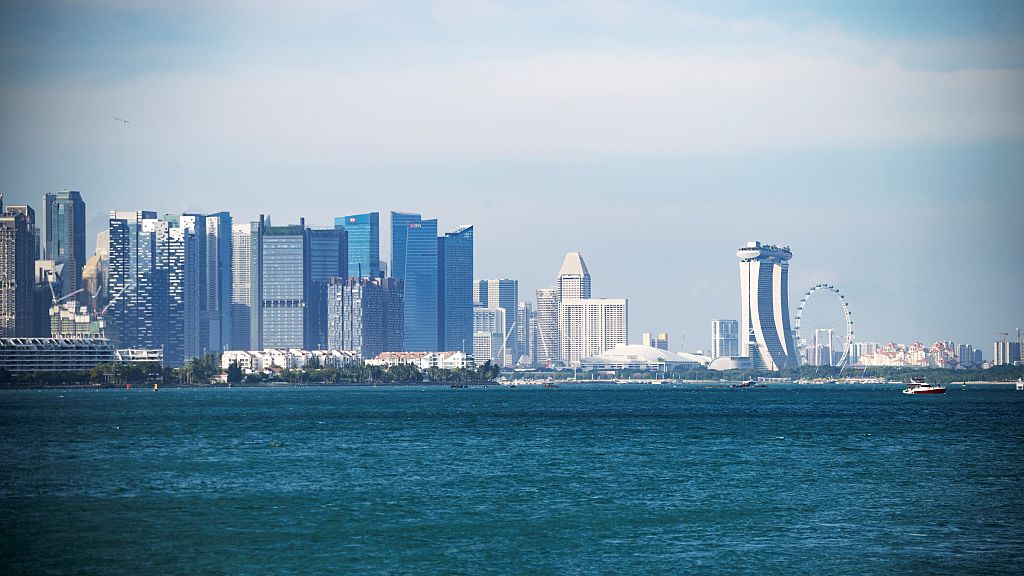
In the U.S., government leaders have seemingly abandoned forward thinking messaging on climate change. Traveling to Singapore for Ecosperity, the closest thing the country has to a climate week, felt like going back in time. Business and finance leaders spoke vocally about their investments in emissions reduction, government officials touted climate policy efforts, and scientists urged action to prevent the worst effects of rising global temperatures.
But it also felt like a glimpse into a possible future. Nascent financing models, including carbon markets, are being scaled to fund the transition, helping unleash on-the-ground investment in clean technologies. And new methods of adaptation are eagerly being adopted as the effects of climate change are already affecting lives and livelihoods. Critically, the moralizing over climate change is gone. Instead, the conversation here sounds much more pragmatic.
The war in the Gulf “makes the case for renewable energy even stronger, not just as a climate solution, but as a pathway to greater energy security, resilience, and long-term strategic competitiveness,” Dilhan Pillay, the CEO of Temasek Holdings, Singapore’s state-owned investment firm, told Ecosperity attendees.
Singapore—and the broader region—have in some ways been forced into this more proactive position. Climate effects, namely heat and sea level rise, are hitting Southeast Asia hard, as is the energy crisis prompted by war in Iran that has led to fuel shortages in the region. But Singapore’s approach is also strategic. The country developed into the economic powerhouse that it is today with strategic investment and planning. While the rest of the world waffles on decarbonization, today’s climate presents another opportunity to gain competitive advantage.
Singapore is an important climate and energy economy case study for a long list of reasons. It’s one of the world’s biggest and most significant energy trading hubs while also producing very little of its own energy. It relies on imported goods, including food, a vulnerability especially worrying in the face of climate extremes. And it’s keen to be a data center hub, though under strict conditions that protect it from some of the externalities that have led to a backlash elsewhere.
But what struck me most about the discussion at Ecosperity was the focus on financial innovation. Singapore is a global financial hub with particular sway across Southeast Asia, and global financial institutions use the city as a home base for their operations in the region. While most big financial firms haven’t fully abandoned their sustainability-minded work, they have in many cases scaled them back. In Singapore, the focus on supporting sustainable and transition-related projects remains.
At the conference, I met with investors and financiers at the leading edge of the financial innovation necessary to accelerate decarbonization. That includes an important focus on the role of carbon markets. Singapore has launched a full-throated effort to establish rules of the road to allow funding for carbon offsets to back clean energy and other climate-related projects. And Singapore has sought to play a key role in developing and scaling blended finance, which combines public and private money to make projects go further and reduce risk for investors. Temasek is a key leader in the region focused on seeded platforms to invest in renewable projects in Southeast Asia using this approach. The goal is to make a whole tranche of “marginally bankable” projects financeable.
These projects might seem regional and the structures a little esoteric, but the hope is that figuring out the right structure and then scaling it will unlock projects across Asia and ultimately the world.
The war in Iran and the closure of the Strait of Hormuz has changed the economics and provided a tailwind to these efforts. The premium that countries in the region are willing to pay to ensure energy security has increased overnight—and so has the viability of clean technologies. “Energy security and climate action are no longer separate. They have converged,” said Ravi Menon, Singapore’s ambassador for climate action. “But that convergence is very fragile.”
Indeed, the market in Southeast Asia is far from perfect. In the near-term at least, coal usage is on the rise to meet shortages from other fuels. And Pillay used the conference as an opportunity to say that Temasek would not reach its 2030 emissions reduction targets.
But the signal in the noise is one of a persistent evolution in energy systems driven by necessity. It’s easy to be myopic sitting in the U.S. or Europe as politics complicate energy markets. But as Singapore reminds us: structural change is coming, even if it’s slower.
To get this story in your inbox, sign up to TIME's Future Proof newsletter here.
Hence then, the article about what singapore understands about the next phase of climate action was published today ( ) and is available on Time ( Middle East ) The editorial team at PressBee has edited and verified it, and it may have been modified, fully republished, or quoted. You can read and follow the updates of this news or article from its original source.
Read More Details
Finally We wish PressBee provided you with enough information of ( What Singapore Understands About the Next Phase of Climate Action )


Also on site :
- She’s Gone From Indie Rocker to Unlikely Pop Star. Now She’s Back With Her First Album Since the Big Change.
- TIER IV joins JST's Next-Generation Edge AI Semiconductor R&D Program to open-source AI chip designs for autonomous driving
- Security and Data-Residency Reviews Push Enterprise AI Buyers Toward Self-Hosted Platforms, and FastGPT Publishes Its Terms