
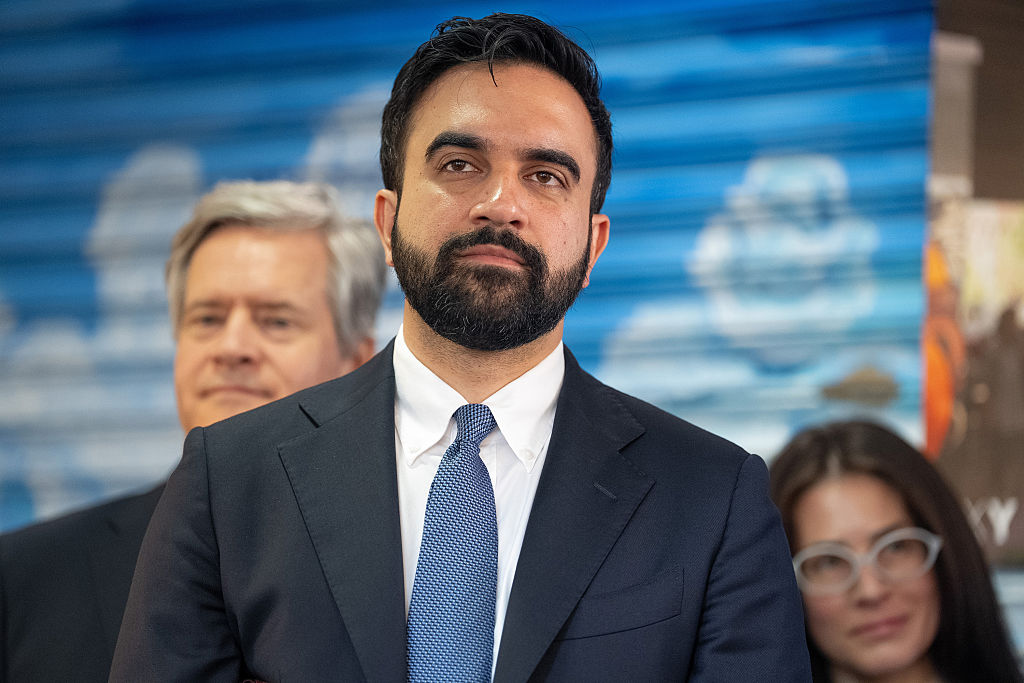
One of New York City Mayor Zohran Mamdani’s central campaign promises, in the face of spiking grocery prices, was to introduce what his campaign described as a “network of city-owned grocery stores focused on keeping prices low, not making a profit.”
Now, Mamdani is unveiling plans to start bringing that promise to fruition. The first of the stores, he announced Monday, will be opened at The Peninsula, an affordable housing complex being built in the Bronx’s Hunts Point neighborhood, next year.
“This store and the Peninsula as a whole will serve as physical proof of our conviction that government can be a force for good, that government can drive change that improves people’s lives,” he said, speaking at a rally with union members at the Bronx site.
Mamdani previously announced plans last month to open another city-owned grocery store at the La Marqueta marketplace in Manhattan’s East Harlem, which he hopes to launch by 2029.
The Mayor’s office has said it selected the sites based on grocery store density, how income levels in the areas compare with the cost of living, and population density, framing the project as an intervention in neighborhoods where access to affordable food remains uneven despite decades of redevelopment efforts.
In total, Mamdani has pledged to ultimately open five city-owned grocery stores—one in each of New York City’s five boroughs. His Administration is still examining locations for stores in Brooklyn, Queens, and Staten Island, and is encouraging property owners to recommend sites to the city online.
The city plans to waive rent and taxes for the five new grocery stores so they can offer residents discounted food prices. The cost of establishing all the stores is estimated at $70 million. The City Council is set to begin reviewing that planned budget and how the funds are being allocated at a May 29 hearing.
Read more: Did Zohran Mamdani's New Budget Really Eliminate New York City’s Deficit?
The proposal has already drawn scrutiny from City Council Speaker Julie Menin, who has raised concerns about how city-owned grocery stores could affect existing bodegas and neighborhood supermarkets, signaling early friction between Mamdani’s Administration and the city lawmakers who will ultimately decide whether to approve funding.
The plan has also sparked opposition from some small-business groups and independent grocers, who argue that city-owned stores could disrupt retail food markets in the city, in which profit margins are already thin.
Here’s what to know about the planned sites Mamdani has announced so far, and the opposition being raised to his plan.
The first of the planned stores, which Mamdani announced this week, will be in the Bronx.
The Hunts Point neighborhood, where the store is set to open next year, is still grappling with the impact of the economic disinvestment that reshaped the South Bronx in the 1970s. It has a notably high poverty rate, with roughly 36 percent of its residents living in poverty compared to 18 percent citywide.
Though one of the world’s largest food distribution centers operates in the neighborhood, the Mayor estimated that 77 percent of households in that section of the South Bronx have difficulty affording basic necessities. According to Mamdani’s office, there is only one full-service supermarket within a quarter mile of the Hunts Point site, Compare Foods Supermarket.
During his announcement, Mamdani referenced a famous 1986 quote from former President Ronald Reagan, who he noted “famously said the nine most terrifying words in the English language are ‘I’m from the government and I’m here to help.’”
“It's a good quote, but I disagree,” the Mayor said, adding, “I think nine more terrifying words are actually, ‘I worked all day and can't feed my family.’”
He said his team aimed to use the power of the government to lower prices so that affordable produce would be accessible to New Yorkers.
The Bronx store will cost an estimated $10 million to build, according to city officials.
The broader Peninsula development that will house the store is expected to include roughly 740 affordable housing units, along with space for light manufacturing and community use. The development is part of a broader city project to redevelop the Spofford Juvenile Detention Center, which closed in 2011.
Rep. Alexandria Ocasio-Cortez of New York, whose district the planned store is located in, voiced support for the initiative. In a statement, Ocasio-Cortez praised Mamdani’s effort to expand access to affordable groceries in the South Bronx.
“Access to affordable, fresh food should not be a luxury determined by ZIP code; it should be a right,” she said.
The plans for the Bronx store have raised concerns among some local business owners, however, who worry a city-run supermarket could draw customers away from existing neighborhood grocers.
Rubén Luna, who owns supermarkets in both the Bronx and Manhattan, told The New York Times he fears lower-priced city-owned stores could undercut private businesses and ultimately lead to job losses.
Some community leaders have also questioned whether public funding could instead support existing neighborhood food sellers. Majora Carter, an entrepreneur and longtime Hunts Point advocate, told the Times the city could potentially help residents more quickly by subsidizing local supermarkets, green delis, or street produce vendors rather than opening a new municipal store.
The Manhattan store
A second planned city-owned grocery store will be located at La Marqueta in East Harlem, a historic marketplace beneath the elevated Metro-North tracks on Park Avenue that is owned by the city and operated by the New York City Economic Development Corporation.
Opened in 1936 as the Park Avenue Retail Market, La Marqueta was originally created to bring pushcart vendors under one roof and improve access to fresh food for working-class New Yorkers. Over time, as East Harlem became a center of Puerto Rican and broader Latino life in the city, the market evolved into a long-standing cultural and commercial hub and acquired its current name. Though its footprint has diminished over the decades, it still supports over 20 small businesses and 120 workers, including restaurants, artists, and community organizations.
Mamdani announced the site for the store in April, describing it as the first location identified for the city’s broader municipal grocery initiative, though officials say the Bronx store is expected to open sooner. The East Harlem location is projected to open by 2029.
The planned 9,000 square-foot store will be built from the ground up on an empty lot at La Marqueta.
City officials have pointed to both rising costs and persistent food insecurity in East Harlem site as reasons why the site was selected.
Pushback against Mamdani’s plans
As Mamdani has moved forward with enacting his promise to build city-owned grocery stores, critics of the plan have begun mobilizing to oppose it.
One organization, the Multicultural Business Coalition, is raising funds to support public opposition efforts and legal challenges aimed at blocking or delaying the city-owned stores and signaled that it may initiate such legal action itself.
“This is a waste of our tax dollars,” Frank Garcia, the group’s chairman, told the Times, arguing that the city should instead pursue subsidies or other mechanisms to reduce prices rather than launching stores that he contended would compete directly with private grocers in already competitive, low-profit retail markets.
Bodega owners, many of whom operate on thin profit margins, have similarly voiced concern that city-run sites could undercut neighborhood businesses that have long served as informal food anchors in working-class communities, warning of potential job losses and store closures if the model expands.
“It’s unfair,” Francisco Marte, a Bronx bodega owner who heads the Bodega and Small Business Group in New York, told the Gothamist. “They are using our tax money to compete with us.”
Officials in Mamdani’s Administration have said the stores would not stock the same mix of products as bodegas, noting they would not sell items like lottery tickets or tobacco, a distinction they argue could reduce direct competition with corner stores.
Mamdani has defended the proposal as part of a broader effort to address affordability in New York City, arguing that rising food costs require direct public intervention.
“We’re going to make it easier for New Yorkers to put food on the table,” he said when announcing the East Harlem store.
Hence then, the article about what we know about mamdani s first planned city owned grocery stores was published today ( ) and is available on Time ( Middle East ) The editorial team at PressBee has edited and verified it, and it may have been modified, fully republished, or quoted. You can read and follow the updates of this news or article from its original source.
Read More Details
Finally We wish PressBee provided you with enough information of ( What We Know About Mamdani’s First Planned City-Owned Grocery Stores )


Also on site :
- ‘The Debut’ Features Seven Original Songs, All Written by Jesse Eisenberg, and One Is Getting an Oscar Push (Exclusive)
- 1971 Movie, Directed by Dennis Hopper, Launched a Music Legend’s Acting Career—Just as He Scored His First No. 1 Hit
- ‘The Debut’ Review: Julianne Moore And Paul Giamatti Get Big Laughs In Jesse Eisenberg’s Hilarious And Even Sweet Look At Community Theatre – Telluride Film Festival