
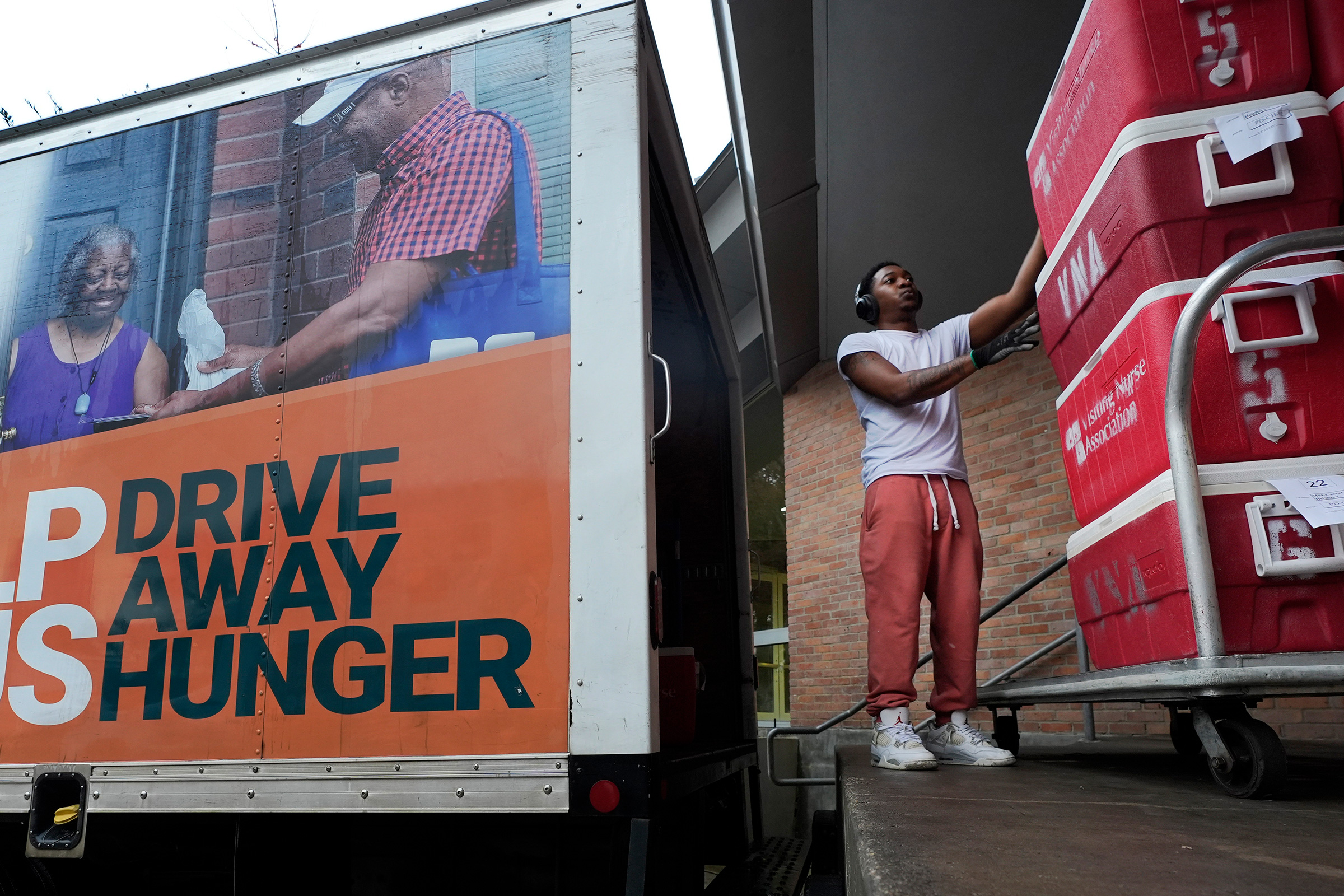
Meals on Wheels, the 72-year-old group that delivers food and companionship to the homes of elderly people, is not immune from the struggles facing America’s nonprofit sector. Applications for meals have risen, volunteers are down, gas and food prices are higher, and the federal funding that supports much of the organization’s work has been down or flat for years. Some local organizations have been forced to close or merge. As the president and CEO of Meals on Wheels America, the advocacy group for the loosely affiliated locally run organizations, Ellie Hollander is deeply familiar with the challenges faced by old people and by the volunteers who keep the neighborhood meals coming. “It's heart-wrenching to me, and it's stunning that older adults are not prioritized in our country,” she says.
In April, billionaire philanthropist MacKenzie Scott gave Hollander’s organization $70 million, her biggest gift so far this year. Hollander talks about how the organization is planning on using such a huge gift, why the waiting lists for Meals on Wheels services keep getting longer, and the difficulties of simply getting volunteers reimbursed for their gas mileage.
This interview has been condensed and edited for clarity.
Is it fair to say that Meals on Wheels is the least controversial charity in the United States?
I would certainly like to think so. When we did our last public survey of voters 18 and above, nine out of 10 knew of Meals on Wheels, and of those, nine out of 10 thought favorably of it.
Does that reputation make it harder to get your concerns heard?
We’re a little hidden in plain sight, just like senior hunger and social isolation are. We got a boost in attention during the pandemic, when all of us were having to isolate at home, wondering where our next meal was coming from, when we were going to see another adult or a member of our family. This is the reality that the older adults that Meals on Wheels serves deal with on a day-to-day basis.
Is Meals on Wheels feeling the headwinds that are being faced by other charitable organizations? Has there been a drop in fundraising and volunteer support?
Yes, no question about that. The increase in gas prices and food costs have had a real deleterious impact on volunteers, because many of our volunteers are older, they are on fixed incomes, as are many of the seniors that we visit. About 32% of funding comes through the Older Americans Act. There are other programs that supplement and complement that, but at the end of the day, it's a public-private partnership, and we need people to care more. A maximum 1% of all philanthropy in our country is earmarked to senior issues. As the need increases, private philanthropy is not able to fill the gap.
In San Antonio, a local group was about to suspend service and wealthy benefactors stepped in, and in Michigan, they're starting to use paid drivers because they don't have enough volunteers. How worried are you about local affiliates ceasing to exist?
It is true that there are some smaller programs that have had to fold. Programs are merging with other programs. Sometimes this makes the most sense, but in this case, it's because of dire need. We do have a shortage of volunteers. One of the things that we've been working on since I've been here is just trying to get the charitable mileage reimbursement rate raised from 14 cents, where it was set in 1997. The business rate is 72.5 cents. But there’s a lot of polarization right now, it's hard to get attention for really anything on Capitol Hill.
Congress is full of old people. Why do they not care?
When you talk to individual members of Congress, they're very supportive, but when it comes to making decisions, it's difficult to get together. Things used to be much more bipartisan than they are now. The staff that they bring in are also younger, and we have to educate them too, because there's a lot of turnover. Many of them just don’t have any idea that there are issues around seniors and hunger and social isolation in our country.
Meals on Wheels America is calling for $2.285 billion in funding for the Older Americans Act Nutrition Program in 2027, which is more than double current levels. Why so much?
Because it's never kept pace with need or the rising costs. It's been flat funding for the past two years, and a year prior, there was actually the first cut in decades. Today, we're serving about 2.6 million seniors across the country. The additional funding that we're requesting is because we know that there are about 2.5 million more seniors who need Meals on Wheels services, not only for nutritious meals, but also for social connection.
What can you do to guarantee that you will be able to reach the seniors who need it?
It's a fair question. The fact is, there is no guarantee. I could say to a community in rural Texas, that we've successfully secured doubling of the Older Americans Act funding. I could not tell that program in Texas whether or not they're going to see a concomitant increase in services. That's the honest-to-goodness truth. But the Aging Network [the system of state and local groups that distributes funding] does work well, and we do know where waiting lists exist. Today, we have one in three programs that report waiting lists of, on average, four months. Some programs have 4,000 people on a waiting list.
In America, the richest country in the world, it's quite something to be waiting four months to get meal delivery.
And that's the average. Meals on Wheels is contracted by Area Agencies on Aging who are under state units. Some states will say they don't want to keep a waiting list. And some programs don't keep a waiting list because they can't guarantee that they're going to be able to take somebody off it.
MacKenzie Scott recently gave your organization $70 million. Even for her, that's a big gift. What are you going to use it for?
We're looking at a combination of questions: how do we accelerate some of the successes in our network, to build capacity in the long run? You could certainly spend something like this down immediately and not even make a dent in just taking people off waiting lists. So we're looking at how to phase and do a multiyear disbursement of these funds in ways that we think is going to really make a difference to the Meals on Wheels network at large.
Are you saying you're not going to give this to seniors? You're going to use it to strengthen the organization in a different way?
The goal of Meals on Wheels America is to do what our individual programs can't do. What they do best is help vulnerable seniors in need in their communities. What we do is run cover for them, be advocates for them, raise public awareness and visibility, do research, prove the evidence base to help make the case with individual donors or corporations in their communities. That’s the thing about getting a gift like that. You could spend it down in an hour, but are you going to solve the bigger problem? We're trying to do both.
Do you feel that the volunteering spirit has died down a bit?
Volunteerism has really not bounced back yet from pre-pandemic levels. A lot of corporations still encourage their employees to volunteer, because it's a great team-building opportunity: somebody drives or somebody else delivers. There's nothing more fulfilling than being a volunteer for Meals on Wheels, because you actually get a chance to see the difference you're making right then and there.
Why do you think volunteerism hasn't bounced back since the pandemic?
I have no idea. I wish I knew the answer to that. It isn't for a lack of our programs seeking volunteers. Our seniors have had amazing lives, they're a lot of fun. We always encourage people just to do it once, and what we find is that they're hooked. I don't know if it's a time issue, inflation, the cost of fuel, or that all of these are adding to a financial strain, not only on our programs, but also on volunteers.
We have Social Security, and we have Medicare, and this is America where there are no food shortages. Why are seniors hungry?
There are 14 million seniors who are threatened by hunger, and that's grown by something like 3.1 million in just three years. The seniors that we serve are older. They have limited mobility. They're dealing with multiple chronic conditions. They're not able to get to a food bank. They're not able to prepare their own food or go to a grocery store. That's why it's not as noticeable.
Where are their families?
They may live alone and they may live remotely. Their family may live nowhere near them. We’re often the first point of contact when something goes wrong. A volunteer or Meals on Wheels staff member goes to a house, knocks on a door, and there's no answer. We're the people that are going to reach out, if there is a family member, to let them know that there's a problem.
Is one of the challenges that we are always going to have seniors, so it’s hard to make this feel urgent?
I just think unless you have an older adult in your life that you're caring for or are aware of, you always think Meals on Wheels is going to be there.
To be clear, Meals on Wheels is always going to be there, right?
Well, Meals on Wheels is a network of individual programs in communities, large and small, suburban, rural, and urban. Is there always going to be a Meals on Wheels program in your community? I can’t guarantee that. But will there always be Meals on Wheels somewhere? Yes, I absolutely believe it.
What can people do to help?
There are three easy steps: donate, advocate, volunteer. All three are important.
Hence then, the article about why meals on wheels america desperately needed the 70 million it got from mackenzie scott was published today ( ) and is available on Time ( Middle East ) The editorial team at PressBee has edited and verified it, and it may have been modified, fully republished, or quoted. You can read and follow the updates of this news or article from its original source.
Read More Details
Finally We wish PressBee provided you with enough information of ( Why Meals on Wheels America Desperately Needed the $70 Million It Got From MacKenzie Scott )


Also on site :
- Inter Miami vs Atlanta United: When and Where to Watch the MLS Match
- ‘The Liberation’ Review: Carrie Coon Is Breathtaking as a Woman Lured by a Cult in Guy Nattiv’s Deeply Personal Film
- Nordstrom Rack’s Striped Ribbed Polo Sweater Is a Stylish Summer-to-Fall Wardrobe Staple, Now 55% Off