
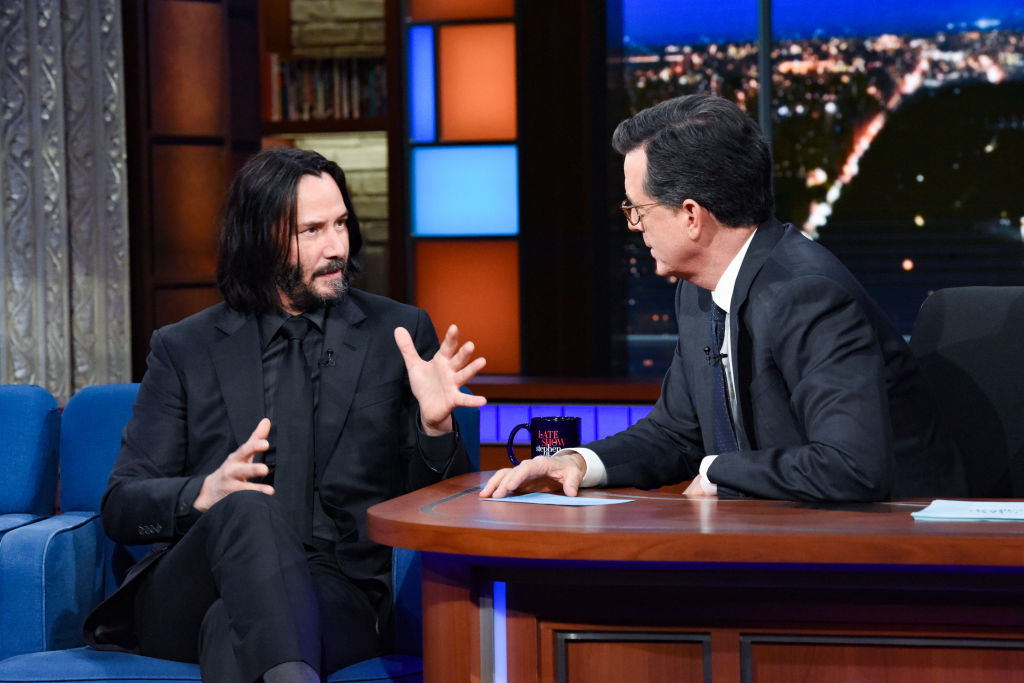
On May 21, when Stephen Colbert tapes the final episode of The Late Show, he’ll walk offstage having done something no one has adequately credited him for: making it normal to talk about the hardest parts of being alive.
I started working on The Colbert Report as a writers’ researcher in 2005. A couple months earlier, my mom had called: “Beck, I heard Stephen Colbert on Fresh Air today. He’s getting his own show. You should work for him.”
We both recognized that Colbert was funny, yes. But the real draw, and what we couldn’t properly articulate, was that he also had a way of revealing the full scope of a guest’s humanity. To my shock, I got the job. On the final night of our late summer hiatus in 2006, my mom died in a car accident 40 miles from the studio.
My life split cleanly in two. Back at work a couple weeks later, I found myself trying to flatten my grief, absorb it and keep going. Not because anyone said to do so (many colleagues showed up to the funeral in an oversized white rental van). Because the culture around me didn’t have adequate language for how to grieve, or where to make space for loss.
Now that The Late Show is coming to an end, I keep thinking about how unusual it is that Colbert refused that expectation. He created moments on one of the most mainstream stages in American life where difficult human experiences weren’t packaged into something easier to sit with or made tidy. They stayed there, unresolved, in front of millions.
Take the viral interview with actor Andrew Garfield in 2021, who spoke plainly about missing his mother and wanting the grief to remain, because he regards it as all the unexpressed love he still has for her. Or one of Colbert’s many conversations with Anderson Cooper, reflecting on the deaths of Cooper’s parents with a clarity that didn’t rush toward closure. In 2019, Keanu Reeves responded simply to Colbert’s question in about what he believes happens when we die: that the people who love us will likely miss us very much. Colbert himself often returned to the loss of his father and brothers in a plane crash when he was a child, and his mother’s death. In 2024, Colbert payed tribute to his longtime assistant Amy Cole, a woman dear to many of us.
These moments didn’t resolve. They didn’t pivot neatly back to promotion or punchlines. They simply existed, often sandwiched between absurd segments like “That’s Yeet Dabbing on Fleek, Fam!” or eating cereal with the help of a crane. The point wasn’t to elevate grief into something holy. It was to let it exist alongside everything else.
For all our talk about authenticity, television still struggles to hold difficult human experience unless it can be shaped into something digestible. Too often, grief is compressed into an origin story, lesson, or turning point. Or it’s reserved for moments of collective catastrophe. Everywhere else, it’s treated like something that needs to be edited down.
When my mom died, I didn’t yet have language for what had happened to me. I only knew the world felt different. Yet, while working for Colbert and watching him on air for years after, I absorbed something else.
Loss didn’t have to be hidden to be survivable. Talking about it didn't diminish you. It deepened your understanding of others. And if you did it with the right beats and warmth, you wouldn’t send people running for the hills. You'd get an Emmy.
In recent years, more spaces for candid conversations about grief have emerged. Anderson Cooper's podcast All There Is invites extended, unguarded discussions about loss. Marc Maron’s WTF podcast spent years doing the same. There are newsletters, online communities, #grieftok, and support networks—many of them thoughtful, nuanced, and deeply needed. But they share a common feature: you have to go looking for them.
We are living in a moment of increasingly fragmented media, where fewer spaces bring large audiences into the same conversation. Late night television remains one of them. Colbert used his platform not just to comment on politics or culture, but to expand what could be said there.
In last year’s acceptance speech after winning his Emmy for Outstanding Talk Series, Colbert shared how he had set out to make a late-night show about love but later realized “we were doing a late-night comedy show about loss. And that’s related to love, because sometimes you only truly know how much you love something when you get a sense you might be losing it.”
In his decades of late night television, Colbert showed that love and loss are inseparable. As he steps away, television producers face a choice: Do we create space for the hard and the painful? Or do we push those conversations back to the margins, even while they shape every one of our lives?
Hence then, the article about stephen colbert made the hard parts of being human watchable was published today ( ) and is available on Time ( Middle East ) The editorial team at PressBee has edited and verified it, and it may have been modified, fully republished, or quoted. You can read and follow the updates of this news or article from its original source.
Read More Details
Finally We wish PressBee provided you with enough information of ( Stephen Colbert Made the Hard Parts of Being Human Watchable )


Also on site :
- Louis Partridge & Anson Boon Set For British Coming-Of-Age Film ‘Andy & Orson’; MetFilm Launches Sales For TIFF Market
- Anna Foglietta on Working With Alba Rohrwacher on Venice Drama ‘A Common Story’ ‘You Have to Have the Guts to Show Yourself Exactly as You Are’ — Trailer (EXCLUSIVE)
- Migrants accused of beating baby dolphin to death in Spain (VIDEO)