
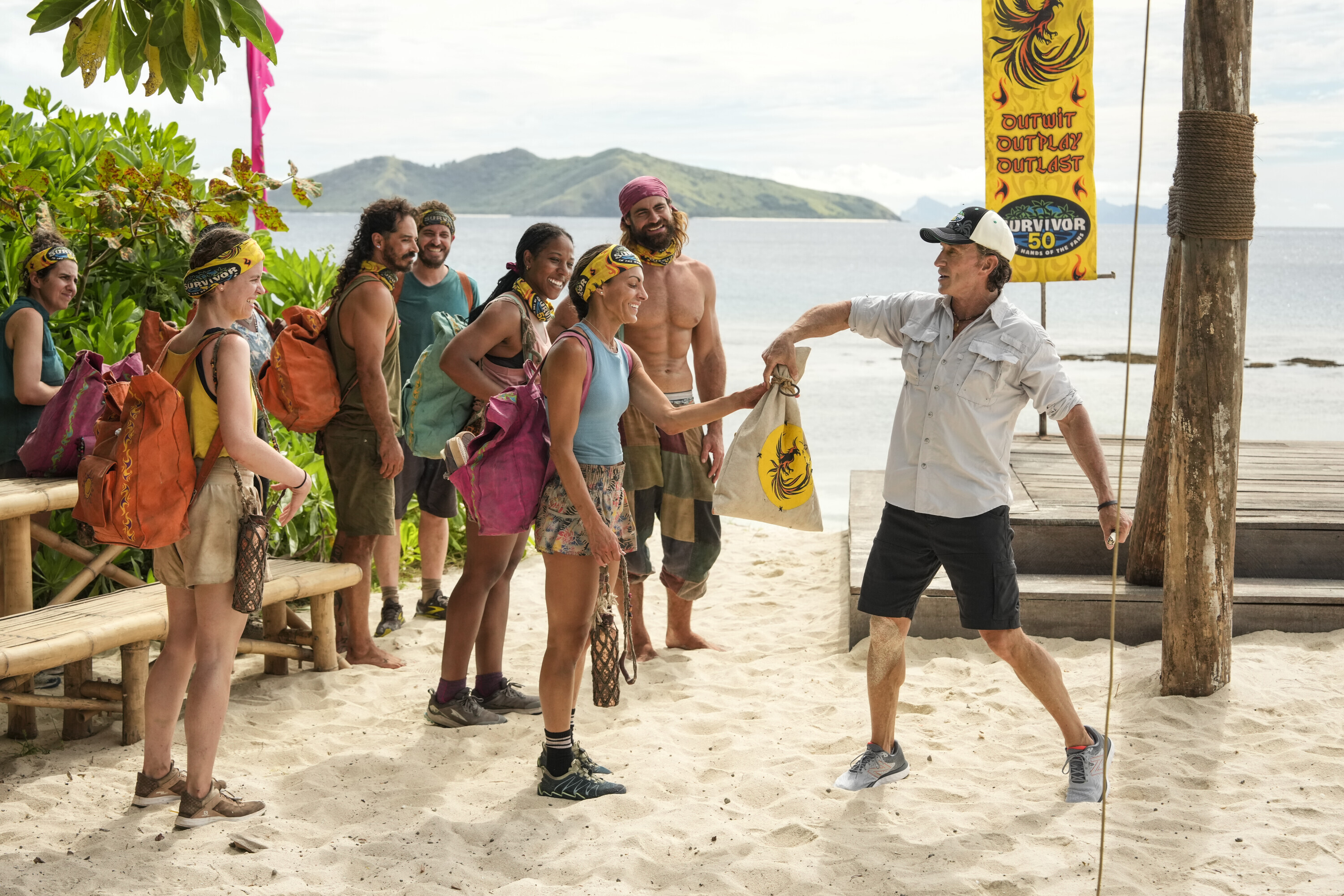
When host and executive producer Jeff Probst officially announced the 50th season of Survivor in February 2025, a key selling point was the theme, as reflected by the In the Hands of the Fans. Viewers had the opportunity to weigh in on game mechanics for this historic season—and during Wednesday’s finale, the results of those remaining fan votes will become clear. The final four contestants will compete in one last individual immunity challenge, selected by vote from three choices: Simmotion, Pinball Wizard, and a recent variant of the classic Obstacle Course.
But who conceptualizes and designs these games? And who decided on those three candidates in the first place? The challenge department is primarily run by senior challenge producer John Kirhoffer (who has been on board since the beginning of the series) and supervising producer Chris “Milhouse” Marchand (who joined for season 23), who take about a month to map out an upcoming slate of challenges in Los Angeles ahead of filming. Along with “third musketeer” Anthony “AB” Britton and production designer Simon “Simmo” Ross, they canvass friends and consultants for new ideas and creative new tweaks on familiar challenges. Achievability is always a priority, but so is fun.
After vetting their ideas, including with challenges editor David Armstrong, Kirhoffer and Marchand pitch them to Probst and executive producer Matt Van Wagenen, who offer refinements. As approval comes in, Simmo and the art department get to work on building each element. That way, when the challenge team arrives on location in Fiji a few weeks later, there are pieces ready to be tested for safety and entertainment. After a month or so of construction, Probst and Van Wagenen arrive on location, at which point the challenges are run without cameras by the Dream Team: young production assistants also known for providing challenge B-roll. Probst allows each department a high degree of autonomy, but the process is heavily collaborative; if a piece isn’t exciting enough, the team (including the director, key grip, and often members of the Dream Team) sits around to spitball new ideas and sculpt it into the challenge that appears on our screens.
TIME spoke with Kirhoffer, Marchand, and Probst about choosing the challenges for this momentous season—and why recreating certain classic challenges of the past is no longer feasible.
John Kirhoffer: We think about the best stuff in our library, and how can we make those successful challenges bigger and better? We watch shows and sporting events from all over the world and adventure races, looking for elements to grab. One of our mantras is, if we were just a couple of 12-year-old kids running around, what would we do for fun? “Can you throw this rock and land it on that stump?” Those kind of things. We always try to think what’s fun for kids to do, then make it bigger for adults.
Chris Marchand: Sometimes, it’s the simplest thing in the world. How can we make the simple thing a little more complicated, or how can we make this super complicated thing a lot simpler so we can do it?
What type of international competitions do you look to for inspiration?
Kirhoffer: We go to the really obscure. Bulgarian game shows.
Marchand: Exatlón from Mexico and Colombia.
Kirhoffer: One of our consultants is Jonathan Chorovicz. He lives in Argentina. He worked with us for a few seasons back in the day, in the Philippines era. Choro does what we do but on these international shows with a much smaller budget. So he goes, “You know what we did in Colombia? You know what we did in Bulgaria?” Those are very valuable resources.
Marchand: Last week’s challenge is the perfect example of what we do in consulting. We got that big teeter tunnel from Choro. The next thing you do is this weird thing that AB found at an old folks’ home in the Philippines, where they’d cut holes out of a plate and move it up through a spoked pole. We’re like, “Well, we can do that. It can be a lot harder and cooler-looking, but the concept is there.” It just takes time, and it’s better than untying knots. They get the stick to carry their puzzle pieces up and over a teeter-totter, then they do an archway puzzle. The whole point of those challenges is big, fast, fun front end, then a back end that anyone can win as long as you figure out the puzzle or word or parlor game.
L to R: Rizo Velovic, Cirie Fields, Tiffany Ervin, Joe Hunter, Aubry Bracco —Courtesy of CBSKirhoffer: Yes. We’re on location six to seven weeks before we start filming.
Do you ever weigh in on the final cut of the episode or how the challenge is presented?
Marchand: We never weigh in. The challenge is like a live sporting event, so the way it’s edited is for entertainment and awesomeness. We don’t stop during shooting.
Kirhoffer: We have a producer on the show, Zach Sundelius, whom we chat with beforehand. He’ll say, “You know, maybe it’s better that we only have three targets rather than five, because when we’re cutting it, it gets really confusing.” Zach goes back to Los Angeles and follows it all the way through with Dave Armstrong, and those guys have a team of editors that work for them.
Kirhoffer: We are so blessed to have the biggest reality show happening. It has been decades since anybody has ever said to me, “Hey, we gotta watch the budget.” We know the scope of things we do. We can get it done, and if something is a little bigger and better, another challenge will be scaled down.
What was your initial approach when you first sat down to decide what challenges to use in season 50?
Jeff Probst: We knew we wanted to approach Survivor 50 as a celebration, so we had some early meetings with all of our creative teams about what that meant and how it might impact the overall game design. We looked at our history for inspiration, made a list of the most iconic, physically demanding, even the silliest challenges, and asked ourselves how we can combine these to honor our legacy while still delivering a season that feels current and fresh. The goal was to build a tapestry of challenges that represent 25 years of Survivor. John and Chris worked on it for several weeks and then came back with a great pitch.
Jonathan Young, Stephenie LaGrossa Kendrick, Tiffany Ervin, Kamilla Karthigesu, Chrissy Hofbeck in Episode 6 —Courtesy of CBSProbst: We have joked about me running a challenge for at least a decade, but it was never a real consideration until Survivor 50. Once we started writing down ideas, that one shot right to the top of the list. And it wasn’t about proving I could do it. I wanted the players to see that I’m willing to have some skin in the game—to be vulnerable, and to fail right alongside them. It was so much more difficult than I thought it would be. The highlight by far was the players finally getting their chance to mock and taunt me as I’ve been doing to them for 25 years. I went into Survivor 50 ready, willing, and able to be the butt of any joke if we thought it would make for a fun moment. I think some fans get it, and other fans might still think I take these kinds of moments seriously. To them I can only ask: Did you hear me rap?
Fans decided whether the final immunity challenge will be Simmotion, Pinball Wizard, or the Obstacle Course. How did you decide on those candidates?
Kirhoffer: We chose three different types of challenges that have been won by all kinds of people. They were all very popular in their seasons, so we just picked out our favorites that were differently exciting and differently dramatic, then let the fans make the decision.
Probst: We actually worked our way down from a much bigger list, looking for different categories so fans could really make a meaningful choice. Did they want something small and intimate, where it’s all about focus and composure? Or something big and theatrical, where it feels like a full-scale showdown? Each one represents a different style of final immunity challenge, and we genuinely had no idea which way the fans would go.
Kirhoffer: I’ll just give you the reality of that. Personally, I don’t want to stand there for 12 hours staring at somebody’s foot. And with our schedule and all the things we have in the show now—back in the day, it was so relaxed. It was a slower pace. Now it’s move, move, move, go, go, go. We don’t have that kind of time, even, to have a 12-hour challenge, especially in season 50, when we have more players. Quite frankly, I don’t pitch anything that goes more than an hour anymore.
Are there any other challenges you wanted to do that didn’t work out, either logistically or timing-wise? Any you’d want to see come back in the future?
Marchand: We always want to do a maze. Mazes are always fun. But they’re big, and we didn’t really have the open fields or time to make them. The maze is the biggest one we always want to do. One day, we’ll get it again.
Probst: It can take six weeks to build one of our mazes, and that is a lot of people power. So instead of putting that many resources into one individual challenge, we decided to spread it around the entire season. I think it was the right call. But I do look forward to doing some kind of big final five challenge again soon!
Kirhoffer: You know the challenge Hot Pursuit? We’ve wanted to do that forever, and people are always asking about it. But we are very topography-dependent, and we don’t have an area that we’ve had in the past with knee-deep, level water. We have a beautiful ocean, but there are things we can’t do just because of the logistics. This time of year, we’re in the surf capital of the world, and we can’t build the things we’d like to build that we could in Philippines or Panama, because we have these massive swells coming through. If we have something too big, it could just get broken up by the swell. But we pretty much have everything we were hoping for that we could logistically do.
Kirhoffer: We keep evolving and evolving. It’s kind of like when you watch a sitcom. The early ones have a vibe, and the middle seasons have a vibe, and the newer seasons have a vibe. There’s definitely a New Era rhythm. We’ve gotten to stay in the same place, which has been awesome, but we don’t have the same diversity of locations. So when you see a water challenge, they’re done in the same basic areas every year, because there are only so many areas that are protected. Many of them will have very similar configurations during this era because those are the constraints.
This year especially, we do pay attention to what the fans say. We love hearing “we love this challenge” and hate hearing “Those guys don’t know what they’re doing. They’re doing the same crap over and over.” You don’t want to listen to your critics, but we do pay attention to what the fans like so we can keep delivering. One of the things we’ve said about Survivor every new year is that we want to keep it fresh but familiar. You don’t want to tune into The Price Is Right and see an obstacle course. You don’t want to tune into Jeopardy and have it become a big prop show. Sometimes we come up with super bizarre stuff, and it’s like, that’s not Survivor. It has to feel like Survivor.
I was wondering about this, because Chris, you worked on Big Brother: Reindeer Games, and Big Brother leans more into goofiness with some of its challenges.
Marchand: Contestants on Survivor aren’t expecting to do a weird Big Brother challenge where they’re getting pulled back by a giant monster hand. Our endurance challenges feel Flintstones-y. They’ll look cool and be hard, and the contestants expect that.
Kirhoffer: What we can’t do is have big aluminum truss systems and mechanisms. We can’t have an engine that keeps something spinning, because we’re still trying to be Robinson Crusoe. It’s as if Jeff is a super carpenter who comes out there and builds these things. We don’t want to leave our world, so we’re not going to have video monitors. Survivor is wood and canvas and sand and sandbags and dirt and mud. Big Brother is CBS Radford, sound stage, polished, clean and shiny. We’re gritty: they got dropped off on an island, they’re marooned, and now they’re coming to shore, where Jeff comes out of his hut.
Kirhoffer: With the advent of this 3D printing phenomenon, there was a time in the New Era where Jeff would retire a challenge. If someone came in and said, “I did this at home and practiced and practiced,” great, that was really good planning on your part, but now this puzzle is retired. We just get rid of it.
Marchand: It’s also, like, great, you printed the fire puzzles. You know what, we can change the shapes of the pieces just as easily as you print the ones you’ve seen. It’s not out of our control to make that puzzle different in a later season.
Kirhoffer: It seems crazy to me that a couple days after one of our new elements airs, it’s on Etsy. Who are these people that are allowed to just replicate our puzzles and sell them?
What was your favorite challenge moment in season 50?
Marchand: One of the coolest things we’ve done collectively is go from the auction and move directly into a challenge. I haven’t seen us do that ever. It was seamless and fast and really, really impressive, from the grips to the camera guys to the ACs to the ADs to the challenge department to art. We moved in concert so quickly.
Kirhoffer: We did Chimney Sweep, a challenge we’ve done many times. That was three teams of five for the Blood Moon. That was such an elegant concept: Jeff can still have conversations with everybody as they’re pinned to that wall. We had three stories going on, three different winners, and then those three different tribals.
Probst: That’s an impossible question to answer, because I loved every moment of every day of Survivor 50. But if I have to pick one challenge moment, it would be the auction. Having Mr. Beast as our special guest really heightened the entire experience.
Jonathan Young, Jeff Probst, Rizo Velovic, Joe Hunter and Tiffany Ervin in Episode 12 —Courtesy of CBSProbst: My commentary during challenges really came out of necessity. In the first season, I didn’t say much of anything during the challenges, and when we got into the editing bay, the challenges felt a little flat. So we saw an opportunity to add some play-by-play simply to help track what was happening for the audience. But the big turning point was when I started adding some color commentary into the mix. It helped me establish my voice on the show: Who am I and what role am I serving to the players and the audience? When I saw a player falling behind, I would call it out, because that was part of the unfolding story of who would win and who would lose. I’m sure it felt personal to the player, but I didn’t concern myself with that. Now my commentary is part of the fabric of Survivor—hopefully in a very fun way—and it wouldn’t feel the same without it.
Are there any lessons you’ll take away from 50 in tackling upcoming seasons? You’ve already been filming 51.
Kirhoffer: It’s all about the fans. Sometimes there might be something I want to see that isn’t as popular. I used to love the torch walk [Rites of Passage] in the old days. Most people didn’t like it. This season has been emblematic of our franchise; “In the Hands of the Fans” is because we have such an amazingly loyal fan base. We want to do more fun stuff for the new fans, and the younger kids. Jeff has really been supportive of and promoting the giant gecko and snakes. They’re like new characters in the show. New, fun elements for kids: the next generation of Survivor fans.
Probst: The goal of our challenges really hasn’t changed. From the beginning, we’ve wanted a wide range of skill sets in play: balance, strength, endurance, focus under pressure, dexterity, and puzzles. On a given day, any player has a legitimate shot to win. That’s still the foundation. As for what’s next, we’re always looking for new territory, but it has to serve that same goal. If a challenge doesn’t test something meaningful or reveal something about the players, it doesn’t belong.
Hence then, the article about heading into the finale the survivor challenge team breaks down season 50 was published today ( ) and is available on Time ( Middle East ) The editorial team at PressBee has edited and verified it, and it may have been modified, fully republished, or quoted. You can read and follow the updates of this news or article from its original source.
Read More Details
Finally We wish PressBee provided you with enough information of ( Heading Into the Finale, the Survivor Challenge Team Breaks Down Season 50 )


Also on site :
- Dolly Parton Secretly Flew to Germany for Experimental Cancer Treatment Before Death
- Quote Of The Day By Benedict Cumberbatch: 'Everything Is Not Necessarily In Decay, But Change Is Constant...'
- Brixton Community Cinema Creator Abiba Coulibaly On Why She Decided To End The Popular London Film Club