
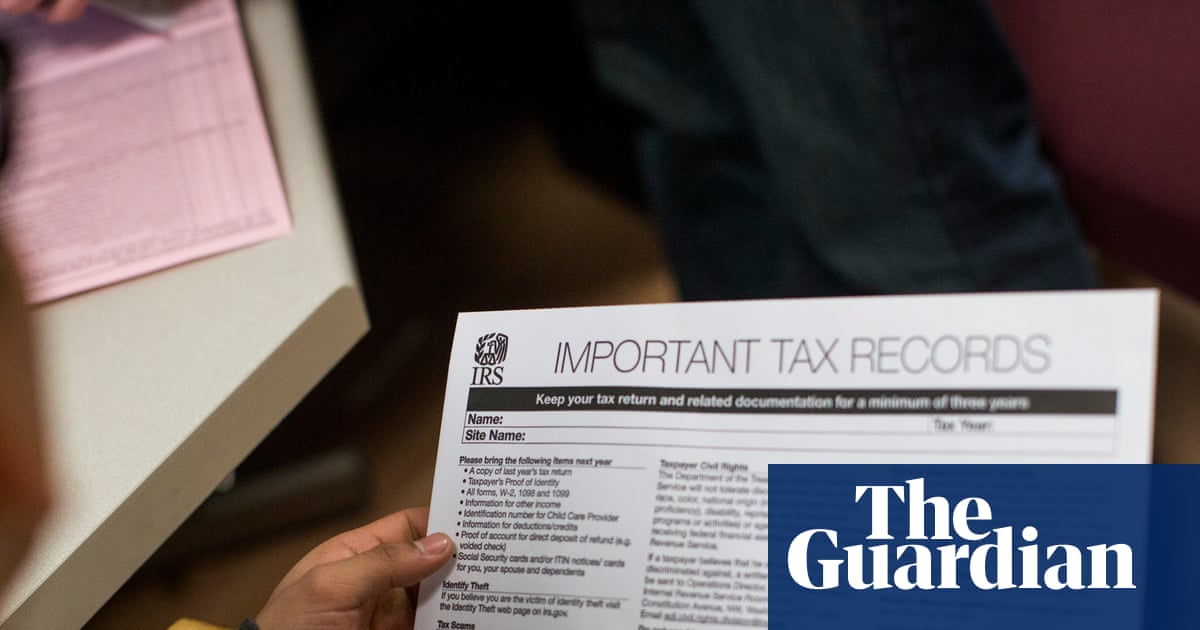
The Trump administration’s immigration crackdown could cause the US to potentially lose up to $479bn in lost tax revenue over the the next 10 years, with enforcement deterring undocumented workers from filing their taxes this year, according to tax experts.
Tax advisers say major changes, including proposed data sharing with immigration enforcement, have made filing taxes risky for undocumented immigrants. Tax benefits for immigrant parents have also been removed, further removing incentive to file taxes at all.
Every tax season keeps Daisy Schmidt busy with typical accounting tasks, from bookkeeping to helping clients prepare their returns.
But with an ongoing Immigration and Customs Enforcement (ICE) crackdown, Schmidt has spent much of her time trying to calm clients that were too nervous to file. Despite her best efforts, many refused to file this year.
“Our target is the Latino community, and many people didn’t file taxes because of fear of ICE,” said Schmidt, a tax adviser. “They said: ‘If they can deport me, what am I filing taxes for?’”
Schmidt said this tax season, she has lost as many as 75% of her clients at Crece Latino, the tax service firm she owns in Springfield Virginia. Other tax advisers who work with Latino clients say they have also seen a drop in clients after changes to federal immigration policy.
Last year, the Internal Revenue Service (IRS) made an agreement to share the names and addresses of undocumented immigrants with the Department of Homeland Security, the parent agency of ICE. Though a federal judge paused the data-sharing agreement in November and later ruled that it violated federal law, many are still worried about having their information passed to ICE.
Parents without legal status also became ineligible for the child tax credit in 2025, even if their children are US citizens, which typically amounts to thousands of dollars in savings.
Immigrants who are not legally authorized to work in the US are still required to pay taxes, and a longstanding IRS policy assured them that their data would be protected.
Though it is harder for the IRS to pursue undocumented workers who don’t pay their taxes, those who work with undocumented immigrants say they still pay their taxes because it shows a willingness to work within the system, which can help when applying for legal status.
“The system relies heavily on this trust, because people can decide not to do it,” said Luisa Godinez-Puig, a senior research associate at the Urban-Brookings Tax Policy Center.
Approximately 50% of undocumented immigrant households typically file income tax returns in the US. In 2022 alone, they paid an estimated $96.7bn, according to the Institute on Taxation and Economic Policy.
Undocumented immigrants don’t qualify for most deductions or tax benefits, and as a result, can end up paying a higher percentage of their income than US citizens, Godinez-Puig added.
“Historically, the IRS has been very, very good at keeping taxpayer information highly confidential, to make sure that taxpayers would feel confident in sharing such personal information with the system,” said Godinez-Puig. “To think that the IRS would share information with any agency would have been unthinkable a few years ago. So this is a huge, huge change to how the policy and then this trust was built between agencies, and that’s why this is a very large issue with grave consequences.”
Experts believe that a drop in tax filings could cost the federal government billions of dollars in lost revenue. According to Yale’s Budget Lab, the losses could range from $147bn to $479bn over the next 10 years. At the same time, up to 2.7 million children who are US citizens or lawful permanent residents might lose access to the credit due to these policy changes.
Though there is no official data on the effect this is having on federal revenue, the IRS estimates that a 1% decrease in voluntary tax compliance would lead to $46bn in lost federal tax revenue. The IRS did not respond to request for comment.
Edgar Villacorta, owner of Latin Tax in Maryland and Virginia, said that around 30% to 40% of his clients didn’t file taxes this year.
“They see that it isn’t giving them any benefit,” he said, referring to the loss of the child tax credit, adding “there is so much news about that ICE-IRS agreement”.
His only consolation is that his losses are not as big as what some of his peers are facing. “Other colleagues tell me that half of their clients didn’t come back.”
The risk of being exposed to federal immigration enforcement has stoked fears among undocumented immigrants across the country. An Urban Institute’s survey found that one in four adults in immigrant families, documented and undocumented, are worried about deportations, and one in six adults reported personally seeing or knowing someone who was taken into ICE custody in 2025.
“The government’s priority should be to ensure everyone feels safe when following the law and filing their taxes. And when they do file taxes, immigrants should be treated the same as other tax filers,” wrote Ben D’Avanzo and Sarah Krieger, senior strategist and senior policy counsel at the National Immigration Law Center, in a report. “The Trump administration should publicly commit to abiding by the court orders prohibiting data sharing of taxpayer information and end its attempt to use IRS or other federal data for immigration enforcement.”
Immigrant advocacy groups assert that children are the ones most harmed by the change in the child tax credit.
Proponents of the child tax credit emphasize it is an important tool for reducing poverty and helps families remain economically stable at a time of rising costs. Child poverty recently surged to an estimated 13% to 16% (roughly 10 million to 11.4 million children), a sharp increase from a record low of 5.2% in 2021.
“It used to be the case that as long as the child was American and had a social security number, the parents could qualify, even if they both were undocumented,” said Godinez-Puig. “Because the point of this credit was to help American children … regardless of who the parents were.”
Trump’s immigration crackdown could cost up to $479bn in lost taxes over 10 years NYT News Today.
Hence then, the article about trump s immigration crackdown could cost up to 479bn in lost taxes over 10 years was published today ( ) and is available on NY Times News ( Middle East ) The editorial team at PressBee has edited and verified it, and it may have been modified, fully republished, or quoted. You can read and follow the updates of this news or article from its original source.
Read More Details
Finally We wish PressBee provided you with enough information of ( Trump’s immigration crackdown could cost up to $479bn in lost taxes over 10 years )


Also on site :
- Witney Carson Claps Back at ‘DWTS’ Judge Carrie Ann Inaba, Joining Uproar Over Comments on Guillermo Rodriguez: ‘I Said What I Said’
- ‘The Debut’: Jesse Eisenberg Praises Oscar Frontrunner Julianne Moore’s ‘Perfect Performance’ at NYFF
- James Gunn Responds to ‘Clayface’ Criticism: ‘The Public Voting on What IP They Want to See’ Isn’t ‘the Only Way to Make a Movie’