
He may have descended Air Force One late Wednesday to the cheers of schoolchildren brandishing the Stars and Stripes, and flanked by tech’s most influential tycoons, but it didn’t take long for U.S. President Donald Trump to be put in his place in Beijing.
In the first closed-door discussions with his illustrious guest, Chinese President Xi Jinping issued a stinging rebuke regarding American arms sales to Taiwan, warning the superpowers could “collide or even enter into conflict” regarding the self-ruling island, over which China claims sovereignty. Taiwan, Xi said, “is the most important issue in China-U.S. relations.”
Given that Trump explodes at even the most trifling perceived affront—pulling 5,000 American troops out of Germany after Chancellor Friedrich Merz said the U.S. had been “humiliated” in Iran—it was telling that Xi felt empowered to lay down the law from the get-go. Indeed, the most enduring image from the entire visit is the two leaders standing outside the Ming Dynasty Temple of Heaven, with Trump remaining curiously tightlipped as reporters enquired whether they had discussed Taiwan. “China is beautiful,” Trump offered instead.
U.S. Secretary of State Marco Rubio scrambled to insist that U.S. policy on Taiwan remained unchanged. But the optics of the U.S. President, for whom belligerence has long been a badge of honor, appearing awkward and cowed is a stark illustration of the shifting balance of global power.
“Xi felt he has a license to make discordant warnings seemingly without concern about blowback or displeasure from Trump’s side,” says Sung Wen-ti, a scholar focused on China’s leadership at the Australian National University. “He appeared tough in public in front of Trump and got away with it.”
That projection of strength may be surprising given the very real challenges China faces, including an economy struggling from a prolonged property crisis, weak consumer demand, and entrenched deflation. GDP growth has slowed to around 5%, far below boom-era levels, while youth unemployment hovers near 19%.
But China has also proven extraordinarily resilient, with a record $1.2 trillion trade surplus last year despite U.S. tariffs that peaked at 145%. In April, China reported record monthly exports, rising 14.1% year-on-year, owed partly to rising demand for green technology products, from electric vehicles to wind turbines and batteries, demonstrating its ability to not just withstand disruptions from the Iran war but benefit from it.
Regarding that conflict, which has now entered its third month amid IMF warnings of a global recession, Trump said that Xi vowed during their talks not to provide military equipment to Iran and offered to help resolve hostilities. “He said, ‘I would love to be a help, if I can be of any help whatsoever,’” Trump told Fox News. A spokesman for China’s foreign ministry took a more robust tact, however, saying the conflict “should never have happened” and “has no need to continue.”
While it’s true that China has considerable leverage over Tehran as purchaser of the vast bulk of Iranian oil, when the regime’s very existence is at stake that influence has clear constraints. Moreover, China has weathered disruption from the war well—owing to large reserves, overline energy pipelines, and green energy infrastructure—and is reaping the soft power benefits of Washington tarnishing its international image, particularly across the Global South, which disproportionately feels the brunt of soaring energy prices.
China’s contention has always been that “America behaves as a thuggish, self-interested warmonger,” says Nick Bisley, a professor of international relations at Australia’s La Trobe University. “And it’s like, ‘yep, this ticks the box.’”
Whether fallout from Iran had sapped his mojo, or he was merely beset by jetlag, Trump appeared on the backfoot throughout his stint in the Middle Kingdom. He did not regale reporters on the long flight to Beijing and neglected to update Truth Social following his initial meeting with Xi. When he did post, it was to defend Xi, who implied that the U.S. was in decline by warning of the dangers of a Thucydides Trap: when an ascendent and a weakening power often come to blows.
Trump defended the characterization of U.S. decline as “100% correct” and expressed “very elegantly,” though “referring to the tremendous damage we suffered during the four years of Sleepy Joe Biden.” Xi, gushed Trump, is “a man I respect greatly” who has “become, really, a friend.”
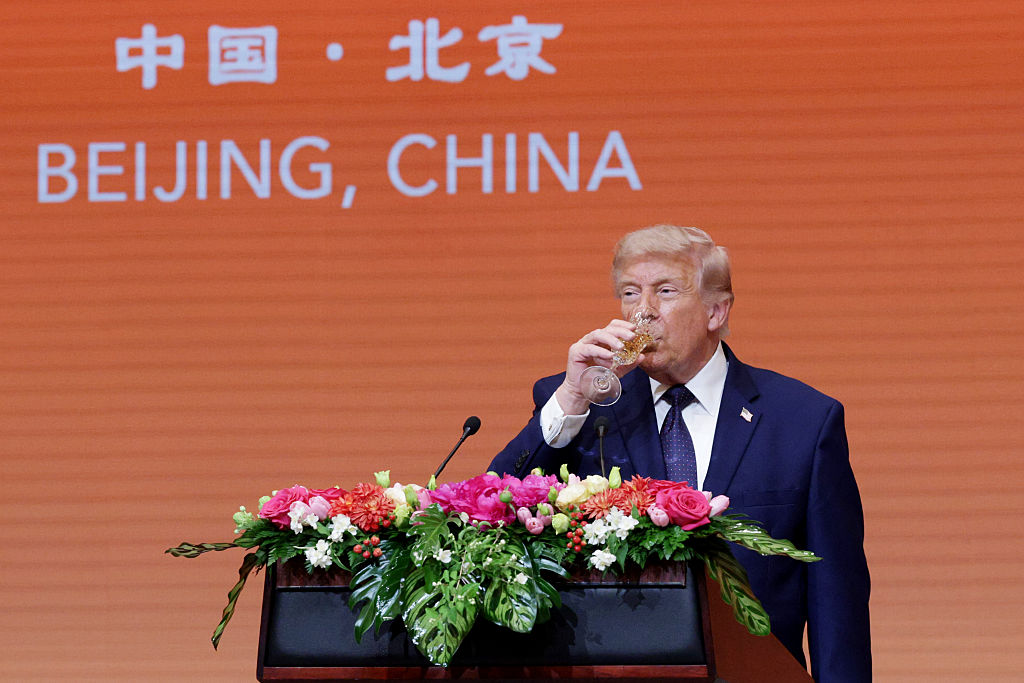
At the state banquet in Beijing’s Mao-era Great Hall of the People, the famously teetotal Trump was so deferential that he appeared to take a sip of wine to toast Xi’s remark that “the great rejuvenation of the Chinese nation and making America great again can go hand in hand.” Later, while touring the Chinese Communist Party’s leadership complex at Zhongnanhai, Trump said, “These are the most beautiful roses anyone has ever seen.”
Naturally, Trump painted the trip as a success, touting a Chinese commitment to purchase 200 Boeing aircraft, saying “that’s a lot of jobs.” U.S. Trade Representative Jamieson Greer also said he expects China to agree to buy a “double-digit billion” order of American agricultural products over the next three years. Though whether these turn into reality is another matter.
It was just in October that China agreed to purchase 25 million metric tons of soybeans annually through 2028, though it is already falling far short of that commitment and instead buying up much cheaper Brazilian alternatives. The Boeing order is especially puzzling as China is rolling out its indigenous C919 passenger aircraft with great fanfare.
“The headline numbers will look very impressive,” says Chong Ja Ian, a professor of international relations at the National University of Singapore. “But I would be a little bit more cautious, because we've seen this movie before [and it's a big question] whether the Chinese side follows through.”
Even before his arrival, Trump had made significant concessions to China, agreeing to sell Nvidia's advanced AI-powered semiconductor chips while suspending a $13 billion arms sale to self-ruling Taiwan. It’s a far cry from the braggadocio of his arrival back into the White House last year to unleash “Liberation Day” tariffs at nearly every country on earth. But as Sino-U.S. relations reached a nadir in early 2025, with tariffs on China getting ever higher, Beijing blocked exports of key rare earth elements and critical minerals, imperilling American manufacturing.
As the Trump Administration quickly sought an off-ramp, China appeared vindicated. When Trump and Xi met on the sidelines of the APEC summit in Busan in October, the U.S. also nixed a new regulation that would have applied export controls to the subsidiaries of sanctioned entities—a loophole that China exploited to source advanced semiconductors.
Indeed, while Trump crowed about the pomp lavished on him—“We certainly got a very nice greeting and today was beautiful,” he told Fox News—China also wins by the sheer number of longstanding bugbears that were given a pass. It’s no secret that Trump has zero interest in religious rights, media freedoms, labor rights, the crackdown on Tibetans and Uyghur Muslims, eroding freedoms in semiautonomous Hong Kong, or even, it appears, military assistance to Russia or support for North Korea these days. Though there was also no sense that he tried to hold Beijing’s feet to the fire on strategic matters such as cyber espionage, IP theft, state subsidies, and an undervalued renminbi, or the export of fentanyl precursors.
More than anything, Trump looked strangely alone despite the phalanx of top executives traveling with him. Notably, this trip was the first by any U.S. President since 1998 that didn’t include even a cursory stop-over to allied countries either before or after. “Certainly, in terms of imaging, Beijing has managed to create this picture of their might and grandeur,” says Chong.
Xi’s choice of words was again telling. China is never shy about trumpeting its “partnerships” of various degrees with scores of nations across the planet, even if in truth these are never evenhanded and exclusively transactional. But with Trump, Xi eschewed any semblance of partnership, merely advocated a framework of “constructive strategic stability,” indicating he’s settled that the U.S. is a rival and, while not wanting ties to spiral, is confident in China’s ability to hold its own.
“What China didn’t say matters,” says Sung. “In spite of all the good vibes and compliments, China today still doesn’t think the U.S. and China see each other as partners when it counts.”
As Trump departed Beijing on Friday afternoon, he gave a fist pump at the door of Air Force One, while another cheering crowd waved more U.S. flags. But while he will no doubt hail the trip as a triumph, it was difficult to see it as anything other than a changing of the guard. Adds Sung: “China showed that they have established themselves clearly as a peer to the U.S.”
Hence then, the article about trump s china trip underscores how power has shifted east was published today ( ) and is available on Time ( Middle East ) The editorial team at PressBee has edited and verified it, and it may have been modified, fully republished, or quoted. You can read and follow the updates of this news or article from its original source.
Read More Details
Finally We wish PressBee provided you with enough information of ( Trump’s China Trip Underscores How Power Has Shifted East )


Also on site :
- New species of sperm whale identified from fossils found in Gunma
- Lexsoft Systems Partners With Clio to Bring Clio's Legal AI Platform to Law Firms and Legal Departments Across EMEA
- ‘Barry Loser’ Animated Series, Based on Bestselling U.K. Children’s Books, Finds Italian Partners Ahead of Rome’s MIA Market (EXCLUSIVE)