
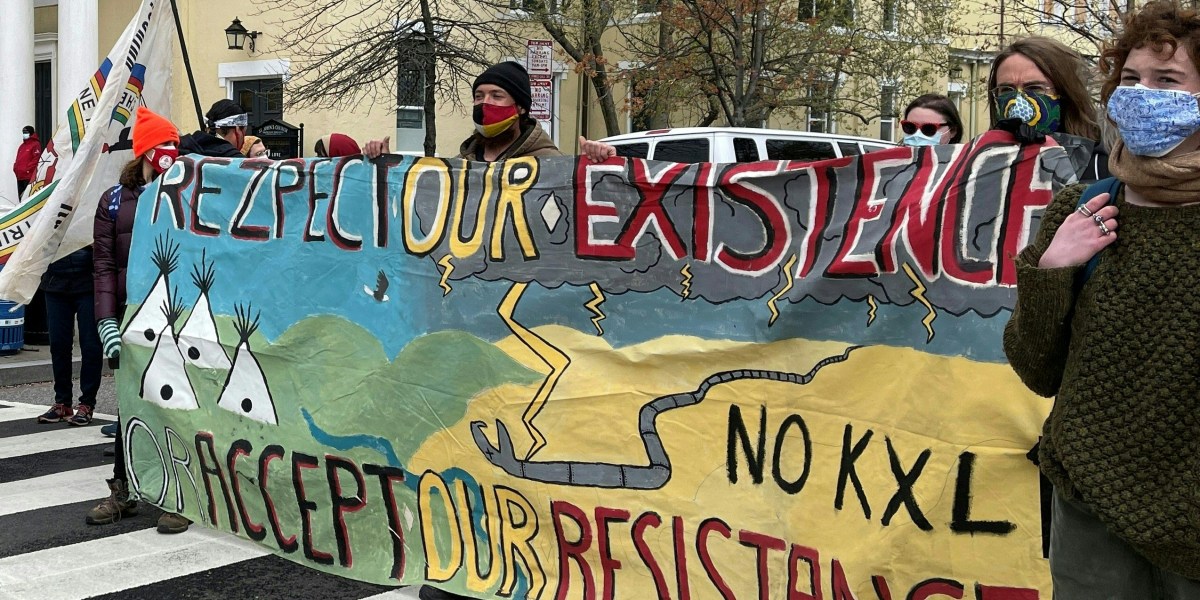
Two of the most controversial pipeline projects this century—the failed Keystone XL project and the successful Dakota Access Pipeline—are gaining new life to move Canadian oil into the U.S., backed by cross-border permits quickly approved by President Donald Trump.
The April permits arrive as oil producers push to move growing Canadian volumes to U.S. refineries, and the war in Iran gives cover to boost the case for greater North American energy self-sufficiency.
“These projects are popping out more so because of what’s happening in Iran,” said Keland Rumsey, crude team lead analyst for East Daley Analytics, arguing the war may help expedite the projects that were already under consideration. “The regulatory environment with the current sitting president obviously helps these projects get movement.”
The defunct Keystone XL (KXL) from Alberta through Nebraska—killed by both the Obama and Biden administrations—is being revived in a slimmer form with a different name.
The combined Prairie Connector and Bridger Pipeline Expansion projects by Canada’s South Bow and True Companies’ Bridger Pipeline would use existing KXL pipe and assets on the Canadian side—partially built before it was last canceled in 2021—meeting a new Bridger pipeline at the Montana border and running 647 miles to the Guernsey, Wyoming interconnection hub.
Likewise, Rumsey said the “notoriously underutilized” Dakota Access Pipeline (DAPL)—which stretches from North Dakota to Illinois—would indirectly expand to move Canadian crude by connecting with Calgary-based pipeline giant Enbridge.
Enbridge plans to reverse its Bakken Pipeline (Line 26)—also underutilized—that historically runs north into Canada to instead flow Canadian barrels south to DAPL. Enbridge would build about 80 miles of additional pipelines to connect the two networks.
“These two projects are leveraging more existing infrastructure so that they already have a lot of the rights of ways and permits in order,” Rumsey told Fortune.
In doing so, the goal is to avoid a lot of the environmental and political fights with protestors and Native Americans that ensued with KXL and DAPL.
“You face less resistance when there’s already pipe in the ground,” Rumsey said.
New Keystone light momentum
The companies are pushing ahead with these projects but neither one is a sure thing at this point.
South Bow, which is the oil spinoff of the original KXL developer TransCanada (now TC Energy), said the Prairie Connector process is undergoing an internal review process until the end of May.
The project would move at least 450,000 barrels of Canadian heavy oil sands barrels to the U.S. each day.
South Bow CEO Bevin Wirzba said in his May 8 earnings call that the presidential permit is a “meaningful development,” but that more planning is still needed, especially when multiple companies are involved.
The biggest question mark is connecting the dots from Guernsey, Wyoming to the Cushing, Oklahoma oil hub that ships barrels down to the Gulf Coast refining complexes and export terminals in Texas and Louisiana.
Another pipeline is still needed and the route is unclear—at least publicly. Following the proposed KXL route means addressing permitting challenges the project faced in Nebraska. Rumsey and other analysts suggested following the route of Tallgrass Energy’s Pony Express Pipeline, but both Bridger and Tallgrass denied to Fortune the possibility of a partnership to move the Canadian barrels.
“We are exploring options for the route from Guernsey to either Cushing or to the Gulf Coast,” Bridger spokesman Bill Salvin told Fortune.
For Enbridge, it’s focused on moving as much additional Canadian oil to the U.S. as it can. It has multiple expansions underway of its Mainline network—the largest source of Canadian oil exports to the U.S.—and the Bakken pipeline reversal in North Dakota is part of the overall effort.
“The importance of energy security has become even more evident since the start of the conflict with Iran, and Enbridge is well positioned to deliver North America’s abundant energy resources, both domestically and globally,” Enbridge CEO Greg Ebel said in his May 8 earnings call.
That means teaming up with Dakota Access Pipeline developer Energy Transfer, whose co-CEO, Tom Long, said on his May 5 earnings call that he is hopeful for a final decision within a month or two to move an additional 250,000 of Canadian oil on DAPL.
These projects also would strengthen Canadian reliance on U.S. oil markets at a time when Canada has looked to export more volumes from its West Coast to Asia. In addition to a planned expansion of the Trans Mountain Pipeline—the only network moving barrels east to west—proposals are being discussed for a new oil pipeline to British Columbia.
The newly permitted projects in the U.S. should nullify any need for another oil pipeline to the west, Rumsey said. “I’m very skeptical of another pipeline,” he said. “I don’t think Canada wants a scenario with an expensive overbuild.”
This story was originally featured on Fortune.com
Hence then, the article about frankenpipelines inside trump s bid to resurrect keystone xl and stretch dakota access north was published today ( ) and is available on Fortune ( Middle East ) The editorial team at PressBee has edited and verified it, and it may have been modified, fully republished, or quoted. You can read and follow the updates of this news or article from its original source.
Read More Details
Finally We wish PressBee provided you with enough information of ( Frankenpipelines: Inside Trump’s bid to resurrect Keystone XL and stretch Dakota Access north )


Also on site :
- A New Chapter of Intimate Luxury in Ubud: The Kayon Resort Introduces Premier Pool Villa & Royal Jacuzzi Pool Villa
- Walmart’s $18 4-Pack of Motion-Activated Solar Lights Are a Bright Idea for Your Deck, Driveway, and Porch
- Walmart’s Rustic 5-Tier Bookcase Brimming With Farmhouse Charm Is Perfect for Book Lovers and Plant Parents