
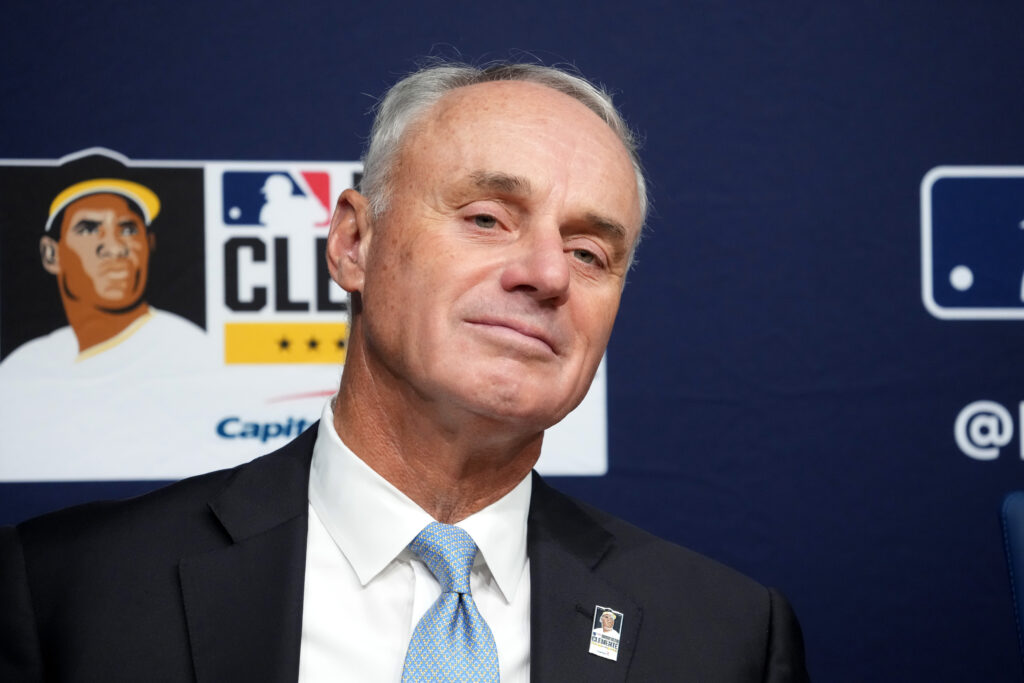
Major League Baseball and the MLB Players Association held their first official collective bargaining meeting of 2026 in New York City today, per reporting from Jeff Passan of ESPN and Evan Drellich of The Athletic.
At this point, there’s not much in terms of news. Both reporters note that today’s meeting was mostly about the two sides presenting basic overviews of their positions. Formal proposals will come in future meetings. The current collective bargaining agreement expires on December 1st. It’s not unusual to begin talks about this far out. As noted by Drellich, they are actually starting a little later than last time. In 2021, opening presentations were made in April.
This round of negotiations is going to be closely monitored, both due to the way the last round went and because of how things have transpired since then. The previous CBA expired without a deal on December 1st of 2021 and the league immediately instituted a lockout, the first MLB work stoppage since the 1994-95 strike. The lockout included a transaction freeze and lasted until March 10th, going about as long as it could have gone while still playing a full 162-game season in 2022.
Over the past few years, the economics of the game have featured a number of contradictions. Perhaps due to the pitch clock speeding up games or due to the rise of international stars like Shohei Ohtani, the sport’s popularly is on the upswing. The league regularly issues press releases about increased ratings and attendance figures. A notable statistic was that Game Seven of the 2025 World Series was the most-watched MLB game since 1991. The final games of the 2026 World Baseball Classic had comparable ratings to the most recent NBA Finals.
But at the same time, many claim that not all clubs are benefitting to the same degree. The collapse of the cable television model has hit some clubs harder than others. Many don’t have a regional sports network at all, with the league handling broadcast distribution for those teams. Other clubs, particularly those in larger markets, seem to still be raking in TV money. Though there is a revenue sharing system in place, there is clearly a massive imbalance in terms of spending. RosterResource calculates the Dodgers’ payroll at just under $400MM. They are on track to pay a tax bill of about $150MM, putting them in line to spend about $550MM on this year’s team. That’s more than the six lowest-payroll clubs combined.
The league is expected to push for a salary cap and floor system. They have made such attempts before, most notably in 1994. That led to the aforementioned strike and the cancelation of that year’s World Series, without a cap being implemented.
The union has long been against a cap since it would negatively impact players’ earning power. The MLBPA continues to have that stance even though they recently had a change in leadership. Tony Clark was the executive director until he stepped down in February, in relation to various scandals. Deputy director Bruce Meyer was voted interim executive director shortly thereafter.
Finding consensus will be a challenge, given that owners and players will have opposing ideas about the best solutions for the game’s current situation. Even among owners, priorities may be different. Smaller clubs may like the idea of a cap but would simultaneously be worried about meeting a high floor. In either case, those small clubs would likely suggest greater revenue sharing is necessary, something the bigger clubs wouldn’t be as excited about.
Most in the industry expect a rough battle. The last lockout went to the brink and it’s possible a similar staredown occurs this time. MLB commissioner Rob Manfred has spoken about his positive view of lockouts. That prompted Clark, when he was still leading the union, to say he expected another lockout after 2026. Assuming a lockout does take place in December, the major question will be if it is once again resolved in time or if it drags on long enough to lose games in 2027.
For those looking for positive signs, there are some to be found. As mentioned, the game is on the upswing in terms of popularity. Though the league wants a cap, they may not want to push so hard that they have to cancel games next year. Such an outcome would certainly cut into the positive momentum with fans. It would be a poor time to take such a hit since most of the league’s broadcast deals expire after 2028, with Manfred and the league hoping to negotiate lucrative new deals prior to 2029. Manfred is also planning to step down when his contract expires in January of 2029, when he will be 70 years old, and may want to go out with a record of no canceled games.
The exact timeline of what happens after today is not clear. Drellich points out that, in 2021, the union made its first economic proposals in May. The league followed in August. Drellich says talks are expected to continue through the upcoming summer, though no specifics are publicly available at this time.
Photo courtesy of Kirby Lee, Imagn Images
Hence then, the article about mlb mlbpa begin cba negotiations was published today ( ) and is available on MLBtraderumors ( Middle East ) The editorial team at PressBee has edited and verified it, and it may have been modified, fully republished, or quoted. You can read and follow the updates of this news or article from its original source.
Read More Details
Finally We wish PressBee provided you with enough information of ( MLB, MLBPA Begin CBA Negotiations )


Also on site :
- Cynthia Erivo Plays Glinda in ‘Nigerian Wicked’ Sketch on ‘SNL U.K.’: ‘She Wants a BBL That Defies Gravity’
- Anthropic Sued for Using Elvis Presley Music to Train AI Models
- The world’s biggest producer of maple syrup has nearly exhausted its strategic reserves after Americans hoarded supplies ahead of Trump’s tariffs