
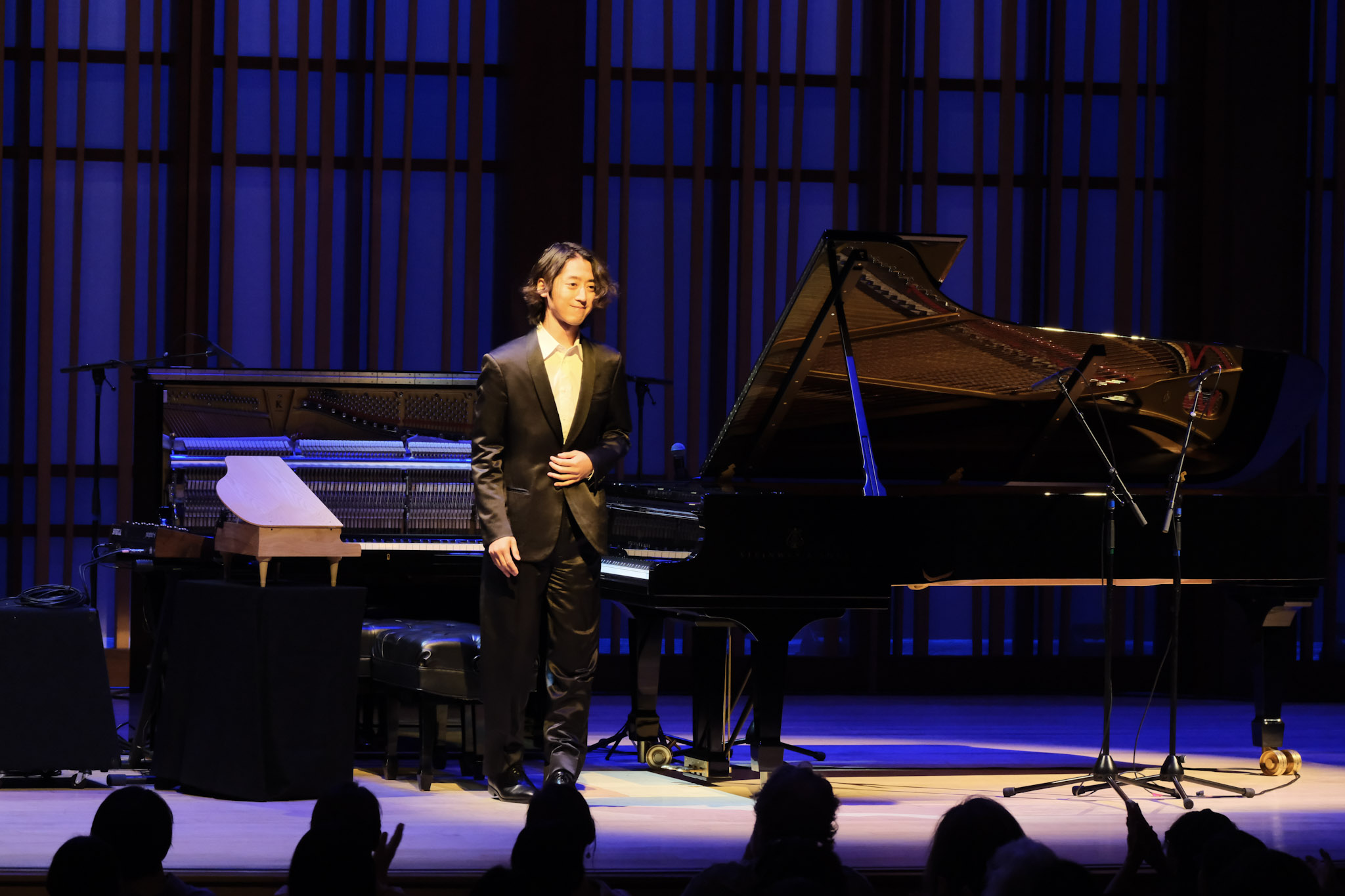
The phenomenon that is Hayato Sumino descended for the first time on San Diego Saturday night, and his fans — 1.56 million follow his YouTube page Cateen — came out in force.
Though the 30-year-old Japanese pianist holds a Guinness World Record for indoor piano recital ticket sales (18,564), the concert’s presenter, La Jolla Music Society, deals in much more intimate seat counts. So rather than disappoint the wait-listed multitudes, it opened its nearby JAI venue to enable viewing via projection screen.
Judging by the unanimous standing ovation at the concert’s end, the Sumino phenomenon is the opposite of a spent force. A glance at Sumino’s program — Bach, Chopin, Gershwin, Ravel — might conjure mistaken assumptions that Sumino belongs to and sees himself as one of the class of classically trained and focused pianists whose repertoire — which also includes Beethoven, Mozart, Liszt, Debussy — he often shares. But for numerous reasons, Sumino is sui generis.
Instead of taking the traditional conservatory route, for example, he earned a master’s in information science and technology at Japan’s best university (Tokyo Daigaku) and studied information processing technology and AI at Pierre Boulez’s IRCAM (Institute for Research and Coordination in Acoustics/Music) in Paris.
Instead of clinging to the canon, Sumino has created his own, covering the traditional classical composers but also Japanese contemporaries (Ryuichi Sakamoto, Joe Hisaishi of Studio Ghibli fame), jazz and pop (Brad Mehldau, Billie Eilish), folk/traditional (“Twinkle Twinkle Little Star,” Japanese children’s songs), and his own hybrid post-minimalist compositions.
Most telling of all, instead of performing on a standalone Steinway grand, Sumino immersed himself in a unique performing cockpit on The Conrad’s stage: a Steinway grand to the right, a Steinway upright (with top lid open to enable prepared-piano techniques) in the center, a Sequential Prophet-6 synthesizer to the left, and a Kawai toy piano closing the semicircle. “I’m just happy to be surrounded by as many keyboards as possible,” he quipped, a mad musical scientist in his lair.
Sumino cheekily intermixed the Bach and Chopin with three of his own compositions (one third of the program’s duration) and added his own arrangements of Gershwin’s American in Paris and Ravel’s Boléro. From the start, he showed a fluid, even-fingered lightness of touch and attention to each voice. Coupled with his flair for improvisation and sense of narrative flow, this lent his opening Bach (Chromatic Fantasia & Fugue in D Minor, BWV 903) a fluid, non-metronomic quality, a Bach infused with Rameau’s light.
To close the first half, Sumino segued unapologetically from his own nocturne Once in a Blue Moon to a spellbinding, unsentiment reading of Chopin’s Nocturne in C Minor (opus 48). The Chopin Scherzo No. 1 (opus 20) that followed, stripped of Romantic varnish, spotlighted Sumino’s talent for making the often-heard feel new, even improvised.
At their best, Sumino’s own compositions — New Birth, Recollection, three nocturnes, a jazzy improvisation to open the second half, and Big Cat Waltz — are melodically affecting, soothingly involving works in the New Age vein of Sakamoto or Ludovico Einaudi, spiced with interesting forays into prepared-piano techniques on the upright, from plucking and muting to harp-like pizzicato effects on his upright’s exposed strings. The jazzy, energized improvisation Sumino created to open the second half showed these strengths in the best light. At its worst, his music (his nocturnes, Big Cat Waltz) can sound soppy and derivative.
The main entrees of the evening’s second half were Sumino’s playful and disarmingly orchestral takes on two century-old gems: Gershwin’s American in Paris and Ravel’s evergreen Boléro — composed almost simultaneously in 1928. In the former, Sumino’s deft use of a small keyboard-shaped Suzuki Melodion with an extension-tube mouthpiece lent just the right Parisian tang, and though his velocity occasionally blurred passagework and muddied textures, his feat — distilling a 35+-instrument tour-de-force with only two hands and one mouth — fully earned the ovation he got.
In the Ravel, Sumino surpassed himself. Using mutes on the upright’s strings he created the dry side-drum ostinato that impels Boléro forward, injected a high-register timbre by playing — behind his back — the toy piano, and magisterially captured the instrumental transitions of Ravel’s gradually intensifying crescendo. His encores were Chopin’s Mazurka Op. 24, No. 2, and Nikolai Kapustin’s Op. 40, No. 3 (Toccatina).
This was not a profound or deep musical evening, but it wasn’t intended to be. As Gershwin said of American in Paris: “Nothing solemn about it. If it pleases … as a light, jolly piece, it succeeds.” A multi-talent with inventive spirit to spare, Sumino succeeded.
Hence then, the article about review japanese classical sensation hayato sumino delights in san diego was published today ( ) and is available on Times of San Diego ( Middle East ) The editorial team at PressBee has edited and verified it, and it may have been modified, fully republished, or quoted. You can read and follow the updates of this news or article from its original source.
Read More Details
Finally We wish PressBee provided you with enough information of ( Review: Japanese classical sensation Hayato Sumino delights in San Diego )


Also on site :
- Penn Yan schools on lockdown and lockout due to possible report of weapon at high school
- NBC Extends ‘Line of Fire’ With Full-Season Pickup
- Jay-Z and his mother founded the Shawn Carter Foundation in 2003; its 20th-anniversary gala raised $20 million in one night