
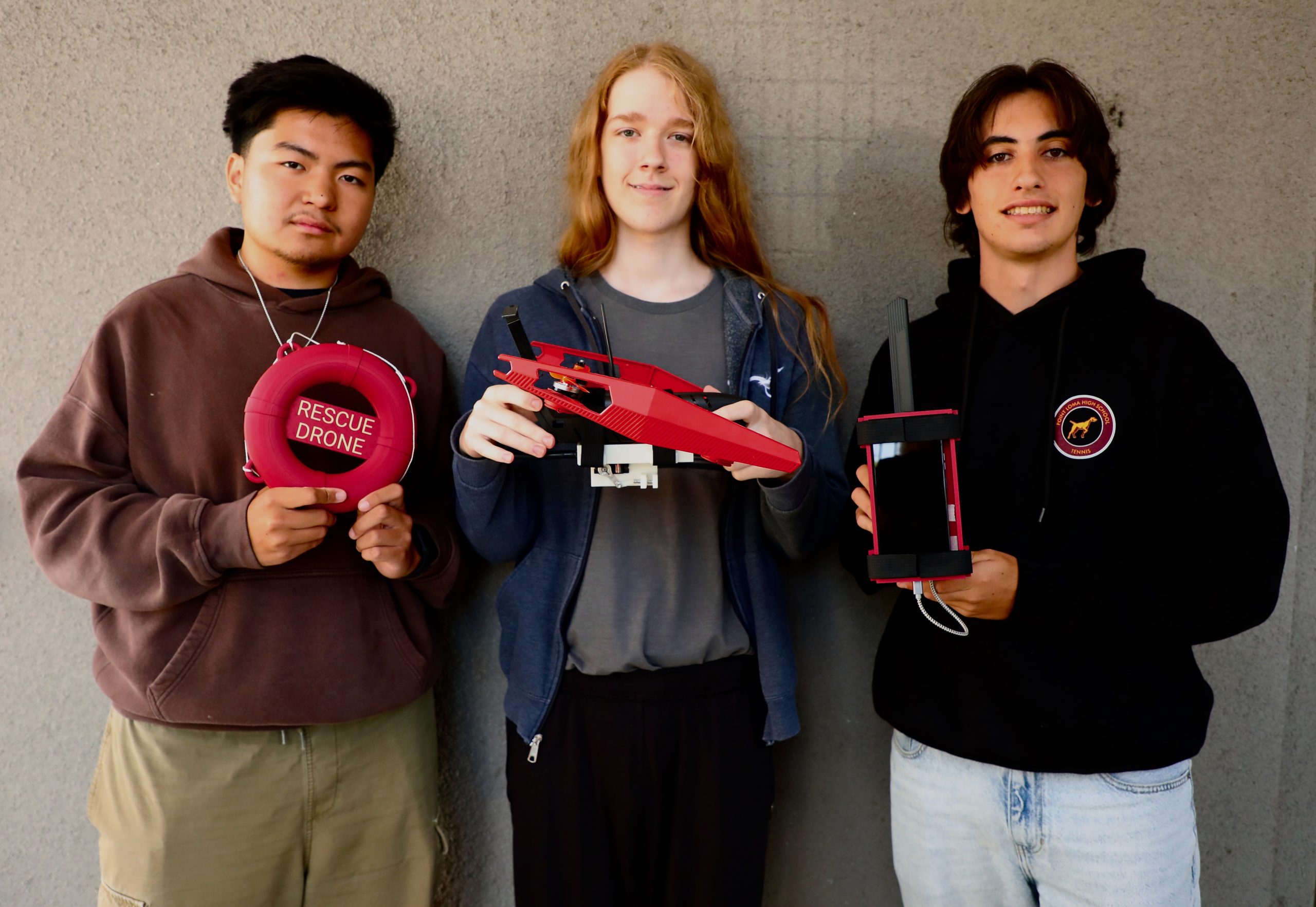
Imagine this: It’s a hot August day in 2029 at Ocean Beach. The 72-degree water is filled with swimmers. Lifeguards perched inside the Santa Monica St. tower spot a distant swimmer, waving their arms in a frantic call for help.A lifeguard rushes out of the tower to assist the swimmer, grabbing a float tank and fins before running to the water.Before the lifeguard has a chance to put their fins on, a drone rises above the tower and propels straight for the drowning swimmer. Once overhead, the drone releases a flotation device, which the panicked swimmer immediately grabs onto. Meanwhile, the lifeguard dispatched is still swimming out through the breakers to the rescue.Soon, this type of rescue could become a reality, that is, if three Point Loma High senior engineering students have their way.High school students Noa McKinney, Elyjah Rodrigues, and Peter DeSalvo are now hard at work developing a working drone model as part of their senior project, under the tutelage of teacher J. Michael Tritchler.“Because we live right on the water’s edge, and wanted to do something new, we decided to reach out and interact with the water in a different way,” said Point Loma High student McKinney. “Drowning deaths still happen, and that’s what caused us to go down this path.”Student Peter DeSalvo said the group began with three options prior to settling on deploying drones for water rescues. “After we did research, we went down three different paths of how we could save someone in the water,” DeSalvo explained. “One was a drone, the second was a t-shirt type gun that would shoot a life buoy or vest, and the third would be a [radio-controlled] boat. We saw the drone could have the most capabilities because it can get to places an RC boat couldn’t or where someone could shoot something at.”Added Point Loma High’s Elyjah Rodrigues, “I was thinking about the cliffs where people swim, and if someone is drowning there, you can’t really get to them,” Rodrigues added. “Lifeguards are going to take some time to (arrive), and the drone would be quicker and be a temporary solution until lifeguards can get there.”The group used one of their own drones as the prototype. The original drone controller had to be paired with a base station, which includes a cell phone and all components, and then linked together. Or, as McKinney and Rodrigues told the Peninsula Beacon, “It’s a terminal app connected to the circuit board inside. The terminal app is then able to talk to the radio, and the radios talk to each other, and that allows it to release an object from high up.”The drone prototype currently has a camera, but it is fixed in a horizontal position. A model used in actual rescue work would be far more powerful if it included additional resources such as a camera to transmit images of victims below, as well as a speaker/microphone to give instructions and to hear victims.Reaction from people viewing the project has been universally positive, with clear visions of fewer drownings and faster lifeguard response to distressed swimmers.The team also foresees such a system being used by private citizens to assist people before rescue personnel arrive.The three students performed the preliminary work in January, when the second semester began. They discussed and researched ideas, created drawings, a 3D model and did troubleshooting. One skill they needed to master was soldering to a circuit board. That’s where their teacher, J. Michael Tritchler, came to the rescue.Tritchler showed them how to solder properly for a connection that would not fail. After clearing that hurdle, the students got to work on the rest of the project. They split assignments to work more efficiently. DeSalvo did the electrical work, McKinney did the 3D modeling and Rodrigues took over the coding responsibility, as well as providing progress photos.The first flight attempt took place several weeks ago as the students prepared to show their project at the San Diego Unified School District’s “2026 Showcase of Learning” event at Lincoln High School, which featured the 150 top projects from around the district. The drone proved difficult to fly, although the mechanism to release the life ring went smoothly.Judges at the showcase also agreed the Point Loma drone project was an intriguing concept for future emergency service personnel, awarding it the “Strongest Career and Industry Connection” prize.Every member of the drone team is headed to San Diego State University’s Engineering Department. For McKinney, it’s mechanical engineering, Rodrigues will focus on computer engineering and DeSalvo is headed for aerospace engineering.If the trio were future business majors, perhaps their model could become the ticket to their financial futures. But that won’t happen.While they have enjoyed the attention received from their drone being featured in local news, none will be pursuing a future with the device.“We probably won’t take this further. For now, we’ll give it to Mr. Tritchler as an example for the next generation,” they decided.
Hence then, the article about point loma high students to the rescue students design drone to speed water rescues was published today ( ) and is available on Times of San Diego ( Middle East ) The editorial team at PressBee has edited and verified it, and it may have been modified, fully republished, or quoted. You can read and follow the updates of this news or article from its original source.
Read More Details
Finally We wish PressBee provided you with enough information of ( Point Loma High students to the rescue .. Students design drone to speed water rescues )


Also on site :
- Sports Legend Roger Craig, Who Made NFL History, Reveals Dementia Diagnosis: 'This Doesn't Define Me'
- Hang Elon Musk Around Susan Collins’s Neck
- This nuclear startup and Halliburton repurposed oil-drilling tech in a bid to solve America’s radioactive waste problem