
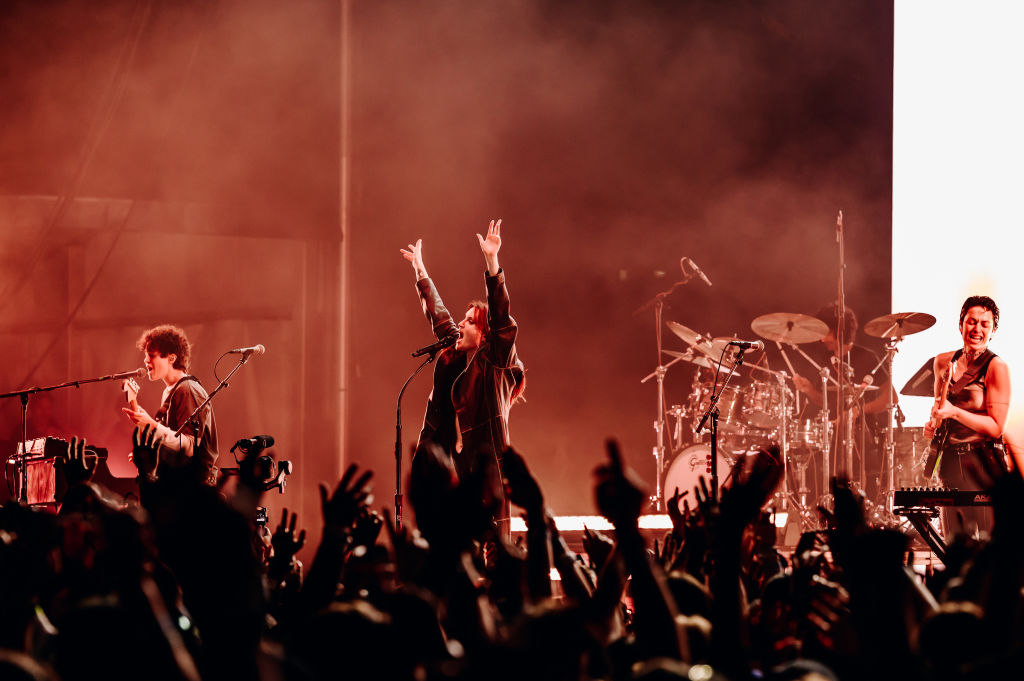
I had just turned 20 when MUNA had our first “rehearsal” in the living room of the dorm where Jo Maskin and I lived together on 27th Street, in the West Adams neighborhood of Los Angeles.
It was the spring of 2013. Jo and Naomi McPherson were playing out of mini amps. I had a MIDI keyboard plugged into my computer speakers. There was a kaleidoscope-style tapestry tacked on the wall and a pack of Marlboro 27’s on the coffee table.
As the story goes, we jammed together that day and ended up with a song that would be the first on our More Perfect EP. Jo will tell you she didn’t know the three of us were starting a band that day. I kind of did.
Naomi and I were in love, and I think in some way, starting the band was me contending with my jealousy of their talent as a musician. I was less threatened by them if I was part of their project.
The same goes for Jo. We were in the same music program at USC, and from day one, I recognized that Jo was one of those undeniable stars. Everyone was magnetized to her. And she was so beautiful.
They both were. The bastards.
Over time, my jealousy came to light.
Years later, we went to see a therapist in Mid-Wilshire as a band. I expressed in a moment of frustration that I was bringing a lot to the table—that I knew I was writing good songs. The implication: I was carrying the band.
The therapist looked at me tenderly and asked if I was truly upset with Naomi and Jo, or if I was actually arguing with an insecure voice in my head which insisted I didn’t have anything to offer them. She may have had a point, but I wouldn’t tell her that.
“I don’t like that therapist,” I quipped as the three of us rode the elevator down together.
We laughed.
Luckily, Jo and Naomi also took issue with our therapist’s point of view. Maybe we felt no one could understand us like we did each other.
This commitment to one another, to seeing each other’s faults and growth, is one of the miracles of being in a band. Back then, I was possessive and quick to anger and had the huge ego necessary of a frontman. Naomi and Jo saw all this about me. And they accepted me anyway.
We don’t love each other because we are perfect, or even good. We love each other because we are part of the same team. Because we belong to one another.
Over time, I’ve gotten less jealous, less possessive, less quick to anger because of the steady acceptance and grace they have offered me. Today, I can admit that I started MUNA partially for a selfish reason: to try to soak up some of the shine that I saw in Jo and Naomi. But I stayed because I started to feel the medicine of real intimacy and interdependence.
Still, these tender feelings can’t gloss over the gory bits of starting a band. Here’s a few things you can expect if you want to go down the path of being a musician: joint pains from sleeping in vans, playing corporate gigs for people eating shrimp cocktails who couldn’t give a damn about your music, electrically shocking yourself while trying to fix an amp, having to perform through various illnesses (both physical and mental), dirty green rooms, moldy showers, sleep deprivation, malnourishment, the list goes on and on.
But some of our most gruesome memories as a band are also our favorites.
For instance, Brian Jones and Scott Heiner, our first bassist and drummer, will tell you that a highlight of our first tour was a chaotic performance at Pet-A-Palooza, a dog adoption festival in Las Vegas. Our label told us it was “very important” for us to do an acoustic set at Pet-A-Palooza. That is, if we wanted the support of the radio station that was putting on the fest.
We had to head straight to the Pet-A-Palooza festival grounds from the airport. The site was speckled with parents and children, but was overwhelmingly populated by dogs. The sound guy was, to put it nicely, struggling. Naomi’s acoustic guitar kept feeding back, causing our stage to spew out the kinds of screeching frequencies that dogs famously hate.
We got through the set without a canine mutiny, but we were humiliated.
At the time, we weren’t laughing. But we certainly laugh about it now. The memories have aged well because when we were humiliated, we were humiliated together.
Here, I feel it necessary to state that the road towards band-dom is even more treacherous now than it was when we started a decade ago. When we started touring, we were signed to a major label deal with RCA that provided us with tour support so that we could effectively lose money on small headline tours while we were building our repertoire and performance skills.
And dear God, did they need to be built up. I’m not sure what our first A&R guy, Dan Chertoff, saw in us when he came to see us play at a bowling alley at the Roosevelt Hotel. Maybe Jo and Naomi had their act together, but I was a raw bundle of nerves, blowing my voice out in the first 15 minutes of a show.
We’re proud to be part of a long line of bands with disastrous early gigs. Hugo Lindgren cites an early gig of the Cure where Robert Smith “was mortified at first by his own voice” and “sang the words to ‘Suffragette City’ while the band played ‘Foxy Lady.’” It’s normal to suck at first and get better over time, but these kinds of growth opportunities are increasingly rare for bands. And when they do occur, they are more likely to be extended to solo artists.
This landscape has caused some to wonder, “Are bands dead?” Journalist James Tapper has made the case that bands are almost increasingly absent from today’s music charts because of social media’s outsized role in scouting for talent (it’s easier to create a viral personal “brand” if you’re just one person) and the development of music technology that has allowed people to create full-sounding pieces of music without relying on any other actual people.
This is what happens when a music industry becomes hyper-individualized and hyper-commodified. Making music on your own with a computer is cheaper and easier than navigating relationships with bandmates and paying other musicians for their time. It’s optimal to market yourself as a solo artist because you can more easily define yourself, and you don’t have to navigate other people’s boundaries and opinions. But in trying to make music under these market pressures, we are losing the most powerful part of art: its ability to connect us to each other.
Every time our band goes back to the drawing board for another album, we face the possibility that we won’t have “it” in us anymore. That whatever magic was with us in that dorm living room in 2013 isn’t there any longer. But perhaps the biggest tragedy that befalls many bands is growing apart. When that happens, even the best inspiration can get squandered by an inability to listen to each other.
In this way, bands are inherently anarchical. They die when one person tries to become their tyrant.
And bands are intimate and intense. Much to the chagrin of my bandmates, who are in committed monogamous relationships, our band has made us all life partners.
Bands require a lot of you—your time, your youth, your health, the very best of you. But in my experience, it’s worth it. My band has taught me how to truly be in relationship with others; how to listen, consider, and negotiate boundaries; and how to stay in love with something.
I am lucky to have had a career in this industry for this long, but my real luck is to have ended up in a band with two people I would still follow anywhere.
Just please, not back to Pet-A-alooza.
Hence then, the article about in defense of the band was published today ( ) and is available on Time ( Middle East ) The editorial team at PressBee has edited and verified it, and it may have been modified, fully republished, or quoted. You can read and follow the updates of this news or article from its original source.
Read More Details
Finally We wish PressBee provided you with enough information of ( In Defense of the Band )


Also on site :
- Walmart’s Wicker Rolling Cart With Pretty Pottery Barn Vibes Is 'Perfect for Maximizing Storage in Small Spaces'
- This Weighted Derpy Pillow Mimics a Hug From the ‘KPop Demon Hunters’ Tiger to Help You Gently Fall Asleep
- 1977 'White-Hot' Fleetwood Mac Smash, Called the 'Most Iconic Breakup Album of All Time,' Is Finally Giving Up Its Secrets