
This is a lightly edited transcript of the May 6 edition of Right Now With Perry Bacon. You can watch the video here or by following this show on YouTube or Substack.
Perry Bacon: I’m Perry Bacon, the host of the The New Republic show Right Now. We have a great guest who’s really up early in the morning. This is David Dayen. He’s the executive editor of The American Prospect, which is one of these magazines—like The New Republic—that is left of center and trying to cover the news in a pro-democracy perspective. And David has done some great work. If you follow him on Twitter or Bluesky, he’s one of the best chroniclers of economic policy particularly, but he runs a great magazine. I’m really honored that David’s come on. So David, thanks for joining me.
David Dayen: Thanks for having me, Perry.
Bacon: So I want to start with the big—you’re the rare person who writes about national politics who is based in California. I wish we had more people who were interested in California because, as we know, it’s the biggest and most important state. And so what I want to talk about first is the governor’s race there—it’s heating up, the voting is going to start pretty soon. And my first question is: a few weeks ago, the big worry was the two Republicans would finish ahead and Democrats would be kind of locked out of that. But I think that’s no longer the problem in some ways, because Donald Trump solved that problem.
Dayen: Yeah. It’s a combination of two things. So one—Donald Trump helped solve the problem by endorsing one of the two Republican candidates. The fear was that there are essentially two prominent Republicans in this race, and at the time, there were up to eight prominent Democrats.
And the way that we do elections in California is with what they call the top-two primary. So on your primary ballot are all the candidates—Democratic, Republican, Decline to State—no matter who you are, you see all those candidates. There are actually 62 candidates on the ballot. And you vote for whoever you want, Democratic, Republican, doesn’t matter, and the top two advance regardless of party.
And obviously this is a state where you could see 65 percent of the voting public vote Democratic and 35 percent vote Republican—but if those two Republicans in the governor’s race got essentially an equal amount of votes, they would have 17, 18 percent of the electorate, and it would be hard for one of those eight Democrats to get more than that—therefore creating a situation where even though 65 percent of the electorate voted Democratic, they’d only have the choice of two Republicans for governor in the general election. And under the statute—this was created by initiative in 2010, and under that initiative, you can’t write in anybody. So in the general election, it’s just the two who are on the ballot.
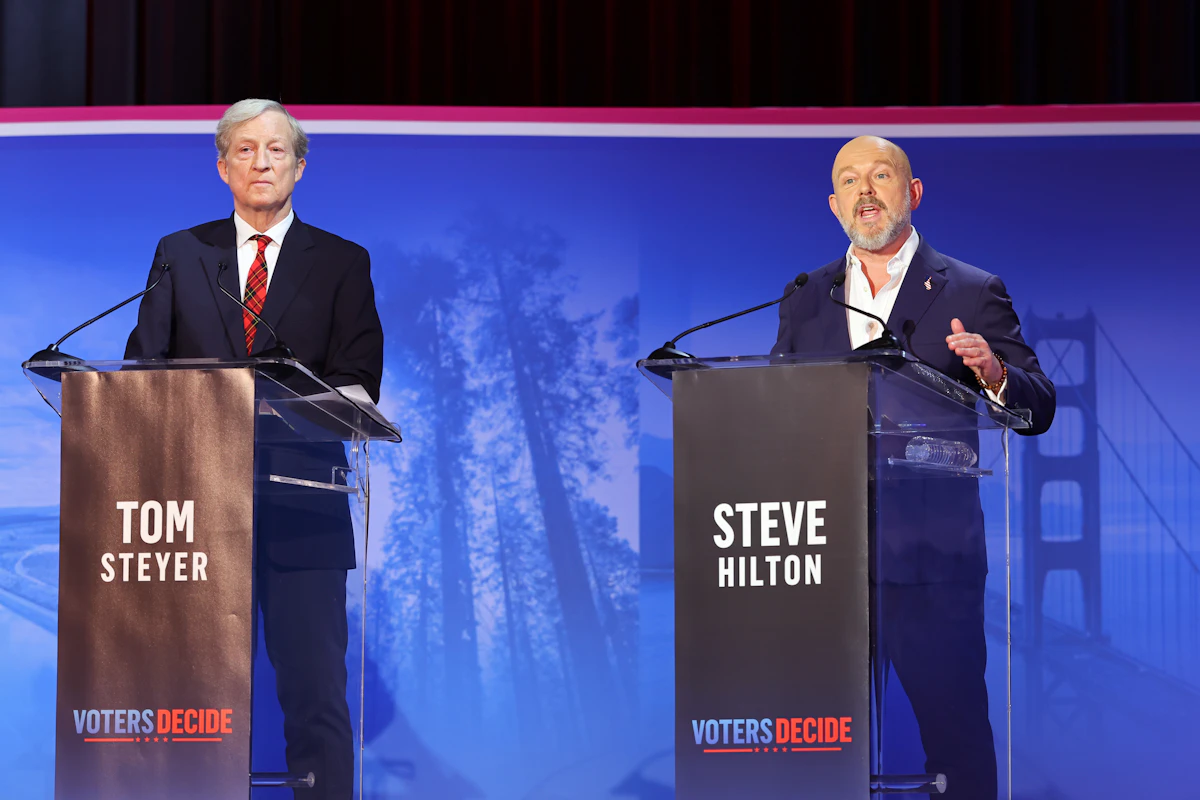
So that was a very palpable fear, I think—particularly when the polls started coming out and showed the two Republicans essentially neck and neck, and other Democrats who hadn’t really gained traction behind them. Now, two things happened. The first is, as you say, Donald Trump endorsed Steve Hilton, who is a Fox News commentator, a former adviser to the British government under David Cameron. And he endorsed Hilton over this guy Chad Bianco, who’s the Riverside County Sheriff and an Oath Keeper—an admitted Oath Keeper—and a MAGA guy.
You would expect, if Trump endorses one over the other, for those two candidates to split. And indeed, in the polling, we’re seeing Hilton poll much higher than Bianco now. So that gives an opportunity for one Democrat to get into that top two.
The other thing that happened, obviously, is that Eric Swalwell—who was running essentially in that top tier of Democrats—had to drop out, for obvious reasons. And so when Swalwell dropped out, that narrowed the field. Another candidate, Betty Yee, dropped out of the race and endorsed Tom Steyer. We’ll talk about those candidates in a second. So the Democratic field has consolidated a bit while the Republican field has stratified a bit. And so that fear is lessened—although it’s not completely gone. You could still see this happen.
Bacon: So I’ve been looking at the polls some, and there’s a lot of buzz about the race—but it appears, from where I’m sitting and not close to the race, that a lot of the Swalwell vote went to Xavier Becerra, the former Biden administration official who used to be in the leadership in the House.
Is that what happened? And secondly, why do you think that was? It wasn’t like Swalwell endorsed Becerra.
Dayen: Yeah. It’s a very interesting dynamic. You saw this happen almost immediately and incredibly inorganically, I would have to say—where all of a sudden there was just all this buzz happening on the Becerra side, after he was in the race for a year with essentially nobody talking about him. So what is going on here?
It was very apparent from reporting that Swalwell had the support of the kind of Newsom faction in California politics, which is aligned with these consultants who run California politics. One’s called Bear Star Strategies. There are a few others. And they have essentially held the main seats in California for some time.
Bacon: Meaning their clients have. So Kamala Harris, Gavin—
Dayen: That’s right. Kamala Harris, Gavin Newsom, Alex Padilla, Jerry Brown—all same consultants, same major people behind them. And all of a sudden, Swalwell was their guy. They—I don’t feel like even Swalwell supporters would admit that he didn’t really have a lot of connection to the state in terms of the state political structure.
Famously, there’s a CNN story that shows that he was up in Sacramento and he was looking at the reconstruction of the Capitol building, and he said, “What are they doing—putting up condos?” He didn’t even know that they were redoing the state Capitol building up there. He was a puppet. He had no sort of firm beliefs about state politics.
Bacon: Let me just zero in on one thing. The Newsom faction—but was Newsom himself behind the scenes as well? Or I thought Newsom was pretty neutral.
Dayen: Yeah, not in any definitive way, but people who worked with him in the governor’s seat—both politically and also even his aides—were working with Swalwell. But when that ended, they all moved to Becerra, and they moved very quickly to Becerra—including Bear Star Strategies and some of these other consultants. Newsom’s digital director—the guy who is putting together the Newsom persona online—moved to Becerra after Swalwell dropped out. So this created—I think a lot of this buzz was internally generated.
But he fits into a role—you could see why, at a superficial level, he would take off a little bit. This is a very heavily Latino state, he is the main Latino candidate. Antonio Villaraigosa is also running. By the way, Becerra and Villaraigosa have run in races against each other for 25 years—they were in the 2001 LA mayor’s race against each other. But Becerra has actually held public office a lot more recently than Villaraigosa, who’s just been out of office for 10 years.
So—obviously a strong Latino candidate, and then someone with connections to the Biden administration. He was the attorney general of California, he was the HHS secretary. So he’s running on that résumé. And so he has risen as Swalwell fell.
Bacon: So the buzz about Becerra has been that he is not particularly effective at the jobs he’s held, and I wanted to ask you about that, because you and I both covered the Biden administration very closely. And so the discussion was that some of the debate was that he wasn’t a great HHS secretary—and my reading was sometimes maybe the White House was blaming him for things that they ran. But do you assess him as being a weak public official?
Dayen: Yes. He was not a competent HHS secretary—maybe not necessarily for some of the reasons that he’s being attacked for, but because HHS, which is a sprawling agency, was the absolute weakest on the kinds of policies that the Biden administration was trying to do in terms of taking on corporate America, in terms of providing better changes to that particular system.
So there was the one famous thing—and I haven’t written about this, but maybe I will—that people in my neck of the world talk about, which is that there was a town hall, like a big event in the Biden administration, around pharmacy benefit managers. These are the middlemen that make drug prices higher. And it’s a major problem and obstacle to lowering drug prices within the pharmaceutical transaction chain. And Becerra was there along with Lina Khan and Lael Brainard and many others, and they gave Becerra about five minutes to speak—and it becomes very clear from the discussion that he doesn’t know what a PBM is.
That he’s—and this is the Health and Human Services secretary—and he’s talking about prescription drug negotiations and Medicare, he’s talking about everything but the thing that this meeting was supposed to be held for. And it just felt indicative of someone who was a little bit checked out in terms of the major issues involving healthcare.
Now, Xavier Becerra was an ally of Nancy Pelosi, he’s a member of the Progressive Caucus, was in Congress for many years. And he has a record of supporting single payer, for example. However, he didn’t really have a huge connection to healthcare. Like, why was he made the Health and Human Services secretary?
He was the attorney general of California—maybe that’s a Justice Department analog, but not necessarily HHS. There have been claims—and these are documented, this isn’t me talking—that he was pushed forward by the Congressional Hispanic Caucus, that they wanted a spot in the cabinet and he became the guy.
And not a lot got done on healthcare during that four-year period. And apparently, after the debate last night, one of the CNN commentators said that every Biden cabinet official will tell you the same thing—that he wasn’t particularly effective.
Bacon: In terms of ideology—I guess you and I are people who want to see corporate power reined in, a more populist Democratic Party, whatever, say that. So in that sense, is Becerra—compared to Katie Porter and Steyer—is Becerra probably the most establishment of the three? Is that fair to say?
Dayen: Yeah, I think he’s adopted that framework from the consultants who are supporting him. And there are two kind of major things that have come out over the last week or so that speak to that. Becerra received a max donation from Chevron—that is the oil company that is very big here, it used to be called Standard Oil of California. He received a maximum donation, which in California for governor is $39,200.
He has since said that Chevron’s not the bad guy. Obviously, gas prices are going up all over the state—they’re as high as six and seven, even eight dollars a gallon. And he said they’re not the bad guy, and we need Chevron, et cetera. So that raised some eyebrows.
And then the second thing is that he’s received support from the California Medical Association, which is the state analog to the AMA—the American Medical Association—which represents doctors and is certainly one of the forces opposed to moving to a single-payer system.
And there’s some audio that’s been reported on—or a meeting that’s been reported on—with Becerra, where he has essentially said that single payer is not right for California anymore. This is after a 30-year record in the House supporting single-payer bills. Those two things gave this sense that he is moving back into a more comfortable mainstream Democratic position that won’t challenge power in much fundamental ways.
Bacon: So if he’s running as the main—you’re saying he might have been progressive in other contexts. But if he’s running as the mainstream candidate, why are—so let’s call it, let’s say Nancy Pelosi, Gavin Newsom—I saw Harris endorse people for other races but not this governor’s race. If he’s the mainstream Democratic candidate, why aren’t they trying to push him over the top? What’s your sense of that?
Dayen: This has been really fascinating within the state political structure this entire race. There was talk at the beginning that Kamala Harris would get in—the race was frozen, seeing whether or not she was going to run or not. She eventually decides that she’s not going to. Then it seemed like the interest shifted to a woman named Eleni Kounalakis, who is the lieutenant governor right now, and a big-time fundraiser and an ally of Pelosi’s.
And Pelosi let slip on a CNN show right after Harris dropped out—she said, “I’m supporting Eleni Kounalakis.” But Kounalakis couldn’t get any traction, and she decided to run for treasurer instead, so she dropped out of the race. So the establishment was left with nobody.
And then late in the race, Swalwell gets in. They figure, Okay, we can work with him. So they migrate to him behind the scenes, without any kind of public—Pelosi didn’t support him, Newsom didn’t support him, not publicly. But then he implodes. And so now it’s a move to Becerra—and I think—
Perry Bacon: But not a strong move, not a public move.
Dayen: Not a strong, yeah, not a strong public move. And I think the establishment in California—those kinds of people—are very dissatisfied with their candidates. And they—I don’t know if it’s internal politics, or being afraid to get involved with someone who might falter like a Swalwell. That’s a cautionary tale, right? If Newsom and Pelosi had all gone all in on Eric Swalwell—who was a Pelosi kind of protégé—and then that happens, that’s a real problem. Maybe they’re thinking, I don’t want to jump in on some other candidate—once bitten and twice shy kind of thing. So maybe that’s it.
Bacon: Let’s move to the more progressive candidates, if I could. So I’ll start with Katie Porter—she famously worked with Senator Warren, some on her staff. When she was a member of Congress, she was very known for taking on corporations in her hearings particularly.
But her campaign—the thing I know most about is this what I consider a goofy proposal to exempt everyone from taxes who makes less than $100,000, which might be good for the working class but is probably not good economics ultimately. And so I’m curious what your—I thought she’d be a progressive candidate with strong ideas. I don’t perceive her as running that kind of campaign. What is your read of what she’s doing?
Dayen: Yeah, I would agree with that. Porter came out—she obviously ran for Senate in 2024, she gave up her House seat, there was a lot of corporate money that was arrayed against her, particularly from the crypto industry, and Adam Schiff won that race.
And so then she migrated, in fairly short order, to run for governor, and she was the frontrunner for a fair bit of time until there was this set of controversies around her abusing staff—not physically, but verbally.
Bacon: Kind of the video of her being very mean to staff—it kind of went really viral.
David Dayen: Went viral. And she hasn’t recovered from that. And there are these attempts to recover that—yes, I think are really terrible economics—and they fit with something that’s happening within the Democratic Party, where you’re seeing a lot of candidates, maybe 2028 hopefuls, saying we need to do our own tax cut. We have to respond to no-tax-on-tips and we have to do our own big tax cut. And the one that Porter has chosen would eliminate about 65 to 70 percent of the tax base in California in terms of the individual tax rate.
And it’s actually the same tax plan that Steve Hilton is running on—Steve Hilton is running on exempting the first $100,000 from taxes. It’s the choice between Republican and Republican Lite. Porter represented an Orange County district—a very affluent Orange County district—in Congress. She has always played footsie with these anti-tax kind of proposals. She was one of the people on the state and local tax deduction or SALT. She was someone who wanted to exempt a higher rate of state and local taxes from federal taxation.
And so she’s had this blind spot on taxes. She is the product of where she’s living and the politics around taxes in Orange County. So I think that’s part of it. But she hasn’t really distinguished herself on many other issues either, and her campaign seems to be a bit stuck in the mud.
Bacon: Yeah, I guess what I’m trying to get at is I thought she was going to run the sort of “I have a plan” Elizabeth Warren-style campaign—where Warren didn’t win the primary, but she said a lot of useful, interesting stuff in 2020 still. I don’t perceive Porter as doing that either. Are you hinting that the corporations, the 2024 race spooked her?
She’s worried if she goes anti-corporate, the corporations and the big money will—you alluded to that.
Dayen: Yeah, I think that’s part of it. I think also she just doesn’t have a firm belief that Californians will go along with her on some of that stuff. And on taxes, I think she just has a bit of a blind spot. So I think you put those all together and it’s little pieces of the whole. But it’s interesting that we’ve heard from other campaigns that yeah, there are more of these Porter dust-ups with her staff and we’re going to draw more of those out. They haven’t really had to, because she’s just—
Bacon: She’s not doing it.
Dayen: Yeah, so it’s the dog that hasn’t barked. And so I don’t know. I think it’s a bit of a disappointing campaign, and it certainly hasn’t been the thought leader—like you alluded to. And that’s a bit surprising.
Bacon: So as a person following this who’s more progressive—the candidate who said the most stuff I liked has been Tom Steyer. And so I’m curious—
Dayen: And he said it a lot. He said it to the tune of about $150 million on television—
Bacon: So I’m not watching the ads, but I know he’s also flooded the airwaves. So my guess—okay, so I was going to ask: the progressives nationally, like Bernie Sanders or Senator Warren, are endorsing Graham Platner. There’s a lot of—Michigan—there’s a lot of reasons where progressives are being endorsed. Is the big problem for Steyer that progressives do not like to endorse billionaires?
Dayen: I think it’s been a sticking point, not just for national progressives, but for Californians and people I talk to. People in my kind of world—the progressive world—they are immediately taken aback just by the nature of his wealth, and have been somewhat reluctant to fall in with him. And then he’s flooded the airwaves, and now people are just—I can’t stand to watch another Tom Steyer ad kind of thing.
But if you get into the substance and the meat of it, there is a reason why all of the most progressive organizations in California have endorsed Steyer, and I’m talking about—
Bacon: He’s for the billionaires’ tax. He’s open to single payer. Those are two things. What else?
Dayen: Those are two. Another—which is probably the biggest one, the biggest line of demarcation between him and all other candidates—is that he supports a thing called split roll. California, since 1978, has had this thing called Prop 13, which limits property taxes on both residential and commercial properties.
So if you’re Disneyland, you’re paying the same property tax rate that you did in 1978. It hasn’t changed, relative to, I think, very limited annual increases. The idea of split roll is that, we can’t take this on to change the way that residential properties are taxed, even though it probably would be a good idea, because this has completely decimated local government in particular, which gets most of its money from property taxes. But if you can’t do it at the residential level, you can do it at the commercial level, and you can reassess these properties so that they reflect current spending levels rather than the levels of 1978.
And so he has endorsed this thing called split roll. It narrowly failed at the ballot box a few years ago, but Steyer has reframed it into a “Trump tax loophole,” which is actually kind of true, because Trump has some properties here that he’s paying 1978-level taxes on. And he’s reframed it in that way. He said, look, if we’re going to build housing in California, the fact that local governments have no money to support any kind of new services if they increase their populations is a big impediment to increasing the housing stock. And if you give these localities the money available that’s needed to actually build affordable housing and to take on populations, you change that dynamic.
And so it’s actually part of his housing strategy: we’re going to reform this corporate tax loophole, and we’re going to put the money into local governments who then will not be an opponent of increasing the housing stock but actually will be a partner in it. And so I think that, among all of these things, is probably the most important thing.
But there are more things he’s talked about, like breaking up utility monopolies. He’s talked about reforming the home insurance system, which is a disaster here in California, so that insurers are properly pricing the actual risk that is out there in the marketplace. And a host of other issues, from education—he’s the only one with an AI strategy that would protect jobs. So he is definitely talking the talk.
Now, obviously his wealth has become a major issue in the race—and particularly how he made his money. So he was a hedge fund manager with a thing called Farallon Investments, and the other candidates are picking and pointing at various investments that he’d made over his lifetime, including in the private prison industry. That was an investment he made 20 years ago that he got out of. They talk about fossil fuel investments and things like that. And this has been—he’s saying, I’m the change agent in this race, but the biggest thing he has to change is that perception of him as a billionaire.
And if you want to say we’ll know these people by who attacks them—so there’s been about $20 to $30 million that has been spent on the air attacking Tom Steyer, and it’s from the realtors, it’s from the Apartment Association, it’s from PG&E—which is one of the major utilities out here—and some of the other utilities. It’s from all of the corporate groups that normally would attack the most progressive candidate.
By contrast, he has the support of the California Teachers Association. He has the support of SEIU California. He has the support of the Faculty Association, which is the higher-ed unions. He has the support of basically all of the progressive unions. He has the support of many of the progressive organizations, like the Courage Campaign and Our Revolution—some of the progressive groups in California.
And so it’s been a bit of a culture shock to people who are finding themselves in support of a billionaire. I’ve heard him referred to as “Temu Pritzker,” essentially. But what he has intimated is that he is interested in being a traitor to his class, and that has worked for Democrats in the past. Exhibit A would be Franklin Roosevelt.
Bacon: All right, so you laid out some things I was going to ask—so if I was out there—I live in Kentucky, so I have no vote—but I would probably vote for Steyer right now. But I was going to ask—don’t tell me who you’re going to vote for, it’s not the place for this—but I am curious, as the editor of The American Prospect, your take on this question of: is it inherently unprogressive to support a billionaire candidate in a country with this level of wealth inequality? Is that an inherently bad thing progressives should not do?
David Dayen: I don’t think so, out of hand. I think you have to assess the race on its merits. The thing I’m personally doing is I’m holding onto my ballot until a few days before the election, until I see that we’re actually clear of this potential top-two situation where Democrats get locked out. Democrats are finally starting to talk about reforming this system—they should have been talking about it in 2010, because it was a ticking time bomb waiting to happen—but now they’re finally talking about we need to get rid of this, because it puts you in these strange contortions where you’re thinking, “Okay, it doesn’t really matter who I personally support, but I have to support the candidate who seems most likely to infiltrate the top two,” et cetera. Hopefully that will change.
As far as, do you have to knee-jerk support or oppose a billionaire—I really think it does depend on the case and the circumstances. And in a situation where you do have to think about who that candidate will be beholden to if they enter office—now maybe not monetarily they would be beholden to whoever funded them and got them into the race—but certainly if Steyer wins, he would have to thank the teachers’ union, progressive groups, and the kinds of organizations that have traditionally been the most progressive in California.
And I think that means something—that he would come in on the backs of those interests, and be more likely and willing to take on special interests who attacked him the entire campaign. I think that kind of stuff matters regardless of whether or not he’s a billionaire. Now, should he also be supporting limitations on self-funding in campaigns? I think so.
Bacon: So we think that [Hilton will] emerge in the top two, and then either Becerra or Steyer—is your sense of it?
Dayen: Yeah, I think right now you’re looking at Steve Hilton will get to the general election—Hilton will get to the general election, and then it’s a question of: is it going to be Becerra, or is it going to be Steyer? There are corollaries to that where you could see maybe a Becerra-Steyer top two. You could maybe see an all-Dem top two. I think it’s not completely out of the realm of possibility that it’s still Hilton-Bianco. And I think things are in flux.
I think what we are seeing is that the actual candidate of billionaires—who we haven’t talked about—this guy Matt Mahan, who is the San José mayor backed by a host of tech company interests and Silicon Valley interests, has failed to launch. He is mired at six percent in the polls or something like that.
So he’s an also-ran, along with Katie Porter, Villaraigosa and then there’s a guy named Tony Thurmond, who’s probably the most progressive candidate in the race but is just completely unknown. He’s the superintendent—the state superintendent of public instruction—and in California you can be a statewide elected official and be completely unknown. And that’s Tony Thurmond’s cross to bear, unfortunately, because he actually would be a good candidate if we had ranked-choice voting or something.
Bacon: Let me take two other issues and then I’ll let you go. The first is there’s also a mayor’s race going on in Los Angeles, which—you live in Los Angeles, right?
Dayen: Yes.
Bacon: And so two questions related to that. First of all, nationally what we know is Karen Bass happened to be abroad during the start of some fires, and there’s been this sort of generic parallel drawn between the challenger Nithya Raman and Zohran Mamdani, mainly on the South Asian and young issue, probably. But talk about those two issues—is Karen Bass a bad mayor, and is Raman the Zohran of Los Angeles?
Dayen: I think Bass is in a very tough spot. She’s pretty unpopular. Whether the fire thing was her fault or not, I think she has been given a really bad hand and she has not played it particularly well—particularly after the fire. The fact that permitting is still a problem up there and not a lot of building has taken place—she’s in real trouble. I don’t think she’s in trouble to miss the runoff, but I think she’s in trouble no matter who she faces in the runoff, in the general election.
For that reason, I think if you’re thinking about this as a Democrat, you almost have to support Nithya Raman, because the other alternative is a guy named Spencer Pratt, who was a reality star who lost his house in the Palisades. And that would essentially be a Republican ascendancy. And I think a Pratt-Bass race—Bass is just so unpopular, I think Pratt would have a real shot. And therefore, the strategizing that you have to do as a California voter—you want to get a Bass-Raman general election.
And as far as Nithya, she was the first candidate on the LA City Council who won with the support of DSA—the Democratic Socialists of America. Since then, they have disavowed her, they’re not endorsing in this race. And there’s a woman named Rae Huang who is a DSA member and is also running, although she hasn’t gotten a lot of interest and support. Nithya has definitely moved into the position of being the favored candidate of the kind of YIMBY movement in California.
She’s been very focused on housing but also focused on government effectiveness—which, to his credit, Mamdani has as well during his mayoralty. I think the parallels are very superficial. But I think, in terms of strategizing—in the absence of a ranked-choice system like in New York—Raman is probably a good bet here for the primary at least, so that there’ll be a debate between two people who are at least on the Democratic side of the equation in November.
Bacon: Final thing—I guess two things, because The Prospect covers the sort of Democratic Party in a very smart way, and some of the fissures and battles happening there. Last Thursday, you have Janet Mills drop out of the race, basically conceding that Graham Platner was going to win and blow her out—that was interesting.
This week, we have the DCCC jumping into eight key districts and endorsing—I’ll call it—the moderate candidate in all those places over the progressive or the populist candidate. So putting those things together, where do you—is—it seems like the party’s fight is still ongoing. Have you learned anything in the last week, taking those two things into account?
Dayen: Yeah, we have a piece up today about this. It seems to be doubling down on failure. And it’s not just Janet Mills, but you look at almost every candidate that Chuck Schumer has endorsed in a contested primary across the country, and his candidate is losing—or his candidate is at risk of losing. You go to—
Bacon: So that would be Minnesota, Michigan. Go ahead, sorry—
Dayen: Yeah. So Minnesota with Angie Craig—that’s a little more under the radar, but I think she’s somewhat clearly the Democratic establishment candidate. Haley Stevens in Michigan, who’s up against two people to her left and has not broken free of them whatsoever. And then Josh Turek in Iowa, who’s in a race against Zach Wahls, who has said—every time that I say I’m not going to vote for Chuck Schumer for majority leader the crowd bursts into spontaneous applause.
What this shows to me—and the fact that other senators—Chuck Schumer has handpicked pretty much every Democratic senator in the Senate right now, but many of those senators are endorsing other candidates than his handpicked choice in those races. And what it shows me is that the sort of stigma or aura of Chuck Schumer as this whisperer who can choose whoever he wants to get elected—is over. And in fact, he’s a liability.
If you have the Democratic establishment behind you in a Democratic primary, you have a problem. That’s something you have to work around.
Bacon: So the Senate—we think that’s true. The House—we think that’s true as well, because the House does not have this defined figure who people see in the same way.
Dayen: That is true. The House doesn’t have a defined figure. But the establishment sort of writ large—this sort of idea of the Democratic Party, which is historically unpopular, bigfooting into a district and choosing a candidate—is really bad optics. And we see how that’s playing out in these Senate races. And now we’re going to see how it’s playing out in these other races.
The one that’s the signature race—and we’ve written about this on multiple occasions—is actually here in California, in the Central Valley. So we still have a top-two primary, but there are only three candidates in this race. The incumbent, who is David Valadao—this was a seat that was changed by Prop 50, which was Gavin Newsom’s redistricting—so it’s a little more favorable to Democrats, but it’s still going to be a toss-up race. Valadao’s the incumbent Republican, and then there are two Democrats running. Dr. Jasmeet Bains, who’s a member of the State Assembly. And Randy Villegas—it’s a majority or very close to majority Latino district, he’s the only Latino, he would be the first Latino to actually win that seat.
He’s running a populist campaign. And Bains is a corporate Democrat who has taken corporate PAC money from 53 of the same corporations that Valadao has taken money from. And she’s voted against progressive things—including things supported by the entire legislature—while she was in the Assembly. The DCCC came in for Bains.
So their conception is: this is a swing seat, so you have to go with the most conservative candidate. Whereas Villegas is saying, actually, I’m the one who has the support locally. I have the background, and I think I can grow the electorate by being more economically populist and take on Valadao—particularly on things like Medicaid, where Valadao said he wasn’t going to vote to cut Medicaid and then he did. That I think is a threshold race.
And so the DCCC is coming into that race supporting Bains as a Red to Blue candidate in a contested primary—essentially saying, “We’re telling you who to choose. Choose Bains over Villegas.” And I think that outcome is going to be very interesting. We’re going to see what happens in June in the primary, because only two of those three can go to the general election, and Valadao’s going to go.
So it really is like a traditional primary in that sense. And I think it’s going to be fascinating to see whether this sort of establishment effect backfiring is going to happen in this House race the way it’s happened in these Senate races.
Bacon: Great place to end on. David, tell people where they can find your work. I know you’re on Twitter, you’re on Bluesky, you’ve got a book. Talk about what you’ve got going on—which is a lot.
Dayen: Yeah, you got it. It’s prospect.org—that’s where I’m at on a daily basis, grinding it out. And yeah, I’m available on Bluesky at ddayen, also on Twitter/X.
And yeah, my books are a little out of date right now, but they’re behind me right here. It’s Monopolized: Life on the Edge of Corporate Power, written in 2020, and Chain of Title: How Three Ordinary Americans Uncovered Wall Street’s Great Foreclosure Fraud, written in 2016. And—
Bacon: I think of monopolies and housing aren’t out of date—I know what you’re saying—certainly—but—
Dayen: Yeah. They’re a little older vintage, but still ring true and fresh, and I get emails about them all the time. Check your local bookstore for those.
Bacon: All right, good. I love reading David’s work—it’s great to have him on. David, thanks for coming. Thanks everybody for joining us. We’ll be back tomorrow with a discussion about the early rounds of the 2028 primary—we’ll be back with Mark Schmitt and Seth Masket, our guests tomorrow. Thanks everybody for joining me. I’m Perry Bacon, and this is The New Republic’s Right Now. Bye-bye, David.
Dayen: Thanks.
Hence then, the article about transcript inside the wild unpredictable california governor s race was published today ( ) and is available on The New Republic ( Middle East ) The editorial team at PressBee has edited and verified it, and it may have been modified, fully republished, or quoted. You can read and follow the updates of this news or article from its original source.
Read More Details
Finally We wish PressBee provided you with enough information of ( Transcript: Inside the Wild, Unpredictable California Governor’s Race )


Also on site :
- Walmart’s ‘Pretty’ $24 Scalloped Stoneware Pie Dish and Ramekin Set With Gold Trim Makes Fall Baking Even Sweeter
- Quote of the Day: 51 Years Ago, Philosopher Stanisław Lem Explained Why Getting It Wrong Is Essential to Finding the Truth—and It Still Rings True Today
- Quote Of The Day By Sebastian Stan: 'With Age, You Realize That Uniqueness Doesn't Come From What You Share With Others, But Precisely From...'