
Soon after President Donald Trump forcibly removed Venezuela’s Nicolás Maduro from power, he laid out what he called the “Donroe Doctrine,” a framework for U.S. dominance over its neighborhood.
It was, in classic Trump fashion, both a throwback and something novel: Former President James Monroe had first articulated his eponymous policy vision in 1823, when he opposed European interference in the Western Hemisphere. Now, Trump had revived it—with a new label.
“This is OUR Hemisphere,” declared the U.S. State Department.
“And Cuba is next, by the way,” said Trump.
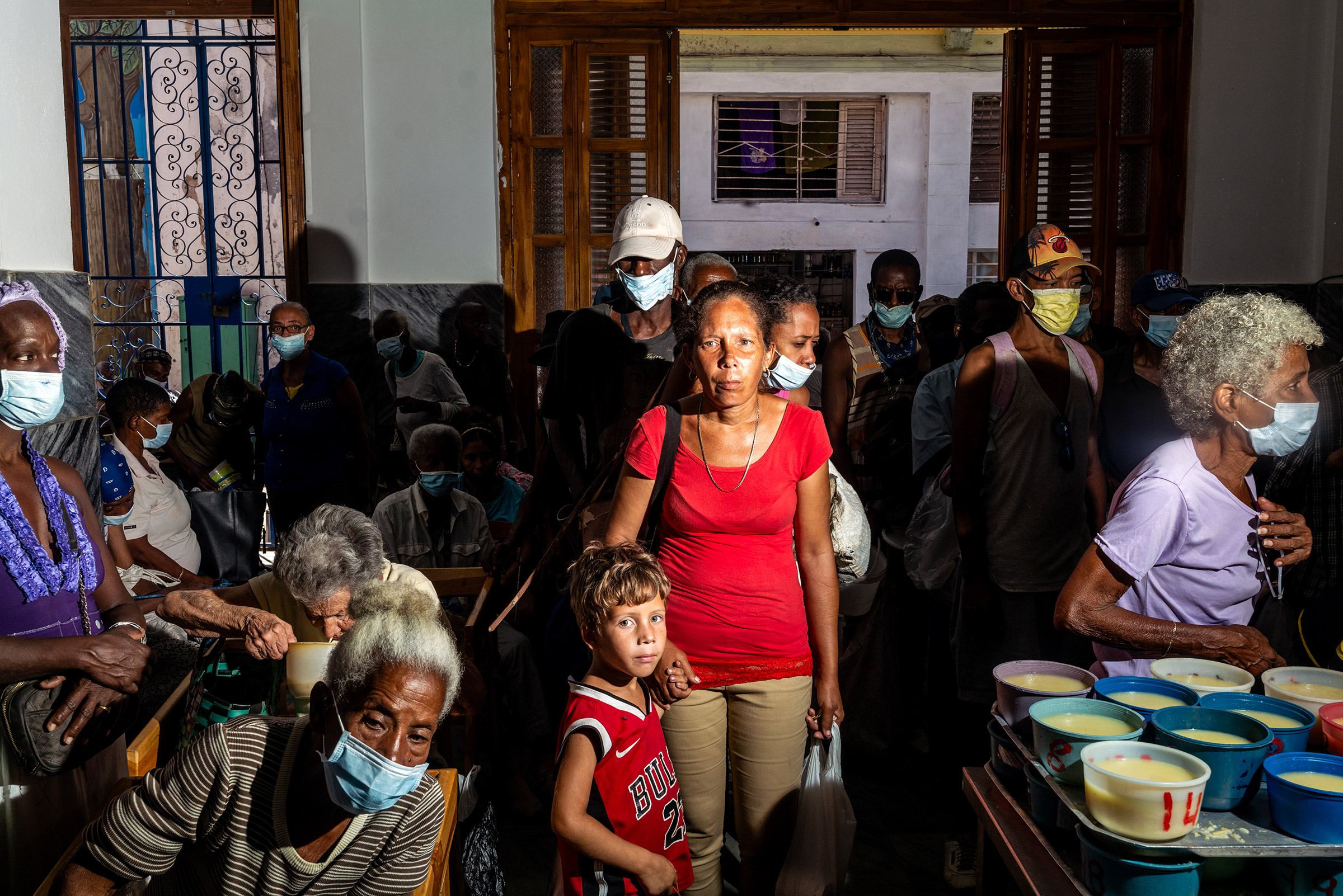
Families gather to receive free meals inside the community center of the Quisicuaba Project in Central Havana, many arriving early and waiting in crowded rooms for their turn.Ever since, the island of 11 million has been waiting. After Maduro’s ouster, the U.S. severed the Venezuelan energy lifeline that had kept Cuba afloat for decades. Energy supplies from other nations were also effectively blocked.
The result has been an almost wholesale shortage of resources across the island, affecting everything from power to agricultural supplies to Cuba’s once-celebrated health system, with patients dying for preventable reasons.
It is this nationwide struggle to survive that photographer Moises Saman chronicled as he traveled across Cuba for TIME: trash collection halted for lack of fuel, workers withering in a strangled economy, and vulnerable citizens left wanting for enough food.
Residents gather along a street in Matanzas, Cuba, during a Good Friday procession. In recent years, public religious observance has become more visible across Cuba, offering a space for collective reflection amid a period of deepening economic strain.A caregiver assists an elderly resident during a meal inside the Santovenia convent in Havana, where older adults receive daily care and support. As shortages of food, medicine, and basic services persist across the island, religious institutions like Santovenia have increasingly taken on a central role in providing assistance to vulnerable populations.Hanel Hernández Torres prepares a meal in her home in Matanzas as her son, Kyliam, sits on the staircase nearby. With cooking oil often unavailable or prohibitively expensive, many families are forced to improvise their daily meals using whatever ingredients they can access.Pepe Alfonso rests near his home in Cuajaní after a day in the field. In parts of the Cuban countryside, limited access to fuel, transport, and modern infrastructure continues to shape daily routines.A student stands by the window inside the computer classroom at Benito Juárez García Elementary School, where outdated machines no longer functional sit idle on aging desks. In these spaces, the promise of connectivity and modernization remains distant, shaped as much by scarcity as by the enduring weight of the past.A lone car moves along the Malecón, seen between the weathered facades of the Girón apartments in Havana.Young performers from the Compañía Cirabana circus train inside a deteriorating former theater in central Havana. The group, made up of children and teenagers from at-risk families, rehearses acrobatics and juggling routines with limited equipment, relying in part on donations to sustain their activities.A barber cuts a client’s hair inside a small barbershop in Viñales, Cuba. American tourism was once a key source of income for the community, a town long shaped by visitors drawn to its surrounding tobacco fields and landscape.Cuban national athletes train at the Estadio Panamericano, in Habana del Este, amid the visible decay of a once-celebrated sporting venue. Nets sag between rusted frames, and the empty concrete stands, built to host international competitions during the 1991 Pan American Games, bear the marks of years of neglect. Above them, a large and crumbling billboard depicting Che Guevara looms over the stadium.Television screens display archival footage of Fidel Castro delivering speeches at the Fidel Castro Ruz Center in Havana, where moments from his decades-long leadership are preserved and presented as part of the country’s historical narrative.A man stands on a balcony under a single bulb, in a neighborhood in Havana sitting largely in darkness during a nighttime blackout.Click here to buy your copy of this issue
Saman’s images reflect the enduringly omnipresent symbolism of revolutionary figures such as Ernesto “Che” Guevara and Fidel Castro—as well as the Cuban communities full of both pride and questions about the future of their country.
A billboard depicting revolutionary leader Ernesto “Che” Guevara stands along a road in Varadero, Cuba. Long associated with Cuba’s political identity and historical narrative, Che’s image remains a constant presence in public spaces.Cuban national athletes train inside a gym at the Estadio Panamericano, where aging equipment and worn out interiors reflect years of limited resources and maintenance.Elderly residents sit in a hall at the Santovenia convent in Havana, where a long table is prepared with simple refreshments. Religious and community institutions like Santovenia have increasingly become places where vulnerable populations, including the elderly, receive support amid ongoing shortages of food and basic supplies across Cuba.Who, indeed, does the hemisphere belong to? In the pieces that follow, three leading Cuban writers attempt to answer this question—and raise a few more.
Read more:
In Cuba: To Be, or Not to Be by Leonardo Padura
Waiting for Spring in Havana by Carlos Eire
What Cuba Needs by Ricardo Torres
The Donroe Doctrine is “a nebulous principle, short on details,” observes historian Carlos Eire, whereas for Leonardo Padura, perhaps the country’s best known novelist, it comes down to the doddering Castro regime: “The Cuban government’s official stance is unambiguous: resist, indefinitely.”
“For some analysts, that 'indefinitely’ coincides with the U.S. midterm elections, which may or may not produce immediate political consequences,” he adds.
Ultimately, says economist Ricardo Torres, “What Cuba requires is neither foreign rescue nor another official mythology. It needs the space and the institutions to rebuild itself.”
Schoolchildren and local residents gather beneath the shade of trees in Varadero, Cuba, as they prepare for an outdoor performance, raising a Cuban flag while a young musician tunes his guitar nearby.Hilda Rosario Rodríguez, 77, sits inside her one-room apartment in Matanzas, where she lives alone and depends on help from neighbors to get through daily life. The small living space has stained walls and minimal furnishings, offering a glimpse into the fragile conditions faced by many elderly Cubans, particularly outside Havana, where shortages are often more acute and access to services and support is more limited.Members of the Alfonso family gather inside their home in the rural community of Cuajaní, where three generations share the same space. In Cuba’s countryside, families like the Alfonsos remain deeply tied to the land, yet face increasing challenges as the country’s economic crisis extends beyond urban centers.A car drives along the Malecón toward a section of central Havana left in darkness during a power outage. Blackouts have become increasingly frequent across the island, leaving large parts of cities without electricity for hours at a time.Hence then, the article about the cuba question was published today ( ) and is available on Time ( Middle East ) The editorial team at PressBee has edited and verified it, and it may have been modified, fully republished, or quoted. You can read and follow the updates of this news or article from its original source.
Read More Details
Finally We wish PressBee provided you with enough information of ( The Cuba Question )


Also on site :
- Katey Sagal Recalls Becoming 'A Mother Again at 52'
- This OK Go Music Video Broke the Internet in 2006—Nearly 20 Years Later, That Treadmill Routine Still Stops You in Your Tracks
- Shareholder Alert: Ademi LLP Investigates Claims of Securities Fraud against Honeywell Aerospace Inc.