
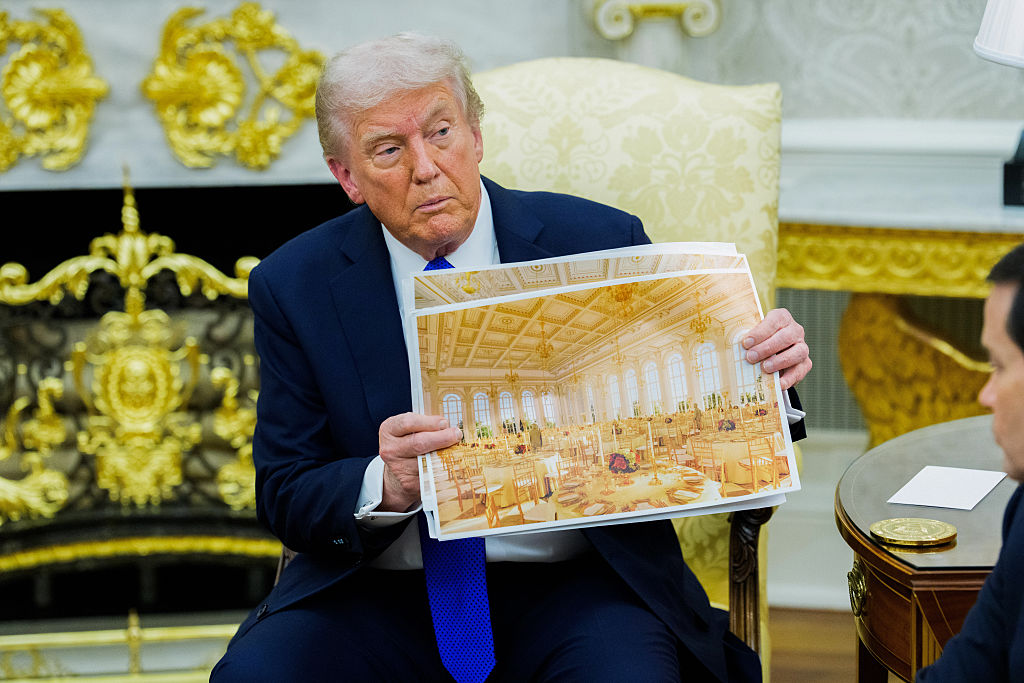
Historic preservation is often dismissed as nostalgia, the hobby of people who prefer old facades to modern needs. But preservation is not a refusal of change—it is a discipline, a way of deciding which changes deepen the meaning of a place and which ones degrade it.
In Washington, that discipline matters because the capital’s buildings do not merely house power. They teach Americans how democratic power is meant to be expressed in architectural language. The National Park Service describes the White House as “a symbol of the presidency, of a free democratic society, and through its continuity, of the stability of our nation.”
President Donald Trump’s actions do not match this vision of stewardship. His ballroom project and proposed triumphal arch seem to indicate an ambition to turn the architecture of the nation into a monument to presidential taste.
That instinct is visible in the way the Trump Administration has handled the East Wing itself. Demolition began in Oct. 2025, before Congress had authorized the ballroom. Later reporting showed that the project was not merely a ballroom above ground but also a below-grade security complex, including a bunker beneath the site.
Now, Senate Republicans are pushing an immigration-enforcement funding bill through Congress that would allocate $1 billion of taxpayer dollars to fund his ballroom renovation.
Even though the White House and its grounds are exempt from the National Historic Preservation Act under 54 U.S.C. § 307104, that does not make the East Wing’s destruction preservation-neutral. Preservation is also a norm of stewardship. Once historic fabric is demolished, the loss is irreversible. Once a president can tear down first and justify later, public review becomes theater rather than protection.
And the White House is not just another old building. George Washington selected the site in 1791. John Adams moved in in 1800. The building has been burned, rebuilt, enlarged, and adapted, but those changes became part of a larger national narrative. The White House is valuable because it embodies continuity.
That is why the recent fight over columns was so poignant, even if no redesign was formally adopted. In March, the chair of Trump’s Commission of Fine Arts floated replacing the White House’s Ionic columns with the more ornate Corinthian order that Trump prefers.
That is not decorative trivia. In architectural language, Ionic columns convey proportion, dignity, and restraint. Corinthian columns, with their acanthus leaves and richer ornament, signal display, monumentality, and theatrical grandeur. The scholar Steven Semes called the proposed switch “inappropriate for the Executive Residence,” and he was right. Architecture has syntax.
To understand why that matters, one has to understand Washington itself. Pierre L’Enfant’s 1791 plan and the later McMillan vision gave the capital a grammar of avenues, framed vistas, measured monumentality and careful relationships between buildings and open space. Congress created the Commission of Fine Arts in 1910 to protect that language. Washington was never meant to be an anthology of presidential whims. It was designed as a civic composition, one in which restraint was part of the message.
The ballroom makes Trump’s misunderstanding impossible to miss. In July 2025, the White House announced an approximately 90,000-square-foot ballroom that would cost about $200 million and be funded by Trump donors. Since then, the price tag attached to the project has ballooned.
A federal judge ruled on March 31 that the project could go forward only with congressional approval, and Judge Richard Leon later clarified that only limited underground work tied to security could continue.
Then came the shooting at the White House correspondents’ dinner, held at the Washington Hilton, after which Trump and his allies rushed to say the attack proved the ballroom’s necessity.
The Justice Department’s April 27 motion went even further, insisting the injunction should be dissolved because such an attack “could have never taken place” in the new facility and accusing the National Trust for Historic Preservation of suffering from “Trump Derangement Syndrome.”
The filing matters not only for its tone, but for what it reveals. The National Trust has repeatedly said its lawsuit is about whether a president can demolish and rebuild parts of the White House without congressional authorization, not about blocking legitimate security measures, and it has not opposed underground protective construction.
The real issue is power.
Meanwhile, the institutional guardrails have been weakened. James McCrery, the project’s first architect, was replaced after clashing with Trump over the ballroom’s size, and once the East Wing was already rubble, Trump fired all six sitting members of the Commission of Fine Arts. The National Capital Planning Commission is now chaired by Will Scharf, Trump’s former lawyer, who worked on his legal team.
The appeals court has given Trump partial breathing room. Aboveground work has been allowed to continue temporarily while the case moves toward a June hearing. Meanwhile, Republican lawmakers are pushing legislation to fund and speed the ballroom, with some now proposing taxpayer money for a project Trump once said would be privately donated. What began as a supposed gift is being converted into a public bill.
Then there is the triumphal arch, which may be the purest expression of Trump’s architectural politics. He has said he wants the largest triumphal arch in the world. The current design would rise 250 feet at Memorial Circle on Columbia Island, on National Park Service land near Arlington National Cemetery. The structure would be taller than the Arc de Triomphe and the Lincoln Memorial, topped by a 60-foot winged figure and embellished with gilded eagles, lions, and patriotic inscriptions. This is not classical restraint. It is self-dramatization in limestone and gold.
Unlike the White House, Memorial Circle does not fall inside the same statutory exemption. That means the preservation question is not merely moral but legal. Section 106 was written precisely to require federal agencies to consider what their undertakings would do to historic properties and commemorative landscapes.
And Memorial Circle is no empty traffic island. It is part of the solemn corridor between the Lincoln Memorial and Arlington National Cemetery. The Commission of Fine Arts gave the arch early design approval this month even after receiving about 1,000 public comments that were, by its own secretary’s account, “100 percent” opposed.
What Trump keeps misunderstanding is that preservation is about preserving meaning. The White House is supposed to symbolize continuity, democratic stability, and the peaceful transfer of power.
A capital city should preserve and project dignity, continuity and civic restraint. It should not be reshaped into an architectural expression of one man’s fantasy.
Hence then, the article about what trump gets wrong about preservation was published today ( ) and is available on Time ( Middle East ) The editorial team at PressBee has edited and verified it, and it may have been modified, fully republished, or quoted. You can read and follow the updates of this news or article from its original source.
Read More Details
Finally We wish PressBee provided you with enough information of ( What Trump Gets Wrong About Preservation )


Also on site :
- UN urges probe into deaths in Pakistani-administered Kashmir unrest
- San Sebastián: New Titles From J.A.Bayona, ’The Beloved’ Scribe Isabel Peña and Fernando Trueba; Mikel Gurrea, Berto Romero and Roberto Bueso Set for Competition
- I Tried 14 Fast-Food Fries to Find the Best—and the Winner Won by a Landslide