
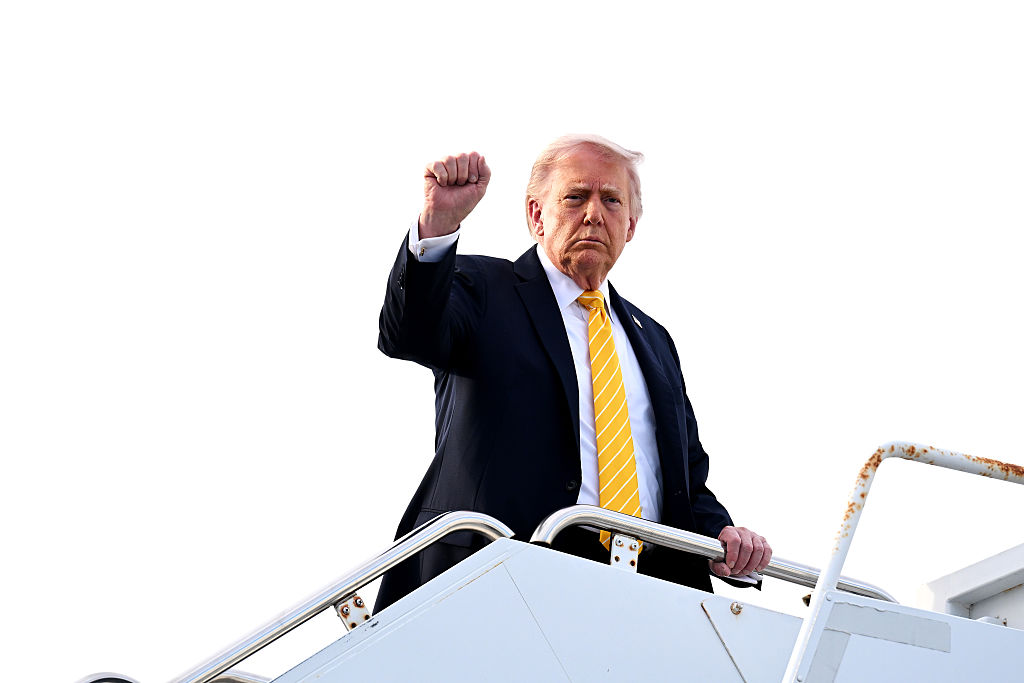
A slate of candidates backed by President Donald Trump won several state Senate races in Indiana on Tuesday after incumbent Republicans opposed the President’s push to redraw the state’s political maps.
Trump endorsed a series of primary challengers against GOP lawmakers who resisted his efforts to redistrict Indiana ahead of the 2026 midterm elections.
Of the seven Trump-backed challengers, five defeated Republicans who had voted against redrawing the state’s congressional maps last year. One incumbent held on, while a seventh race remained too close to call.
Read more: What to Know About Deep-Red Indiana’s Resistance to Trump’s Redistricting Desires
Indiana Republican Sen. Jim Banks, an ally of Trump, described the results as “a big night for MAGA in Indiana.”
“Proud to have helped elect more conservative Republicans to the Indiana state Senate,” he said.
The races became a major focus for Trump, who viewed them as a test of his influence over the Republican Party after the GOP-controlled Indiana state Senate rejected his push for redistricting.
Indiana Republican Governor Mike Braun, another Trump ally in the state, framed the results as a victory for the President and those who backed him. “Historic night for Indiana as Republicans stood with me and President Trump to nominate some great America First conservatives,” he said.
Last December, 21 Republican Indiana state senators joined all 10 Democrats in opposing a measure that would have redrawn maps ahead of the 2026 U.S. midterms.
The White House had strongly encouraged Indiana Republicans to support the proposal, which would have given the GOP an advantage across all nine of the state’s congressional districts, eliminating the only two Democratic seats.
While the measure passed the state House of Representatives, it ultimately failed in the state Senate despite Republicans holding a 40–10 supermajority. Twenty-one Republicans voted against it.
The defeat drew Trump’s anger. He said in December that Republicans in the Indiana state Senate who had voted against the measure should be “ashamed” and warned that those who opposed the redistricting would be subject to a primary challenge, singling out Indiana state Sen. Rod Bray.
“Headed by a total loser named Rod Bray, every one of these people should be 'primaried,' and I will be there to help!” he said, though Bray will not be on the ballot until 2028.
Trump followed through by backing primary challengers, a move that resulted in multiple incumbents losing their seats on Tuesday night and underscored the President’s continued influence with Republican voters.
On the eve of the election, the President again drew focus to the contest as a showcase of his influence.
“Good luck to those great Indiana Senate candidates who are running against people who couldn’t care less about our country, or about keeping the majority in Congress,” he said. “There are eight great patriots running against long seated RINOS — Let’s see how those RINOS do tonight!”
RINO stands for ‘Republican in Name Only’ and is a term used by some to describe Republicans who are viewed as disloyal to the party.
The victory of the Trump-backed candidates drew cheers from his supporters, who claimed this solidified the President’s influence in the state.
“Everyone in Indiana politics should have learned an important lesson today: President Trump is the single most popular Republican among Hoosier voters,” Banks said. “Indiana is a conservative state, and we deserve conservatives in our state Senate who have a pulse on Republican voters.”
The effort came with a financial cost. AdImpact, a tracking firm, estimated that spending in Indiana’s state Senate primaries reached roughly $13.5 million this cycle, compared with less than $300,000 two years ago.
“Welcome to D.C. politics in Indiana because this means that’s what’s coming,” state Sen. Travis Holdman, one of the incumbents to lose his primary, said.
More redistricting fights may lie ahead
The heightened focus on the races highlights how central redistricting and gerrymandering have become to Trump’s political strategy ahead of the midterms.
The President has pushed Republican-led states, including Texas, Missouri, North Carolina, and Ohio, to redraw their maps in ways that could strengthen the party’s position in the 2026 elections.
This has led to a broader national fight over congressional maps, with Democratic-led states pushing back against Republican gains, after voters in both California and Virginia approved redistricting maps that would solidify Democratic gains.
As a result, the latest push for gerrymandering includes efforts by Florida Gov. Ron DeSantis to redraw districts mid-decade to bolster Republican advantage over the Democrats.The results in Indiana also mark the beginning of a key stretch of primary contests for Trump, as he looks to test his political influence against long-standing Republican critics including Louisiana Sen. Bill Cassidy and Kentucky Rep. Thomas Massie, both of whom have publicly clashed with the President in recent years.
Hence then, the article about trump makes indiana republicans pay for opposing redistricting was published today ( ) and is available on Time ( Middle East ) The editorial team at PressBee has edited and verified it, and it may have been modified, fully republished, or quoted. You can read and follow the updates of this news or article from its original source.
Read More Details
Finally We wish PressBee provided you with enough information of ( Trump Makes Indiana Republicans Pay for Opposing Redistricting )


Also on site :
- Marathon Fusion Publishes New Pathway for Scalable Production of Promising Cancer-Treatment Isotope Terbium-149
- Rush-Henrietta Senior High School went into lockdown due to fight, superintendent says
- Discord roll out revised age verification following delay due to pushback, pledging to be "safer for teens, same Discord for Adults"