
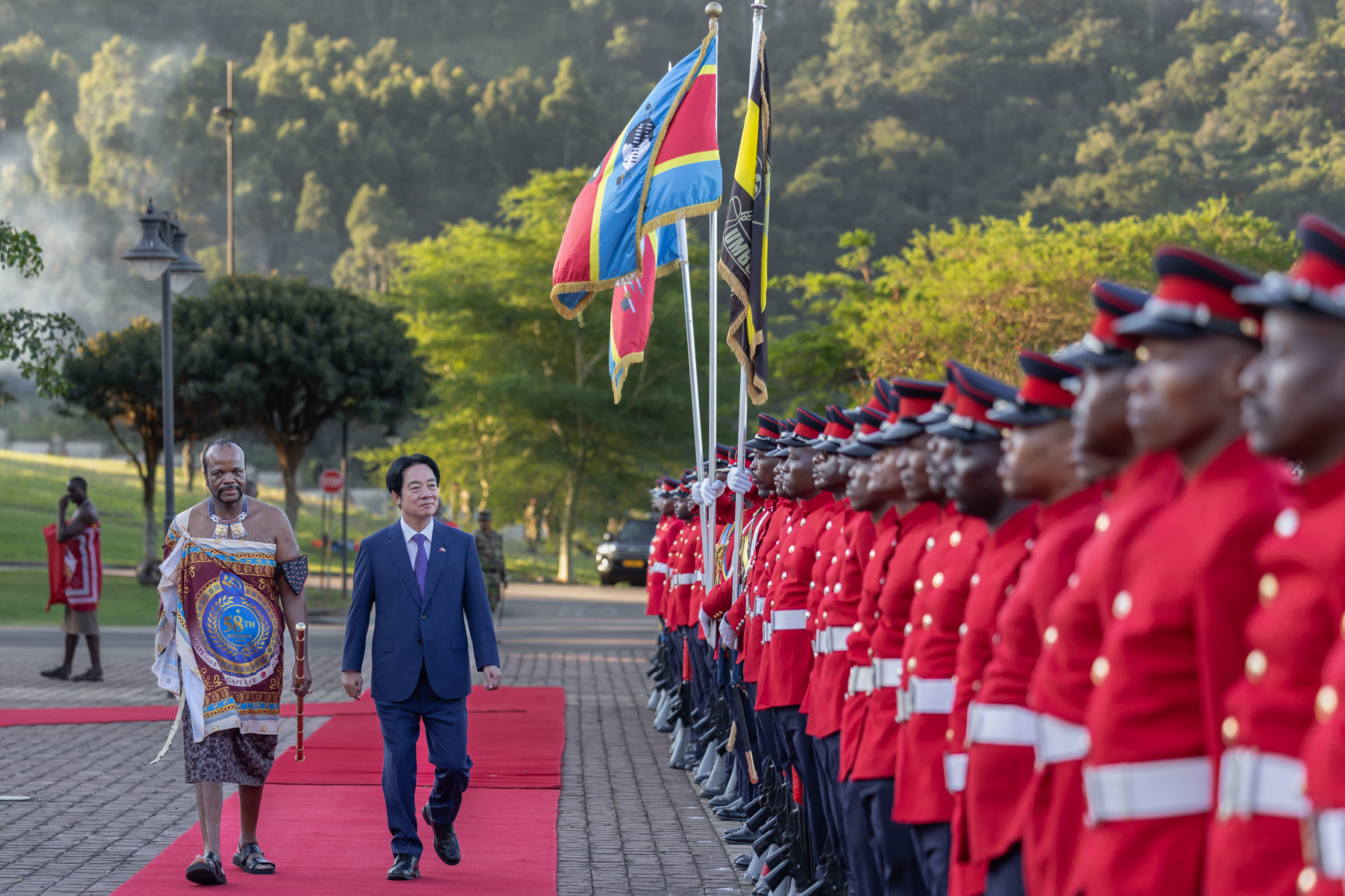
Taiwanese President Lai Ching-te arrived in Eswatini on Saturday for a diplomatic visit neither government had announced beforehand after having been blocked from making the trip last month, sparking anger from Beijing.
China’s foreign ministry condemned what it referred to as Lai’s “despicable conduct,” likening the Taiwanese President in a statement to a “rat scurrying across the street” and urging Eswatini and other countries “to see clearly the general trend of history” and not “pull chestnuts out of the fire for a handful of ‘Taiwan independence’ separatists.”
Lai’s visit to Eswatini marks Taiwan’s latest use of the so-called “arrive than announce” model of diplomacy to circumvent potential interference from Beijing, which views Taiwan as part of China’s territory and has sought to block other countries from maintaining formal diplomatic relations with the island.
Ahead of Lai’s planned trip to Eswatini—one of just 12 countries with such formal ties to Taiwan—for the 40th anniversary of King Mswati III’s accession last month, three African nations friendly to China closed their airspace to the Taiwanese President’s aircraft, forcing him to cancel the visit. According to Bloomberg, Germany and the Czech Republic also denied Taiwan’s requests to travel through Europe for the trip.
Taiwan blamed China for blocking the trip, accusing Beijing of forcing the African nations to deny permission for Lai’s aircraft to pass through their airspace. China has denied pressuring the countries to do so, though it publicly praised them for the decision.
Read More: How Hormuz Could Shape China’s Taiwan Strategy
"Taiwan will never be deterred by external pressures,” Lai said in a social media post announcing his arrival to Eswatini this weekend. “Our resolve & commitment are underpinned by the understanding that Taiwan will continue to engage with the world - no matter the challenges faced.”
Lai’s departure from Eswatini on Monday, like his arrival days earlier, was unannounced; his office had previously indicated he would be staying another night in the African nation, indicating concerns about potential Chinese efforts to disrupt travel plans.
Tension between U.S. and China
Lai’s visit to Eswatini has also highlighted simmering tensions between the United States and China over Taiwan.
A U.S. State Department spokesperson said the Taiwanese President’s trip was "routine and should not be politicised.”
"Taiwan is a trusted and capable partner of the United States and many others, and its relationships around the world provide significant benefits to the citizens of those countries, including Eswatini," the spokesperson said. They added that Lai’s predecessor Tsai Ing-wen traveled to Eswatini in 2023 and 2018.
While the U.S. does not maintain formal diplomatic ties with Taiwan, it is the island’s primary international supporter and arms supplier. In December, amid escalating Chinese military and diplomatic pressure on Taiwan, Washington announced an $11 billion arms package—the largest ever sent to Taiwan—in a move many interpreted as part of U.S. efforts to deter any potential effort by China to take the island by force.
The following month, however, Trump said that what action Chinese President Xi Jinping decides to take toward Taiwan is “up to him.” The Pentagon has also pulled aircraft carriers and missile defense systems from the Pacific Ocean to aid in Trump and Israel’s war in Iran since it began in February.
Trump is now days away from his rescheduled summit with Xi, set to take place in Beijing for May 14 and 15. Taiwanese lawmakers have expressed concern that the President could be willing to make concessions to preserve relations with China.
“What we are the most afraid is to put Taiwan on the menu of the talk between Xi Jinping and President Trump,” Deputy Foreign Minister Francois Wu told Bloomberg last month. “We worry, and we need to avoid that it happens.”
During a call last week with Secretary of State Marco Rubio, Chinese Foreign Minister Wang Yi said that “the Taiwan question bears on China's core interests and is the biggest risk in China-U.S. relations,” according to China’s foreign ministry, and urged Washington to “make the right choice.”
Hence then, the article about why the taiwanese president s arrive then announce diplomacy has infuriated china was published today ( ) and is available on Time ( Middle East ) The editorial team at PressBee has edited and verified it, and it may have been modified, fully republished, or quoted. You can read and follow the updates of this news or article from its original source.
Read More Details
Finally We wish PressBee provided you with enough information of ( Why the Taiwanese President’s ‘Arrive Then Announce’ Diplomacy Has Infuriated China )


Also on site :
- Kiteworks urges customers to shut down their servers amid ‘imminent’ threat of cyberattack
- The Oligarch Part 4: This man made billions in Ukraine, befriended Soros – and bought a place at the West’s table
- Of All the New Netflix Shows to Watch This Weekend, These Are the 3 You Absolutely Need to See (Sept. 25-27, 2026)