
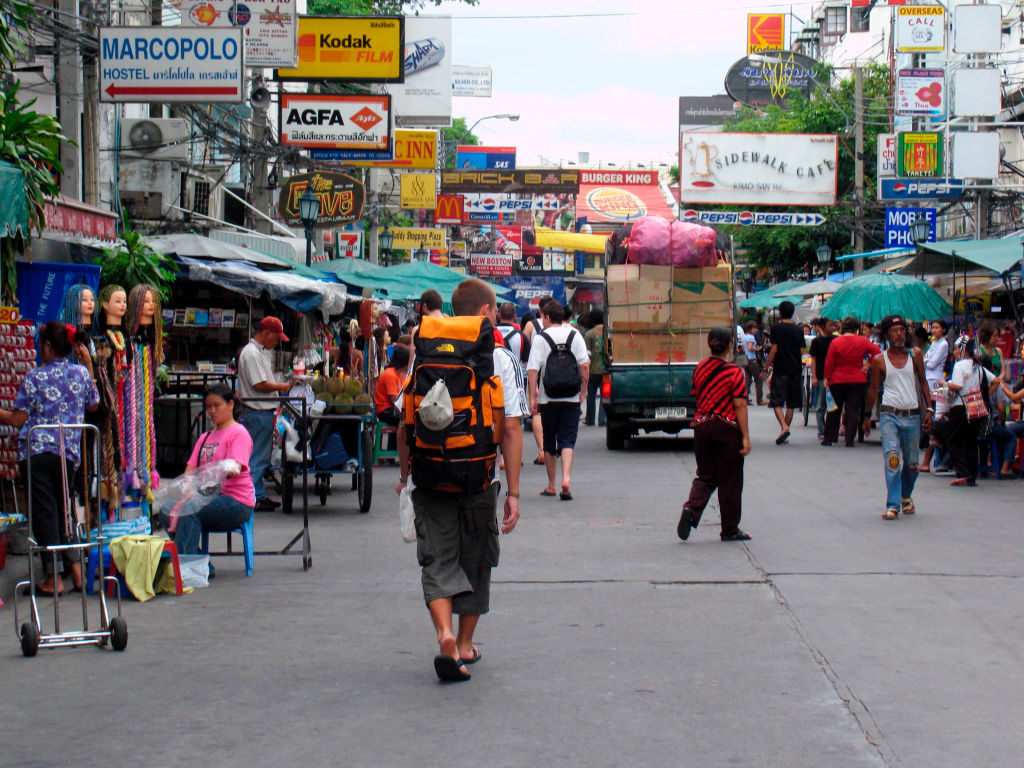
One night, while backpacking in Guatemala, I was woken up by a pain in my leg. Nearly bumping my head against the upper bunk of the hostel bed, I pulled away the blanket only to find nothing. Confused, I tried going back to sleep, but couldn’t. The pain was still there, and getting worse. Certain I’d been bitten or stung, I got up to properly shake out the blanket, and onto the floor dropped a small, brown scorpion.
Half an hour later, I was on the back of a moped, zigzagging past stray dogs towards the home of the village doctor. But although the nearest hospital was hours away and my throat was starting to go numb, I wasn’t afraid so much as excited. This, I thought, was exactly why I’d come to Guatemala in the first place, and I couldn’t wait to tell people about it.
Stories like these are more relatable than you might think. For every person who prefers spending their holiday by the infinity pool of an all-inclusive resort, there’s another who sleeps in moldy dormitories, sweats on hours-long bus rides without air conditioning, and lives out of a bulging, threadbare backpack. Instead of rest and relaxation, they seek action, adventure, and “authenticity.”
A decade of backpacking through countries like Laos, Armenia, and El Salvador has taught me that travel makes poor therapy, finding yourself abroad won’t solve the problems waiting for you back at home, and focusing on the journey rather than the destination isn’t as straightforward as it sounds.
Thanks to a variety of factors—including social media influencers, travel apps like Hostelworld and Couchsurfing, and the post-pandemic prominence of remote work and digital nomadism—backpacking has developed from a niche subculture into a popular form of vacationing.
At the same time, this newfound popularity has brought to light some major contradictions between people’s ideas about backpacking and the experience of itself. Now more than ever, I believe backpackers are driven not just by curiosity or wanderlust, but an expectation that exploring the world will also help them discover a better version of themselves.
The link between travel and self-improvement calls back to the 18th century “Grand Tour,” when the (usually male) children of upper class Europeans would top off their liberal arts educations with trips to places like Italy, Greece, India, and Japan. Similar to now, their goal wasn’t to have fun—though fun was certainly had—but return with interesting stories to tell at dinner parties and networking events.
Think also of the generation that gave birth to modern backpacking: the countercultural hippies of the 1960s and 70s, many of whom ventured east in search of cannabis, Buddhism, or both. Opening their minds with substances and immersing themselves in different cultures and religions, these supposed hedonists sought not pleasure so much as purpose—a modus operandi untainted by their consumerist upbringings.
Backpacking in 2026 is heavily influenced by contemporary self-help culture, particularly its call for nonstop improvement and optimization. Treating travel as a form of therapy, backpackers often talk about how their trips have changed them as a person—how giving up comfort and embracing the unknown has made them more independent, confident, adaptable, open-minded, or aware of their own privilege.
Yet this is seldom the case. If anything, extended travel doesn’t broaden your sense of self so much as narrow it. Backpack for too long, and you’ll forget who you were prior to leaving home. Backpack too often, and you’ll start to feel like you’re in a constant state of passing through, even when you aren’t on the road.
But that’s not all. When backpackers reduce foreign cultures and peoples to exploitable resources, they don’t dismantle so much as they perpetuate colonial power structures. Moreover, by concentrating on their personal journeys—emotional, spiritual, or otherwise—they often fail to fully appreciate the moment-to-moment experiences of their actual journey.
Far from helping us feel better about ourselves, the travel-as-therapy mindset can turn backpacking into a competition to prove who is the bravest or most self-sufficient. I still remember the proud smile on the face of a backpacker in Bangkok as he told us how he’d smuggled himself into war-torn Myanmar, hiding in the luggage compartment of a bus. Or my disappointment when someone countered my scorpion story with a scorpion story of their own. (Hers was more venomous.)
In the past, danger and discomfort were seen as necessary evils: the admission price for visiting parts of the world that hadn’t yet been spoiled by the crowds and conveniences of mass tourism. Now, hardship seems to be an end in itself, a battle scar or badge of honor that distinguishes true backpackers from mere pretenders.
Backpackers like to think of backpacking as anti-escapist. Where other vacationers withdraw into the protective bubbles of all-inclusive resorts and luxury cruise lines, a backpacker goes out into the “real” world. They eat street food, use public transport or hitchhike, and say yes to every side quest—even and especially when they don’t know where it will lead.
But whether they’re willing to admit it or not, many of them are actually running from reality. Check into a hostel in any country, and you’re bound to find at least one person suffering from burnout or going through a “quarter-life crisis.” Some are on sabbatical from their jobs and are slowly talking themselves into quitting. Others have quit their jobs already and can’t figure out what to do next. Lost at home, they go abroad to find something.
But few understand exactly what they are searching for. Local beer and cigarettes in hand, they talk on and on about turned leafs and fresh pages without ever going into specifics. The one thing they know for sure is that they have to keep on moving. Regardless of who they are or where they came from, the answers always seem to lie just beyond the horizon, somewhere near their next destination.
In his 1994 essay “Getting Away from Already Being Pretty Much Away from It All,” about the Illinois State Fair and who such events attract, David Foster Wallace observed that travelers from small towns tended to seek out excitement while over-stimulated urbanites gravitated towards peace and quiet. One group went to the fair, the other the beach.
A similar dichotomy can be applied here. While the average beachgoer escapes the pressures and responsibilities of working life, I believe many backpackers are trying to escape from themselves. Their inability to do so explains much of the emotional baggage they carry with them.
When travel writer Paul Theroux, father of documentarian Louis Theroux, trekked through hashish-filled Afghanistan in 1974, he found himself seated across an American teenager in a countryside hotel without electricity or running water. Asked where he saw himself at age 60, the teenager responded, “Right here—probably rolling a joint.”
Unlike their hippie predecessors, most modern backpackers struggle to stay in one place even for a single day. When you arrive somewhere new, you feel like a new person yourself, experiencing the world with fresh eyes and untested taste buds. But linger for too long, and old thoughts, feelings, and habits soon catch up with you, reminding you it’s time to move along to your next hiding place.
Conventional backpacking wisdom tells you to focus on the journey rather than the destination. In truth, many backpackers, myself included, have it backwards. Running either from or towards something, we search for a source of meaning that cannot be found, and in the process, end up getting stung.
Hence then, the article about the case against backpacking was published today ( ) and is available on Time ( Middle East ) The editorial team at PressBee has edited and verified it, and it may have been modified, fully republished, or quoted. You can read and follow the updates of this news or article from its original source.
Read More Details
Finally We wish PressBee provided you with enough information of ( The Case Against Backpacking )


Also on site :
- 12 British TV Shows That Make It Hard to Stop at One Episode—From Twisty Crime Dramas to Cozy Countryside Escapes
- ‘You Can See Everything’ Directors On Filming Complex Doc: “If We Can’t Agree On What’s Happening, There’s Something There” – NYFF
- Home Depot’s Newest Holiday Drop Gives DIYers Over $200 Worth of Tools for Just $30