
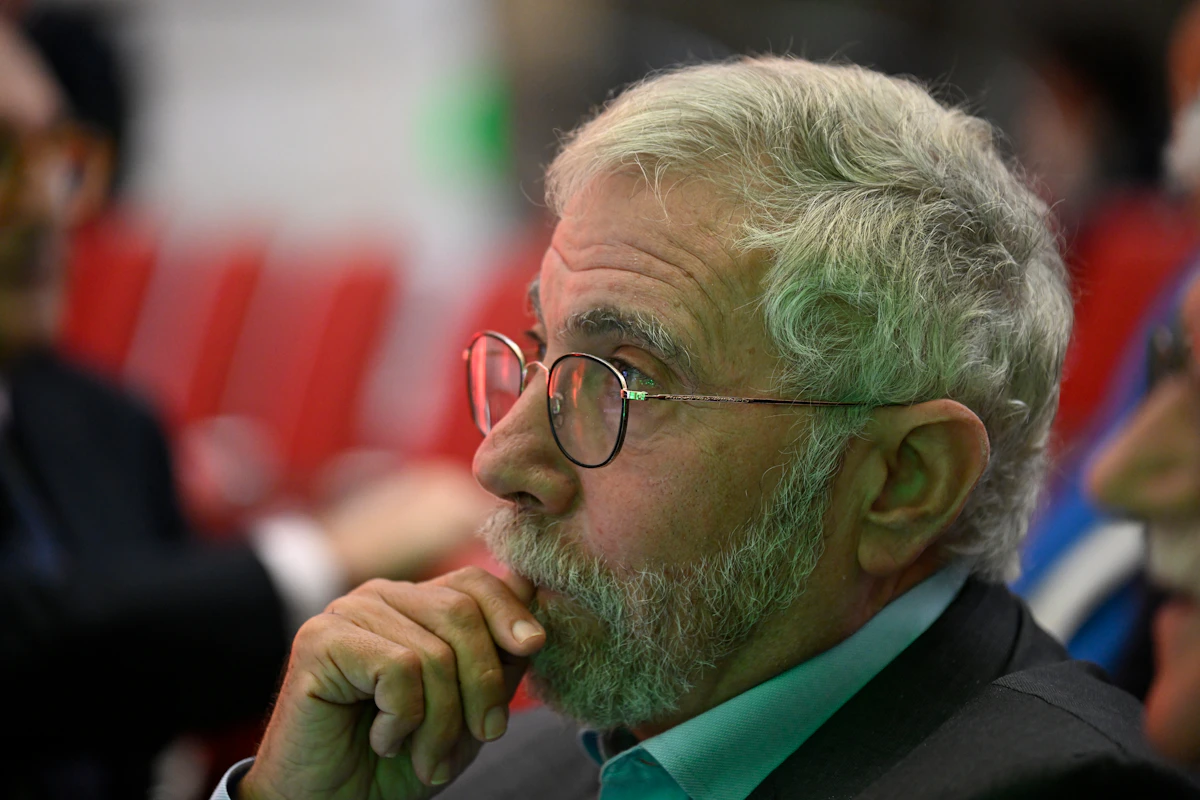
The following is a lightly edited transcript of the April 29 episode of the Daily Blast podcast. Listen to it here.
Greg Sargent: This is The Daily Blast from The New Republic, produced and presented by the DSR Network. I’m your host, Greg Sargent.
This week, Donald Trump rejected a proposal from Iran to reopen the Strait of Hormuz. This offer would have set aside questions about Iran’s nuclear program for now. That may be why Trump rejected it. But there’s another possible reason—accepting that deal wouldn’t make him look as if he’s winning. Yet this comes as gas and oil prices continue to rise, which isn’t making Trump look like a winner either. And partly because of that, Republicans are privately warning that their prospects in the midterms look increasingly dire. So what now for Trump?
Paul Krugman has a great new piece on his Substack, arguing that Trump simply does not have the cards in the Iran situation, even though he may not know it. So we’re talking with Krugman about where all this is going. Paul, always nice to have you on.
Paul Krugman: Good to be on again.
Sargent: So Trump rejected that proposal from Iran to reopen the Strait of Hormuz, perhaps in part because it would not address Trump’s demand for total termination of Iran’s nuclear program. But the New York Times had an extraordinary detail about the Iranian offer: “A U.S. official also said that accepting it could appear to deny Mr. Trump a victory.” Paul, apparently that’s the single most important factor in all of this, right?
Krugman: That’s what’s been holding everything up. For most of us, by about a week into the war, it was obvious that basically America lost. But Trump cannot bring himself to acknowledge that.
He’s been trying—he’s threatening to bomb them back into the Stone Ages, and he’s been threatening war crimes, and he’s been imposing counter-blockades against the blockade—all of which seems to be because he cannot seem to accept that actually he screwed up badly. There is no good outcome for the United States here. All we can do is accept something that actually leaves Iran stronger than it was, but he won’t do it.
Sargent: Well, we just learned that gas prices rose on Tuesday to the highest level in four years. It’s well over $4 a gallon on average. Brent crude is over $100 a barrel again. Paul, can you just walk us through the basics of how those developments are tied to the Strait of Hormuz remaining closed?
Krugman: Yeah. Before this war, about 15 percent of the world’s oil flowed through that strait. And it’s other stuff too—natural gas, helium, fertilizer—but right now let’s focus on the oil.
So 15 percent of the world’s oil goes through that narrow passageway, which is extremely easy for Iran to block. That 15 percent—there’s really not much of an exit. There’s no real way around the Iranian blockade. A little bit of stuff can go by pipeline, but not much. And that’s a lot of oil being denied to the world market. And of course, the price of oil has gone way up.
But if this continues, he ain’t seen nothing yet. Because the really interesting thing—I cited some numbers from Goldman Sachs in the Substack—although the price of oil is way up, consumption of oil is only down a little bit. And mostly what’s happening is that they’re drawing down inventories of oil, that people who have oil in storage tanks, with oil that was already on tankers, is being used up, which is all happening out of the belief that the strait will reopen soon and prices will come down.
As people start to realize that that’s not about to happen—which has been happening just over the past couple of days—then the prices have to go much, much higher.
Basically, the price of oil has to go high enough to inflict enough economic damage—we have to somehow or other stop, reduce the consumption of oil by another 11 million barrels a day. Convenient thing is that right now, world oil consumption is about 100 million a day. So that’s also about 11 percent. And it takes a huge price increase to do that.
It’s not easy to wean yourself off oil, in the matter of weeks, which is what we’re kind of expecting has to happen. So this can get much—it’s ugly already. It’s ugly politically, obviously, for Trump and the Republicans to have gas hitting its highest level in four years. But it’s going to get a lot uglier very soon unless Trump swallows his pride and accepts that he actually lost this war.
Sargent: Well, just to clarify what you’re saying here—in other words, in order to get the world to demand less oil in keeping with the fact that there’s less supply, the prices really have to go up a lot.
Krugman: I mean, think of it. There’s a certain amount of oil available, which is less than it was. You can’t burn a barrel of oil that isn’t there. So one way or another, people have to be induced to burn less oil. And the way we do that—it’s a world market—the way we do that—in effect nobody decides on it, but what happens is just that the price of oil, there’s bidding for barrels of oil, and the bidding drives the price up until the demand for oil has fallen back in line with the supply.
And the thing—a crucial point again—is oil is, to use the jargon, it’s inelastic. It’s very hard for people to switch away from oil. Give me five years and we can all be driving electric cars, but next month, we can’t. So the prices have to go really, really high to make that big of a dent in oil demand.
Sargent: Right. And so this is where your argument comes in. It’s sort of a structural argument about the situation. You wrote that Trump doesn’t have the cards in the standoff with Iran precisely because the longer we wait, the harder it gets for the world. So I guess the only way out—the only way this can be resolved—is in a way that leaves America weaker and leaves Iran stronger. Can you explain that?
Krugman: Yeah, I mean, basically Iran clearly still has the ability to block that strait. They have drones, they have missiles. The United States bombed a lot of their sites, but not enough. And these things are really easy to hide. They have speedboats.
And, if you want to think of the maximally vulnerable target—a fully loaded oil tanker. You want to hit something with bombs that will go off with a big bang and a lot of flames, it’s an oil tanker.
So Iran has the ability to block the strait. And they have every incentive to do that until they feel that they’re not facing an existential threat—the Iranian regime. So really, the strait does not get open until Trump accepts a deal that is sufficiently favorable to the Iranians for them to start letting tankers through again.
By definition—the strait was open before Trump started his war—Iran is clearly going to want to charge tolls on it. Iran is not going to cancel its nuclear program because...they’re hurting too. The United States has a blockade. Iran can’t export oil—it’s among the countries now that can’t sell oil. And they also can’t import food, which is probably more important. But they are prepared to pay that price. So in this waiting game, basically they have by far the upper hand.
Another—well, another president would not have started this idiot war in the first place. But in any case, given the situation, would say, okay, we need to face reality. I need to face reality. I messed up and I’m not going to get something that looks like victory out of this. But Trump so far won’t.
Sargent: Well, you mentioned that there’s pressure on Iran as well. And I want to ask you—is there a scenario where the pressure on Iran actually does matter and forces them to the table on terms that are more favorable to Trump?
Trump had this missive on Truth Social where he said, “Iran has just informed us that they are in a state of collapse. They want us to open the Hormuz Strait as soon as possible.”
Is this just complete bullshit? I mean, is there a scenario where the pressure on Iran does sort of force them to the table on terms that would make Trump feel a little more like a winner, or whatever the only thing that matters is?
Krugman: Yeah, it’s one of those things where—is this unadulterated bullshit? No, it’s adulterated bullshit. I mean, Iran is hurting. Their economy normally depends overwhelmingly on selling oil. And again, they actually import food. So there’s going to be a lot of unemployed, hungry Iranians, a lot of economic disruption—maybe even, if this goes on long enough, maybe even runaway inflation in Iran.
But this is a fanatical, theocratic regime which is completely willing to kill its own people to stay in power. That is not going to force them to cave. And on the other hand, the whole world economy outside the Persian Gulf is looking at very nasty consequences, including the United States and the political consequences of—I guess, $4.18-a-gallon oil today and much more than that for diesel, by the way. So there are other things that are hurting even more.
It’s very unlikely that the United States is prepared to deal with multiple months of this stuff. So, yeah, it’s not the case that [it’s all] Iran is hurting us and we aren’t hurting Iran. But if you ask who is going to have to cry uncle sooner, it’s almost certainly us.
Sargent: Well, beyond this one missive on Truth Social, Trump keeps making the opposite argument in a bigger sense. He keeps saying Iran has been totally defeated. And as you mentioned, it’s true that Iran’s military has been badly degraded. But Trump also says time is on his side. He doesn’t feel rushed to make a deal at all. He’s perfectly happy to wait until Iran submits and gives him his way—that’s almost exactly verbatim what he’s saying.
Paul, I think the temptation is strong to read that as sort of typical Trumpian bluster, but it seems plausible to me that he doesn’t understand the situation at the most fundamental level, in the sense that he doesn’t understand that Iran has some leverage here precisely because he can’t accept that thought [that] he’d be the submissive one and they’d be the dominant one. And that doesn’t compute in Trump’s brain. Do you think that’s plausible, that he just doesn’t know that he is kind of on the losing end of the situation in some ways?
Krugman: I think he’s in a kind of superimposed state where at some level he does know, but he can’t bring himself to admit it, even to himself. We got into this mess, he pulled us into this mess, in part because he has a completely wrongheaded notion of what war is about. He thinks if we have more bombs and we can kill more people, then of course we have the upper hand. That has never been what war is about. It’s always about ends and means and ability to inflict pain.
And he reverts to that over and over again. I’m not a young kid and I remember Vietnam and body counts. And a lot of what Trump says is reminiscent of the body counts. We have destroyed—actually, it turns out that we were much less successful in destroying their missiles and drones than a lot of the claims. In any case, that is not what it’s about.
But Trump just has this, I have the ability to carry out violence, so surely I can’t be losing this war if I can do violence and they can’t do equivalent amounts of violence in return. Except the problem is that it’s not what they can do to America’s military. It’s what they can do to oil tankers that try to exit the Persian Gulf.
Sargent: Right. In his head, he’s always the winner. So he can’t be losing. Isn’t that the basic size of it?
Krugman: Yeah, all of it ties together. I mean, the inability to accept that they lost the 2020 election is part of the same syndrome, you know. A guy who can’t admit that he lost a presidential election to Joe Biden is not going to be able to admit that he lost a war to the mullahs of Iran.
Sargent: That seems like a plausible reading. So The Times has this other report laying out how Republicans are anxious about the midterms, and the factors they cite are the war, gas prices, and affordability more generally. They’re describing this with words like “bleak.”
But it seems like Trump—who keeps saying time is on his side, as we mentioned—isn’t letting that intrude on his calculations either. And yet Republicans can’t push him to change course because they’re not allowed to say he’s not in the midst of a glorious triumph. Paul, what do you make of that dynamic?
Krugman: The moral, intellectual, emotional collapse of the Republican Party is in a way a bigger story than Trump. I mean, yeah, he’s a world-class, bizarre, dangerous person, but what makes him able to do this is the submissiveness of his party.
The celebration of a guy who is an absolute disaster at presidenting—he has led, more or less single-handedly, on his own decisions, his own faith, his own judgment, he has led America into one of our worst strategic defeats in our history. He took on this relatively small military power in Iran, figuring that he could destroy the regime and install his people in a few days, and he lost the war.
But his party will never admit that. They’re busy—just an item that crossed earlier, a couple of hours before we recorded this—the State Department is getting ready to put Trump’s picture on U.S. passports. This cult of personality around a guy who is objectively maybe the biggest loser in the history of U.S. presidents. It’s just amazing.
Sargent: Yeah, I just want to clarify that that was a report in The Bulwark about the passports and Trump’s face. Can I ask you about the global economy? You mentioned that it’s in pretty rough shape right now. What do you predict is going to happen with the global economy over, I don’t know, the next six months to a year?
Krugman: Well, tell me what’s going to happen with the Strait of Hormuz, and that makes all the difference in the world. I don’t think the global economy was in dire straits. There were some wobbles, but it wasn’t that bad before the war. And if the price of oil stayed where it is right now, then we’re talking about a significant but not catastrophic hit to global growth.
The trouble is that the world has not adapted to 15 percent less oil yet. If the strait stays closed, it will have to. And I tried—I did this in a Substack post a few days ago—if your forecast about world oil prices does not lead to a severe economic blow to the world economy, your forecast is too low. Because there’s no scenario in which we get by with 15 percent less oil that doesn’t involve a global recession.
So if the strait stays closed, one way or another we will have a global recession. I don’t know what oil price that will mean—$150 a barrel, $200 a barrel. I can do some economic algebra there and try to give you an estimate, but it’s really all over the place. High enough that we have a global recession, because that’s the only way to reduce oil consumption that much that fast.
Sargent: Right. And that’s built into the structural situation that we described earlier, right? In the sense that Iran knows that if the strait remains closed, the global economy could very well go into recession. So that incentivizes them to not give in, right?
Krugman: Time is very definitely on their side. We’re burning through whatever oil was in storage very fast. And as that happens, the situation gets grimmer. They’re suffering too, but time is on their side. It gives them every incentive to hang tough for something that looks like a victory to them.
And this is another thing where I don’t think Trump understands. For him, everything is about appearance and illusion, and he’s going to goose the markets and try to produce confidence. He’s done that now four times—he’s goosed the markets by saying peace is around the corner.
And the problem for him is that this ends up being about brute physical facts. The oil is there or it’s not. And you can play confidence games for a while, but at a certain point, the reality of are those barrels actually on their way to markets or not is the story. And the Iranians are in control of how that story plays out.
Sargent: Well, maybe you can explain something to all of us. Why do the markets keep going up when he gooses them? Can you explain that dynamic? It’s still something that puzzles me. It seems very obvious that Trump is goosing the markets and yet the markets get goosed. Why?
Krugman: Anybody who tries to explain what the stock market in particular does—God knows. It’s not a good predictor of the future. My old teacher, Paul Samuelson, famously said that the market had predicted nine of the last five recessions.
So the market has got its own psychology. I think we went through a long period when anybody who went optimist, people who bought the dips, did very well. And it takes a while to end that psychology. Now, I think the stock market—God knows.
The oil futures market is more tied to concrete events. I think the problem with that market is they keep on thinking that Trump is going to be rational. Every time he says something that sounds like he might be willing to acknowledge reality, the oil futures drop because people think, so he’s finally ready to recognize reality. And they’ve done that four times now. And I’m not sure it’s going to happen again.
The Lucy and the football analogies seem a little too flippant for this situation. But I think that’s really where it is. At a certain point, the markets stop doing that. So far, I think people, to the extent that there’s a story, is that people in the market keep on betting that, yeah, he can’t be that crazy. And that is not a good bet.
Sargent: It seems like a terrible bet. Just to close this out—Trump may not be winning in Iran, but he’s demanding his ballroom. You made the case that he’s obsessing over the ballroom because it’s an easy area for him to assert dominance over Republicans and over donors who have to pay tribute to him.
I just want to add something to your argument. The ballroom obsessing is clearly a problem for Republicans in the midterms. It’s sort of a symbol of how out of touch he is with voters’ concerns and problems. But here again, even the most vulnerable Republicans are required to go out and cultishly declare that the ballroom has to happen and that it would be the greatest accomplishment by any leader in world history.
Now that’s a dynamic that’s just deeply baffling, but almost sort of weirdly satisfying because their continued hagiography about Trump could screw them almost more than anyone else.
Krugman: Yeah, I mean, Marie Antoinette had nothing on Trump. Here we are, people are complaining about gas prices, there’s a war, and he’s always obsessed with his gilded ballroom. And yeah, I think that for him, it’s an escape. He fantasizes about giant ballrooms.
And for his party, the Republican Party functions as if it was a totalitarian police state, even though, we don’t actually live in a totalitarian police state—not yet. But I think if you’re a Republican politician, first, if you take on Trump, you think he still has the power to destroy you politically. And also, you’re probably a little afraid. Defy Trump and legal action will be taken against you. Who knows, maybe even a MAGA mob will show up. And I think that there’s a real element of intimidation, both political and to some extent even physical, going on here.
Anyone who had the character to stand up to that has left the Republican Party. What’s left—what we’re left with is the people who are willing to debase themselves for the sake of Trump. And it’s become a habit with them. They just do it regardless.
Sargent: So is there a scenario where Trump accepts something in between what he wants and what Iran wants—is there a scenario where Iran makes an offer like that and Trump accepts it and then just declares victory and goes home? Do you see that as a possibility?
Krugman: At a certain point, the sheer damage that’s being done by this closed strait will—I think even Trump will have to at some point acknowledge it and face up to it. I actually think is that the substance of what’s going to emerge is going to be pretty much what the Iranians are demanding. I don’t see—why they would give any significant substance here?
But they might be willing to use evasive, clever language to provide something that Trump and his propaganda machine will, with great effort, spin as a victory. I’m not sure how they’ll do that, but I think the most likely scenario is that effectively Iran remains—it’s collecting tolls and does not give up its nuclear program. Basically it’s the Iranian plan, but that somehow the language of it makes it sufficiently obscure that Trump can go out and say, see we won a great victory.
Sargent: Well, and thinking about Trump’s psychology a little more—he could just say, well, I won because I’m a winner, so I only can win.
Krugman: Yeah. He has never acknowledged defeat on anything. He never acknowledges having been wrong on anything. So he will do that. And the question is only whether they offer him enough cover to do that. Iran is in this for a lot of reasons, and many of them are horrible and crazy, but it’s not for ego. So they are probably willing to assuage Trump’s ego as long as they get the substance of a deal that is overwhelmingly in their favor.
Sargent: Very plausible outcome. Paul Krugman, thanks so much for coming on, folks. Make sure to check out Paul’s Substack—it’s just great. It’s so informative day in and day out. Paul, thank you so much.
Krugman: Thank you.
Hence then, the article about transcript krugman on how trump accidentally screwed himself on iran was published today ( ) and is available on The New Republic ( Middle East ) The editorial team at PressBee has edited and verified it, and it may have been modified, fully republished, or quoted. You can read and follow the updates of this news or article from its original source.
Read More Details
Finally We wish PressBee provided you with enough information of ( Transcript: Krugman on How Trump Accidentally Screwed Himself on Iran )


Also on site :
- Dwayne Johnson and Oprah Winfrey gave $10 million to launch the People’s Fund of Maui for wildfire survivors
- In 2017, Jack Daniel’s named Nathan “Nearest” Green its first master distiller for teaching the brand’s founder to distill whiskey over a century earlier
- Clarks’ ‘Fabulous’ Fall-Ready Leather Loafers Are Cushioned for Bouncy Comfort, and They’re Now 40% Off