
As NASA’s Artemis II astronauts zipped around the Moon in early April, they observed flashes of light caused by meteoroids hitting the lunar surface. At the same time, volunteers for the NASA-funded Impact Flash project scanned the Moon with their own telescopes and sent their videos to scientists to share what they saw from Earth.
“We were incredibly grateful for the videos people submitted,” said Impact Flash project lead Ben Fernando, a planetary scientist at Los Alamos National Laboratory. The locations and brightness of flashes observed by different instruments at different locations together can help constrain the nature and origin of the impactors, as well as the craters they form.
The Artemis II astronauts have splashed back down to Earth, so their observations of the Moon from space have come to a halt for now, but the Impact Flash team is just getting started. They need your continued help scanning the Moon to watch for flashes. If you have access to a telescope four inches in diameter or greater with video capabilities, your observations can make a difference. The more observations you submit, the better the team will be able to constrain the present-day impact rate on the Moon and how it changes over time. Instructions for making and uploading your observations can be found on the Impact Flash website.
In the future, the project team also plans to use your impact flash observations to study tremors on the Moon, similar to earthquakes. They’re called ‘moonquakes’ and they help us figure out what lies beneath the Moon’s surface.
“We are planning to send seismometers to the Moon to measure how the ground shakes,” said Fernando. “Your measurements of impact flashes will help us work out the sources of moonquakes we detect. This will help us work out what the Moon’s interior looks like.”
To collect data during the Artemis II mission, the Impact Flash investigators teamed up with several other groups of amateur astronomers, including the NASA-funded Kilo-nova Catchers, Exoplanet Watch, UNITE (Unistellar Network Investigating TESS Exoplanets), and Night Sky Network teams, as well as the Lunar Impact Flashes project, based at the National Research Council of Italy (IMATI-CNR). Thank you to all those who submitted data.
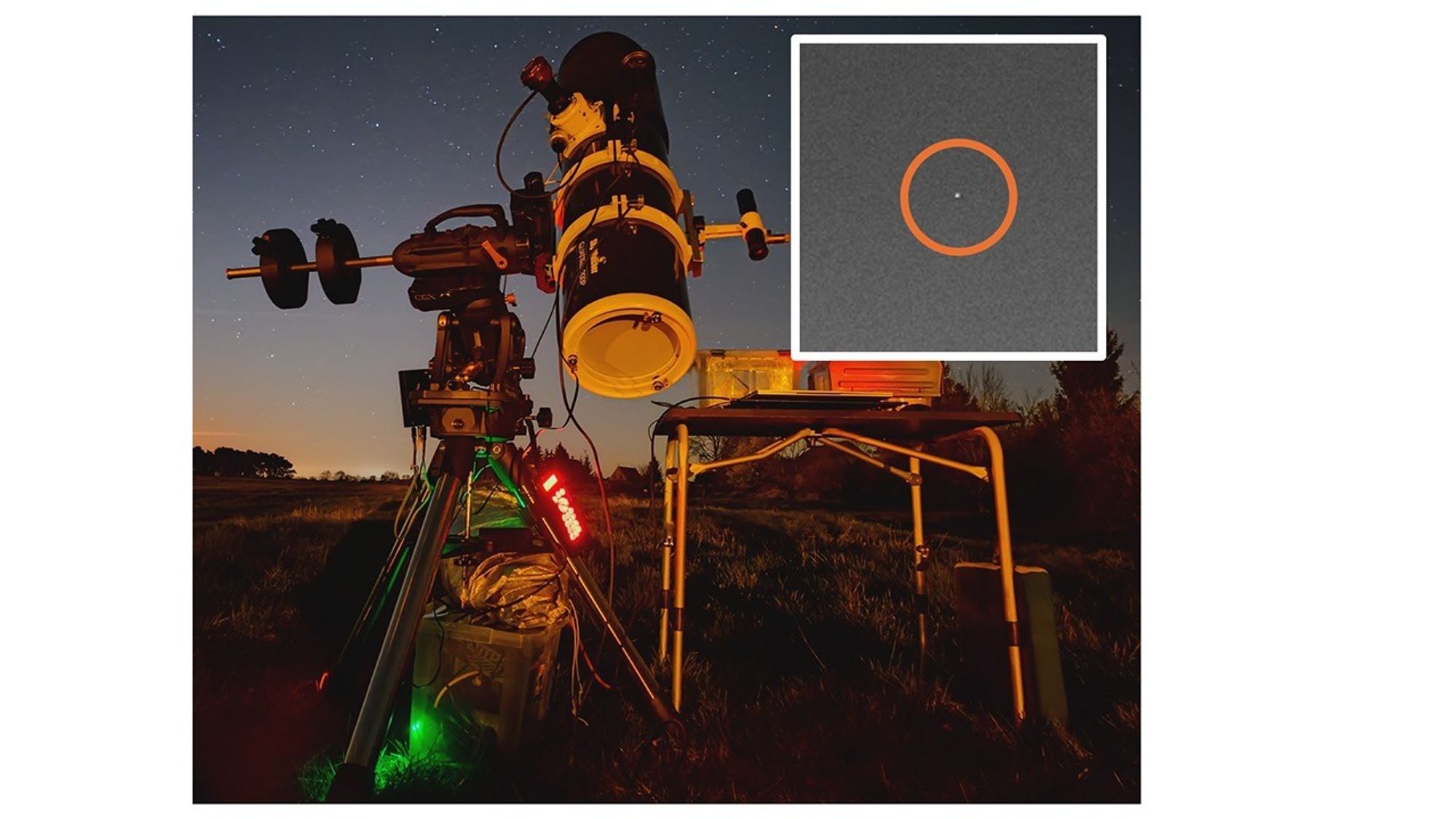
Impact Flash volunteer Joerg Tomczak sent in this image of the Moon he took during NASA’s Artemis II mission, as well as a photo of his telescope. The bright dot in the orange circle shows an impact flash candidate Credit: Joerg TomczakGrab your telescope and get started with Impact Flash: www.geodes.umd.edu/impactflash
The Impact Flash team acknowledges the work done by Institute for Applied Mathematics and Information Technologies-Consiglio Nazionale delle Ricerche (IMATI-CNR)/Italy (E. M. Alessi, M. T. Artesi) to set up the web page and A. Cook (Aberystwyth Univ., UK) and D. Koschny (Technical University of Munich, DE) for data curation. The IMATI-CNR team receives funding from the Italian Space Agency, corresponding to ESA’s (European Space Agency) Lunar Meteoroid Impacts Observer mission.
Learn More and Get Involved
Impact Flash!
You and your telescope can join a global network of amateur astronomers documenting meteors hitting the moon.
Facebook logo @nasascience_ @nasascience_ Instagram logo @nasascience_ Linkedin logo @nasascience_Share
Details
Last Updated Apr 27, 2026Related Terms
Citizen Science Planetary Science UncategorizedExplore More
3 min readCSDA Quality Assessment Report Evaluates Satellogic NewSat Data
The report adds to the growing documentation on commercial data’s contributions to Earth science research…
Article 1 week ago2 min read
Volunteers Discover Rare Space Weather Events Using Their Ears
Scientists are working to understand exactly how these waves behave, and the team behind NASA’s…
Article 1 week ago5 min read
NASA Finds Young Stars Dim in X-rays Surprisingly Quickly
Article 2 weeks ago
Hence then, the article about volunteers help nasa astronauts record lunar flashes was published today ( ) and is available on NASA ( Middle East ) The editorial team at PressBee has edited and verified it, and it may have been modified, fully republished, or quoted. You can read and follow the updates of this news or article from its original source.
Read More Details
Finally We wish PressBee provided you with enough information of ( Volunteers Help NASA Astronauts Record Lunar Flashes )


Also on site :
- APOD: 2026 September 23 – A New Lunar Crater: McGetchin
- A Fat, Nude Woman Became a 1970s Merchandise Sensation. Who Was “Bridget in the Buff”?
- Macy’s Has an Elegant 8-Piece Reversible Comforter Set That Exudes French Countryside Charm for Under $40