
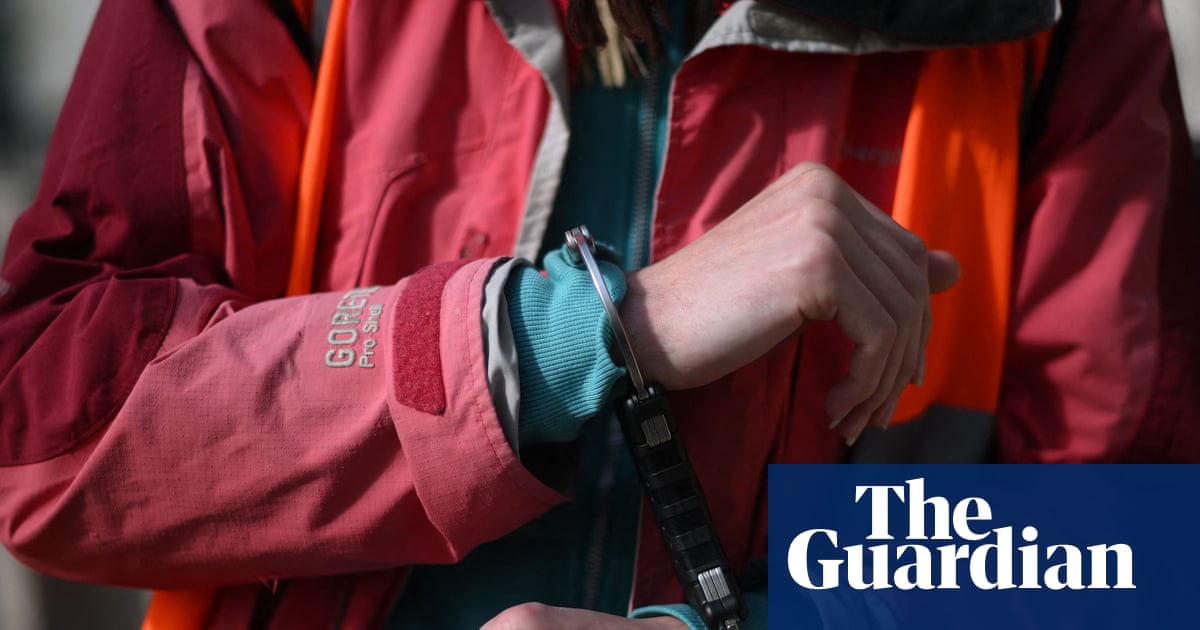
The criminalisation of direct action climate protests in the UK is counterproductive and increases the determination of activists to undertake disruptive demonstrations, according to a study of 1,300 campaigners.
New findings suggest arrests, fines and lengthy prison sentences given to nonviolent climate protesters who have blocked roads or damaged buildings may actually radicalise them. The repression of protest could even be one driver of recent covert actions such as the cutting of internet cables, they said.
Previous research found conflicting results on the impact of repression on protesters, some suggesting it deterred further action and some indicating it encouraged it. The new work found the emotional response of the activists determined their reactions to repression they experienced or anticipated experiencing.
Those who had already been jailed, fined, arrested or surveilled said they were less fearful of taking part in future disruptive actions. The campaigners who had not experienced repression fell into two broad groups. Those who felt anger or contempt about the prospect of repression were galvanised and had stronger intentions to take part in future. Those in whom the idea of repression increased fear had weakened intentions.
The UK government has cracked down on climate protesters in recent years. Some were jailed for four years for planning to block a motorway and have been denied the ability to put a “reasonable excuse” defence or climate facts before a jury.
The UN special rapporteur for human rights defenders, Mary Lawlor, recently accused the UK, US and other governments of paying lip service to climate goals while criminalising activists. Research has found that 17% of all climate protests between 2019 and 2024 resulted in arrests, compared with an international average of 6.3%.
“These kinds of actions are counterproductive as they alienate people from the state,” said Dr Nicole Tausch, at the University of St Andrews and part of the study team. “The emotion of contempt is really indicative of that. When people start to feel contempt, they tend to feel they don’t have to comply to the norms and rules any more. [Repression] might actually radicalise people – if you don’t give people the legitimate route to express their discontent, then they will find other routes.”
Tausch, who has studied protest in highly repressive situations in Russia, Hong Kong and Egypt, added: “This really mobilises people. It creates a shared identity, a shared fate, a moral obligation to act. This is not going to undermine protest.”
Sunniva Davies-Rommetveit, also at the University of St Andrews and part of the team, said: “We’re also starting to see different kinds of actions, sabotage for example. [Repression] may possibly be turning people towards more covert types of actions.”
A Home Office spokesperson said: “The right to lawful protest is fundamental to our democracy. However, protests should not cross the line from peaceful demonstration to serious disruption. Existing laws give the police robust powers to manage protests and prevent serious disorder, disruption or intimidation, while protecting the right to peaceful protest.”
The research, published in the journal Nature Climate Change, used anonymous surveys completed by 1,375 members of an Extinction Rebellion mailing list.
The largest impact was reported by those who had experienced repression. “It was very striking,” said Davies-Rommetveit. “They feel less fearful and therefore more likely to intend to act disruptively in the future.”
She added: “Policymakers listening to climate activists is probably a good idea, especially as the climate crisis is worsening. Our findings suggest there’s definitely frustration with the way the system is dealing with protest at the moment.”
A 2023 opinion poll commissioned by the University of Bristol found 68% of the British public disapproved of the disruptive protest group Just Stop Oil, which had blocked roads and interrupted sports events. However, only 29% thought imprisonment was the most appropriate punishment for people who participate in disruptive, non-violent protest, while a fine was seen as most appropriate by 37% and 15% thought such activists should not receive any punishment.
Ministers have commissioned an independent review of public order and hate crime legislation, which is considering whether it is “fit for purpose” and “strikes a fair balance between freedom of expression and the right to protest with the need to prevent disorder and keep communities safe”. It is expected to be published shortly.
Criminalisation of climate protesters in UK is counterproductive, research finds NYT News Today.
Hence then, the article about criminalisation of climate protesters in uk is counterproductive research finds was published today ( ) and is available on NY Times News ( Middle East ) The editorial team at PressBee has edited and verified it, and it may have been modified, fully republished, or quoted. You can read and follow the updates of this news or article from its original source.
Read More Details
Finally We wish PressBee provided you with enough information of ( Criminalisation of climate protesters in UK is counterproductive, research finds )


Also on site :
- This Airline Just Upgraded Premium Economy With Full Privacy Screens, Electric Recline, and Wireless Charging
- France Launches Global Initiatives to Support Independent Cinema and Establish Framework for Alliance of State Film Commissions: Lumiere Summit
- Nuclear-capable warship that capsized when launched finally joins North Korea’s fleet