
Listen to this audio excerpt from Peter Rossoni, Orion Artemis II Optical Communications System flight manager:
0:00 / 0:00
As a child, Peter Rossoni watched the Apollo missions launch with his family. In April 2026, he became a part of NASA’s Artemis II mission, helping enable communications as astronauts journeyed around the Moon.
Rossoni’s path to NASA began as he followed his parents’ footsteps into science. That foundation eventually led him to laser communications and NASA’s Artemis II test flight.
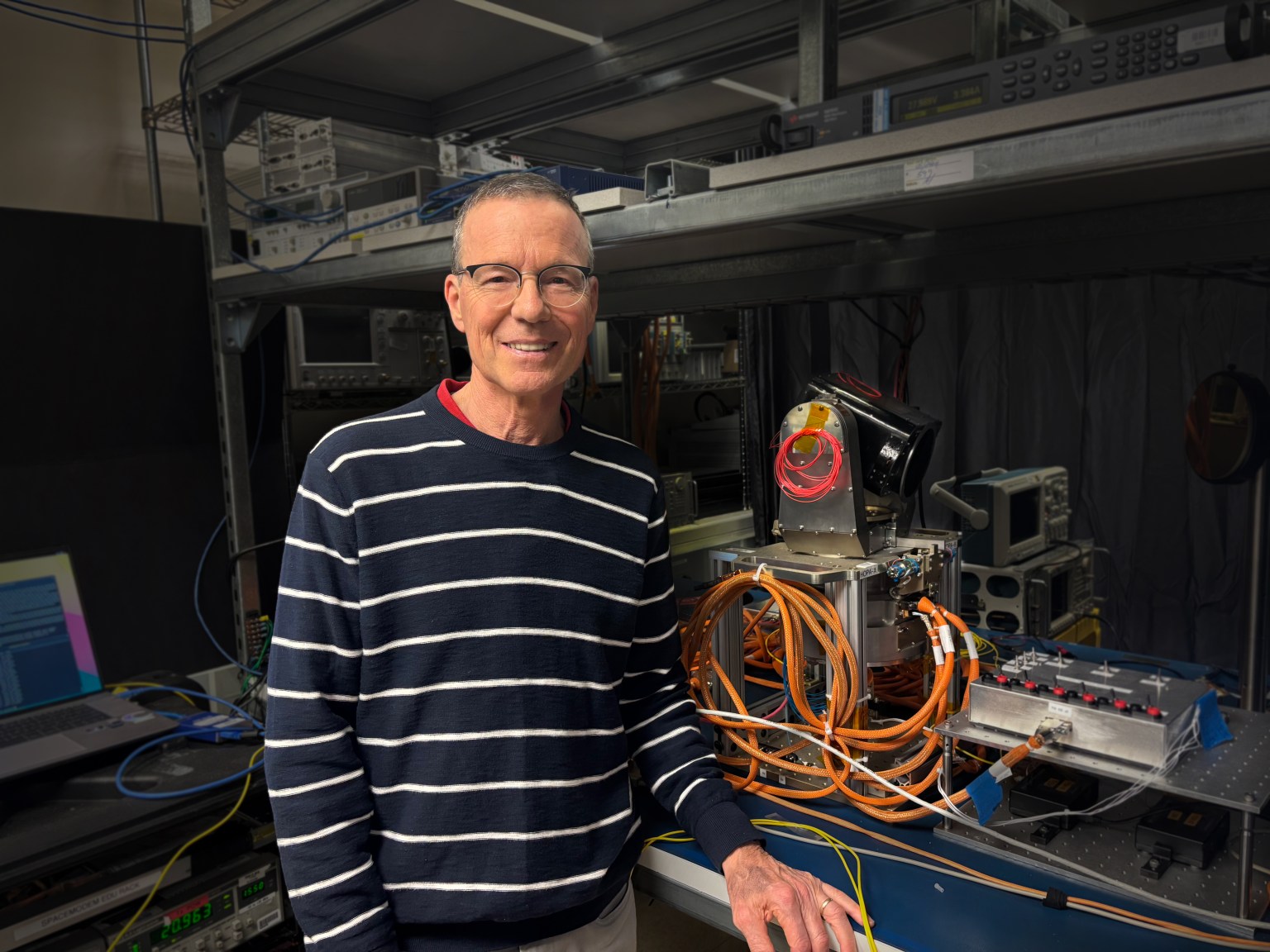
Peter Rossoni in an optical lab at the Massachusetts Institute of Technology Lincoln Laboratory in Lexington, Massachusetts. MIT-LLToday, Rossoni is the flight manager for the Orion Artemis II Optical Communication System at NASA’s Goddard Space Flight Center in Greenbelt, Maryland. Throughout Artemis II, he oversaw the first use of laser communications on a crewed deep space mission.
The optical terminal flew aboard the Orion spacecraft alongside NASA astronauts Reid Wiseman, Victor Glover, and Christina Koch, and CSA (Canadian Space Agency) astronaut Jeremy Hansen. Through the system, laser communications links transmitted video, photos, engineering, and science data, flight procedures, and crew communications to Earth from the lunar vicinity. In total, the terminal transferred over 450 gigabytes of data to Earth. That’s roughly equivalent to 100 high-definition movies.
The Orion capsule in flight with the O2O payload pointed out. NASADuring the approximately 10-day mission, Rossoni joined the mission control team to ensure smooth data flow from the laser communications terminal on Orion to the Mission Control Center at the agency’s Johnson Space Center in Houston.
“Communications is an important pillar of exploration. We’re venturing into deep space for longer periods of time, and we need that vital link back to the home base. Laser communications were proven to work in previous experiments, so the demonstration phase is over. Artemis II showed us what it can do operationally.”
Laser communications were proven to work in previous experiments, so the demonstration phase is over. Artemis II showed us what it can do operationally.
Peter Rossoni
Flight Manager for the Orion Artemis II Optical Communications System
Laser communications systems use invisible infrared light to pack more data into a single transmission. With downlink speeds of up to 260 megabits per second, the optical communications system was capable of transmitting a full-length 4K movie from the Moon to Earth in about a minute.
“Beyond supporting a crewed mission around the Moon, I’m excited to work with an amazing team of talented engineers and visionaries who understand that high-performance communications and networking is a key element of exploration infrastructure.”
Merging existing infrastructure with the next-generation system was no easy feat. While the system’s laser communications path operated in parallel to traditional radio communications, both tied into the same networks at the Mission Control Center and aboard Orion. The team developed solutions that would allow the systems to work together at the higher rates that laser communications can provide.
To prepare for liftoff, Rossoni and the optical flight and ground teams supported extensive testing activities, including practice runs simulating team and facility operations, the operational readiness reviews confirming the system’s terminal and ground segment, and assuring the teams work smoothly together for the mission. The result was a communications system with up to 100 times greater capacity, enhancing the connection between astronauts and their support teams, while freeing the radio communications systems for sensitive and critical data streams.
“A well-respected scientist at Goddard once said, ‘communications is the secret sauce behind all NASA missions. For Artemis II in particular, with the astronauts’ mission and safety at stake, it was critical to have robust communications to both enhance successful exploration and address any eventualities in the demanding environment of deep space. I had a deep sense of fulfillment when the Orion Artemis II optical communications system started working, and it kept growing as the mission progressed, with more and more objectives achieved.”
I had a deep sense of fulfillment when the Orion Artemis II optical communications system started working, and it kept growing as the mission progressed, with more and more objectives achieved.
Peter Rossoni
Flight Manager for the Orion Artemis II Optical Communications System
About the Author
Kendall Murphy
Technical WriterKendall Murphy is a technical writer for the Space Communications and Navigation program office. She specializes in internal and external engagement, educating readers about space communications and navigation technology.
Share
Details
Last Updated Apr 24, 2026 EditorLauren LowLocationGoddard Space Flight CenterRelated Terms
I Am ArtemisArtemisArtemis 2Communicating and Navigating with MissionsGoddard Space Flight CenterSpace Communications & Navigation ProgramTechnology DemonstrationExplore More
3 min readI Am Artemis: Erik Richards
Article 4 weeks ago 5 min readNetworks Keeping NASA’s Artemis II Mission Connected
Article 3 months ago 1 min readI am Artemis: Steven Horowitz
Article 5 years ago Keep ExploringDiscover More Topics From NASA
Missions
Humans in Space
Climate Change
Solar System
Hence then, the article about i am artemis peter rossoni was published today ( ) and is available on NASA ( Middle East ) The editorial team at PressBee has edited and verified it, and it may have been modified, fully republished, or quoted. You can read and follow the updates of this news or article from its original source.
Read More Details
Finally We wish PressBee provided you with enough information of ( I Am Artemis: Peter Rossoni )


Also on site :
- SWAT response shuts down streets in Chicago's Logan Square neighborhood
- French President Emmanuel Macron Calls on YouTube to Finance Content and Warns of Growing Threat to Cultural Model (EXCLUSIVE)
- President Trump Posts Photo of Hollywood Icon Who Has Slammed Him for Years: ‘Even This Jerk Is Beginning to Get It’