
4 min read
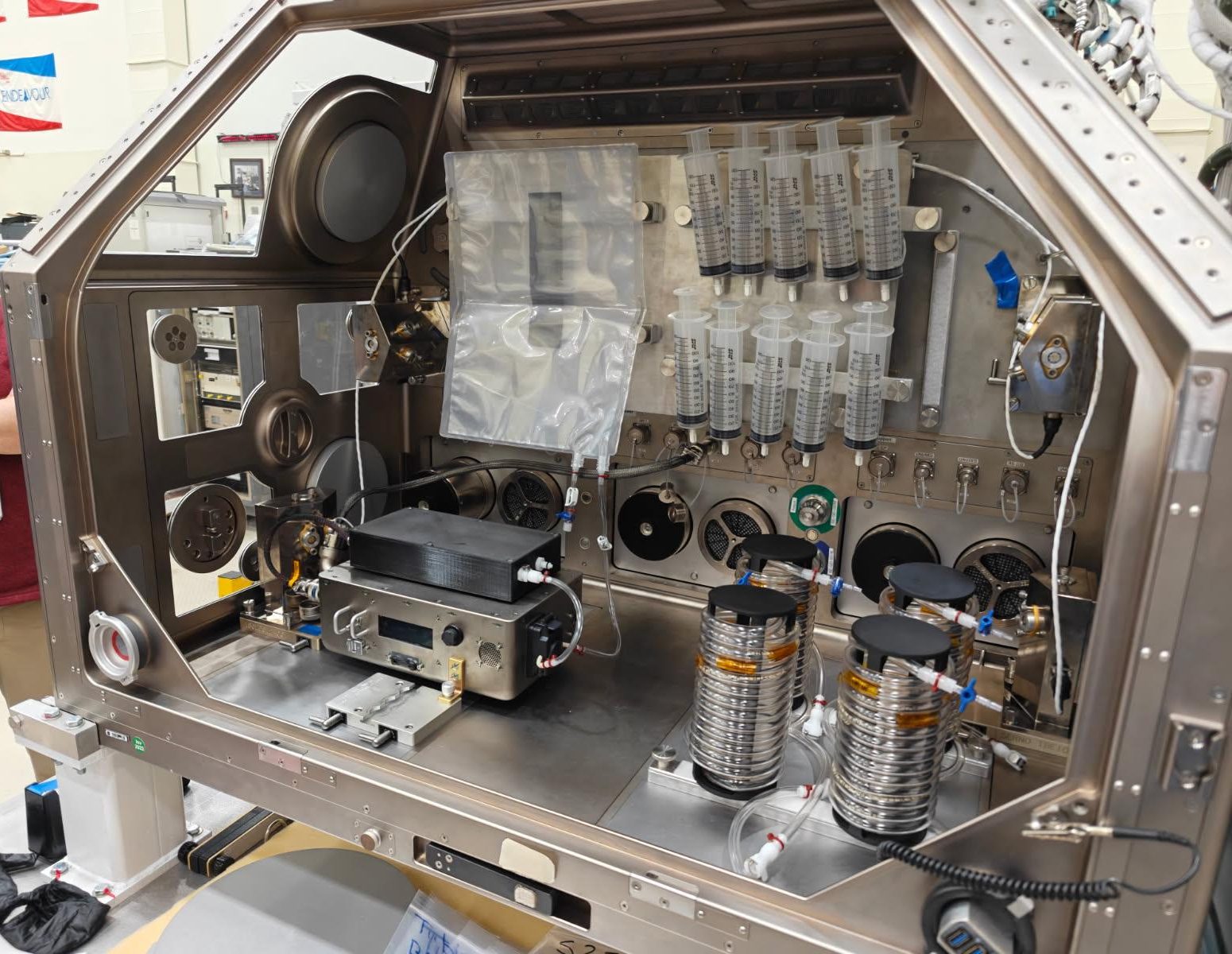
Preparations for Next Moonwalk Simulations Underway (and Underwater) IVGEN Mini hardware is installed in a replica of the International Space Station’s Life Sciences Glovebox at NASA’s Marshall Space Flight Center in Huntsville, Alabama, in November 2025. The system operates by filtering drinking water on the International Space Station to produce medical-grade IV fluid for use when treating inflight medical conditions.Credit: NASAOn every crewed mission, NASA packs pouches of a potentially life-saving liquid in its cargo, known as IV (or intravenous) fluid. A simple mix of sodium chloride and purified water, it can treat up to 30% of medical conditions in flight, resolving things like dehydration, burns, and more.
Crewed missions beyond low Earth orbit into deep space could last up to three years and may require IV fluid for crew health. However, current IV fluid shelf life is limited to 16 months. To avoid the complications of stocking a perishable supply of prepacked IV fluid, experts at NASA’s Glenn Research Center in Cleveland have created a technology that can transform water into IV fluid on demand. They now are preparing to test the latest, lightweight version of the system aboard the International Space Station.
The system, known as IntraVenous Fluid GENeration Miniaturized (IVGEN Mini), flew to the station on April 11 aboard NASA’s Northrop Grumman Commercial Resupply Services 24 mission along with other supplies, experiments, and hardware. IVGEN Mini will produce IV fluid during demonstrations this spring and fall to verify that the design works as intended in space.
The system operates by adding space station drinking water to a large supply bag. The bag is connected to IVGEN Mini, which filters the water to remove any particulates and mineral ions. The processed water flows into an output bag that contains premeasured sodium chloride, and the measured combination of both creates sterile, medical-grade IV fluid.
Technicians conduct prelaunch operations on the Northrop Grumman Cygnus XL spacecraft’s pressurized cargo module on Monday, Feb. 23, 2026, inside the Space Systems Processing Facility at NASA’s Kennedy Space Center in Florida. The Cygnus capsule carried supplies, food, and scientific experiments – including IVGEN Mini – for crew members at the International Space Station as part of the company’s 24th cargo resupply mission for NASA on April 11, 2026.Credit: NASA/Kim Shiflett“Following launch, we have tentative operations planned for May,” said Courtney Schkurko, engineering project manager at NASA Glenn. “The crew aboard the International Space Station will operate IVGEN Mini over the course of two days, and 10 liters of fluid will be generated. Those liters will then be prepared to return to Earth and analyzed to make sure the fluid that was generated in flight meets requirements and is safe to use.”
The IVGEN Mini system is the second iteration of this technology, originally called IVGEN, which was demonstrated aboard the space station in 2010. The original was much larger because it included additional sensing equipment to prove that the system worked as intended. Following the successful demonstration, the team created a miniaturized version.
“With IVGEN Mini, we’ve reduced the system’s size and weight,” Schkurko said. “The previous system used gaseous nitrogen to pump fluid through the system. Now, we have pumps that are miniaturized, which allow us to optimize our designs and refine the filtering process.”
In addition to solving the limited shelf life concerns of prepackaged IV fluid, IVGEN Mini also lightens cargo loads. During a deep space mission where crews may spend years in space, cargo must be as lightweight as possible. With IVGEN Mini, NASA won’t need to pack an abundance of IV fluid — it can be produced as needed if supplies run low.
“On a mission to Mars, if you needed to fly 100 liters of IV fluid, those 100 one-liter bags will take up a large amount of space, while IVGEN Mini takes up much less,” Schkurko said. “It’s that trade between packing IV fluid bags that are likely to expire during the mission or taking a small device and making it as you go. The latter means it will always be within expiration period, it will be available to the crew, and it’s one less risk we have to worry about.”
The IVGEN Mini development team poses for a photo in November 2024. The team consists of members from NASA’s Glenn Research Center in Cleveland; Sierra Lobo, Inc.; and NASA’s Johnson Space Center in Houston.Credit: NASARequirements for IVGEN Mini were based on what medical events could occur during a deep space mission, how much fluid it would take to treat those events, and how quickly the fluid can flow through the system. The current system can produce 1.2 liters of IV fluid per hour, which meets these needs. The team also is adhering to United States Pharmacopeia standards, which ensure the system and the fluid it produces meet required pH values and salinity tolerances, and do not contain bacteria, organic carbon, or particulates. Although IVGEN Mini testing will take place aboard the space station, none of the fluid produced will be administered to the crew.
The IVGEN Mini team is currently planning for shelf-life testing of IV fluid produced by the system as a next phase of this technology. The system is managed by NASA’s Mars Campaign Office as one of the many technologies developed to enable human exploration on the Moon and Mars.
For more information on future innovations for crewed missions to Mars, visit:
www.nasa.gov/exploration-systems-development-mission-directorate
Share
Details
Last Updated Apr 23, 2026 EditorHeather RoeContactShauntina LillyLocationGlenn Research CenterRelated Terms
GeneralExploration Systems Development Mission DirectorateGlenn Research CenterHuman Space Travel ResearchHumans in SpaceJohnson Space CenterMarshall Space Flight CenterNASA Centers & FacilitiesNASA DirectoratesScience & ResearchTechnologyTechnology for Space TravelExplore More
4 min readNASA Releases Powerful LAVA Software to US Aerospace Industry
Article 37 minutes ago 1 min readNASA SBIR/STTR Phase I and II BAA, 2026 Appendix A and B are now live! Offers due May 21, 2026, 5:00PM EDT
Article 18 hours ago 3 min readNASA’s 777 Aircraft Returns Home with Science Flights on the Horizon
Article 20 hours ago Keep ExploringDiscover Related Topics
Missions
Humans in Space
Climate Change
Solar System
Hence then, the article about liquid lifeline nasa tech could create iv fluid in space was published today ( ) and is available on NASA ( Middle East ) The editorial team at PressBee has edited and verified it, and it may have been modified, fully republished, or quoted. You can read and follow the updates of this news or article from its original source.
Read More Details
Finally We wish PressBee provided you with enough information of ( Liquid Lifeline: NASA Tech Could Create IV Fluid In Space )


Also on site :
- Before You Bag Up Your Fall Leaves, Gardeners Say to Try These 7 Ways to Put Them to Work in Your Yard
- ’90s Southern Rock Legends Announce Winter Tour Supporting ‘Magnolia Medicine,’ Their First Album in 28 Years
- LPBW’s Jacob Roloff Reveals Real Reason He’s Being ‘Kicked’ Off Family Farm: ‘If I Speak, I’m in Trouble’